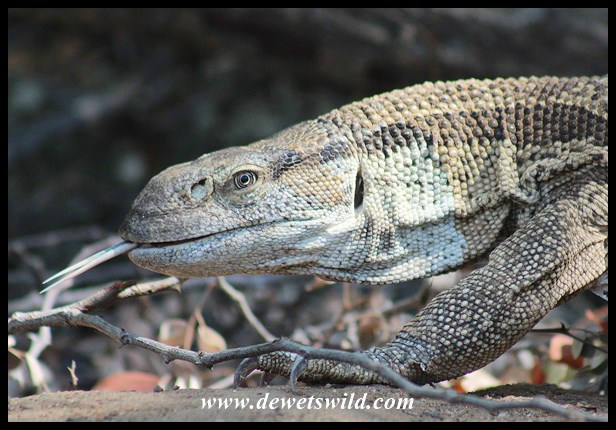
Varanus albigularis
The Rock Monitor, also known as the White-throated Monitor, at a total length of up to two meters, with males weighing as much as 17kg (average is about half that, and males are much bigger than females), is one of our biggest lizards (just slightly shorter, but heavier, than the closely related Water Monitor). They occur all over South Africa, with the exception of the southwestern Cape and very arid western parts of the Northern Cape, inhabiting arid scrublands, grasslands and savanna. It also occurs widely through the rest of southern, central and east Africa as far north as Ethiopia.
Rock Monitors are diurnal predators, feeding on anything small enough to overpower (mainly invertebrates and smaller reptiles) and carrion. At night they hole up in burrows, under or between rocks, or in large holes in trees. They also hibernate in these places during cold winters. Rock Monitors mate in early spring, wit the female laying clutches of up to 50 eggs in termite mounds or holes dug in soft soil. While incubation periods of about 4 months have been recorded in captivity, the eggs normally take much longer to hatch in the wild, with many clutches also being lost entirely to opportunistic predators like the Banded Mongoose.
When threatened, Rock Monitors will defend themselves with powerful lashes from their tails, failing which it will sham death in the hope that the attacker will lose interest and move on.


 DeWetsWild
Ek het eendag gesien hoe ‘n nuuskierige leeuwelpie met daardie stert geslaan word toe hy aan die likkewaan ruik.Die groot leeus in die trop het die likkewaan geïgnoreer, beslis uit ervaring! Daardie nuuskierige een het omtrent ‘n agteroor bollemakiesie gemaak van skrik. Ons het so gelag. Jou foto’s is weereens pragtig, Dries!
Sjoe, Dina, dis nou iets om te sien en nooit te vergeet nie! Klink asof die leeutjie darem lig daarvan afgekom het – daardie stert kan lelik seer maak as hy raak slaan!
Fantastic photos Dries. It really does seem to have such a primaeval quality.
Thanks again, Carol. I don’t normally like using the word “beast” for animals, but somehow it seems to fit this guy perfectly.
Yes it does, and also somehow sounds like a compliment.
Nee dankie … ek vat hom maar verby
Hulle maak maar slegte troeteldiere! 😀
🙂
It is always a joy to see these creatures.
Agreed, Anne! They seem so purposeful in their habits, and very dragon-like when you see them at their level.
Na die muishond nou die aand begin ek aandag gee aan spore. Mongoose beteken blykbaar ‘tracker’. Kan dalk so agterkom of die likkewaan hierbo in die omtrek is of nie. My pa en ek het een keer ‘n likkewaan weggelei, of probeer weglei, van die plaashuis en omliggende werkershuise af. Daar’s blykbaar ‘n bygeloof oor hulle maar kan nie nou onthou wat dit is nie.
Ek kan dink dat likkewane nogal aangetrek sal word deur opstalle op plase – met die dat daar gewoonlik baie pluimvee en ander kleiner prooi beskikbaar is.
Ek het egter niks raakgelees oor bygelowe wat likkewane raak of bedreig nie. Hulle word wel van tyd tot tyd gesmokkel as eksotiese troeteldiere.
Dis wat my pa gesê het. Kan eintlik nie nou ordentlik onthou nie.
Sal graag wil hoor wat jou Pa daaroor se.
Al wat Google eintlik daaroor oplewer is n bygeloof uit Uganda dat likkewaan bloed HIV/Vigs kan genees, as Wikipedia geglo kan word: https://en.wikipedia.org/wiki/Rock_monitor#Folklore
My pa kan ongelukkig nie meer vir ons sê nie Dries. Dit sou gister sy verjaarsdag gewees het … al tien jaar …
Jammer, Petru. Mens onthou hom altyd asof dit net gister was en asof hy enige tyd weer deur die deur gaan kom. My eie Pa al amper 13 jaar gelede oorlede en elke nou-en-dan vang ek myself nogsteeds dat ek dink ek moet onthou om hom dit-of-dat te vertel wanneer ek hom sien.
Dis waar!
Now that’s a very serious lizard!
Yep, the stuff of nightmares – especially if you are small enough to be on its menu!
impressive lizard.
i love the forked tongue
They’re quite intimidating, Gavin!
these guys are such fun to watch
Australia of course has no shortage of monitors!
Well up north, not too many down south where we are
Naturally so, Julie, or because the south coast is the part of Australia that’s most inhabited by humans?
Well there is that too but it gets quite cold
Interesting, thanks Julie!