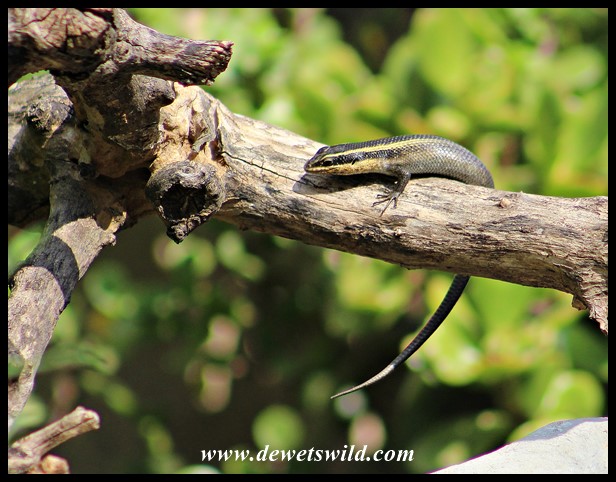
Trachylepis punctatissima
The main population centre of the Speckled Rock Skink, a common and very adaptable lizard, encompasses Botswana, Lesotho and South Africa (Free State, Gauteng, western Kwazulu-Natal, Mpumalanga, Limpopo, North West and the eastern reaches of the Northern Cape) with a seperate population along the borders of Zambia and Malawi. They are diurnal, enjoy basking in the sun, feed on small invertebrates and inhabit a wide range of rocky grassland and savanna habitats, as well as urban landscapes. Speckled Rock Skinks become very tame around houses, especially where marauding pet cats are not a threat. In the colder, high-lying parts of their range they may hibernate through the harshest winter months. Females give birth to litters of 3-9 babies in summer. Adults measure around 19cm in length (including the tail).
The Speckled Rock Skink is closely related to the Striped Skink, was originally considered a race of that species, and is listed as being of least concern by the IUCN. It is also known as the Montane Speckled Skink.


 DeWetsWild
Tot my skaamte het ek nie geweet die engels vir akkedis is ‘skink’ nie.🙈
Die “Skink” word gebruik in plaas van “lizard” vir die gladde akkedisse, Una
Fascinating.
Glad you think so too, Lakshmi!
The other day my youngest asked me what a skink was. I’m going to keep this up to show her.
Isn’t that a happy coincidence!
Yes, I imagine they are fun to watch.
janet
Right you are, Janet – these little ones aren’t just about baking in the sun as many other reptiles seem to love!
I always just assume Striped Skink, so from now on I will need to look more carefully to see if they are in fact Speckled Rock Skinks. I assume it is speckles that differentiate them?
The two species are very similar indeed, Carol, and were considered races of the same species until quite recently. I suppose the easiest feature to look for is that the stripe along the side of the body fades into speckles just after the front legs in the Speckled Rock Skink, whereas it extends all the way to the back legs in the Striped Skink. Here’s a link to our post on that species if you want to compare: https://dewetswild.com/2018/06/26/striped-skink/
Thanks very much.
This is the first time I’ve heard of this lizard. Always happy to learn something new 🙂 Thanks much for sharing!
Glad we could introduce you to our Speckled Rock Skink, Takami!
I am glad you have focused on skinks as they tend to be ignored in favour of larger or more colourful creatures. This year we have observed an unusual abundance of skinks, lizards and geckoes in both our home and in the garden – from minute to fairly large. The breeding conditions must have been just right for some reason.
We’ve noticed exactly the trend, Anne! Just one anecdote in support of what you’re saying: I’ve occupied the same office for the last 10 years, and for the first time I’ve now had to catch and release not one but three skinks, and that in the space of three weeks! I’ve still got no idea how they got in to begin with.
That is interesting.
Pretty little fellow. These would be welcome in my yard!
In ours as well, Montucky! They’re quite active and lots of fun to watch!
He’s quite a cute little lizzie. I wonder whether he’d get along well with my lot? 😀
I think Mr Iggie would look like Godzilla compared to these little guys! 😀
Jy’t n paar goeie fotos hier. Kannie glo dat hul nog verskillend is nie. Nie dat ek ooit gedink het daar is nog verskillendes nie. Volgende keer sal ek beter kyk want hier is ook nogal n paar verskillendes.
Dit is vreeslik interessant vir ons om die klein verskille tussen die soorte te leer uitken, Ineke.