
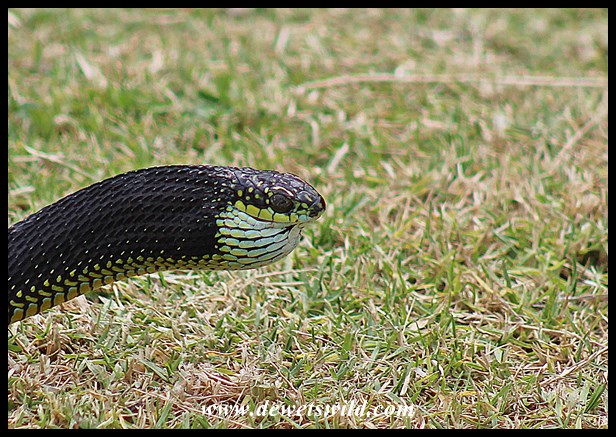
Dispholidus typus
The highly venomous but rather shy Boomslang (Afrikaans for “Treesnake”) occurs in parts of all South Africa’s provinces, occupying fynbos, savanna, thicket and forest habitats. It is also widely distributed over much of the rest of sub-Saharan Africa.
The Boomslang is diurnal, arboreal and very agile, hunting by sight for chameleons, lizards, geckos, frogs, small mammals and small birds. When threatened, a Boomslang will inflate its throat and strike out at the attacker (see photos in gallery below). Their venom is a potent haemotoxin, delivered in extremely small doses of between 1 and 15mg, breaking down blood components, preventing blood from clotting and causing hemorrhages into the body tissues and externally. While it may be a slow-acting venom in these small doses, drop for drop it is the most potent venom of any African snake, and without prompt treatment with antivenom and blood transfusions a Boomslang envenomation of just 1mg will kill an adult human within 1-3 days. Thankfully a Boomslang will much rather retreat than bite when crossing paths with a human, and left unmolested a bite from one is highly unlikely to occur.
Boomslange mate in spring, with females laying clutches of up to 30 eggs in holes in trees, burrows in the ground or in heaps of dead leaves about 60 days later. The eggs hatch about 3 months after being laid, with the newly hatched babies measuring about 25cm. Adults measure up to 2m long and can weigh up to half a kilogram. Males are far more colourful than the females.


Now, for a bit of a tongue-in-cheek Public Service Announcement: If ever you visit South Africa, and in the unlikely event of being bitten by a Boomslang, then be sure to pronounce the name correctly, as can be heard in this very interesting video, when you arrive at the hospital. Pronouncing it as the two English words “BOOM” and “SLANG” (as in this horrible tutorial), especially with an ominous tone in your voice, will cause your nursing staff to start laughing uncontrollably and delay your rescue until they’ve been able to compose themselves…
 DeWetsWild
Pingback: Summer Snapshots from Kruger: Boomslang! | DeWetsWild
No worries on how to correctly pronounce the name. I plan for NO bites!! 😱😜. Amazing photo with the bird, BTW!
That certainly is the best strategy! 😀
Love the PSA. I’ll steer clear thank you. 👍
Always the best option!
Fantastiese foto’s, Dries! Veral die een waar hy die voël aanval en die een waar sy bek so opgeblaas is. Het hy die voël gevang? Interessante video en sowaar slegte uitspraak in die ander video.
Baie dankie, Dina! Bly om te sien jy het die spesiale post oor die slang en waterfiskaal se onderonsie gesien.
Ja ek weet nie hoe ek dit gemis het nie. Dis werklik besonders!
Amazing pictures.
Thank you very much!
I have to pretend to have actually read this without looking at any of the photos {shudder!}
My aversion to snakes is still rigidly intact! There are certain advantages to living in a cold environment 😉
😀
Then I suppose you didn’t watch the video to learn how to pronounce “Boomslang” correctly, Joanne?
bwahahahaha! No.
… unless there aren’t any actual snakes in it, in which I will reconsider 🙂
The video is of a talk by a snake expert handling a Boomslang… 😀
Wow en vir die laaste deel 🤣🤣🤣 bygesê as jy ‘n mediese fasiliteit betyds haal 😂
Gelukkig spuit hulle n baie klein hoeveelheid gif in, so selfs al is jy baie diep in die gramadoelas kan jy betyds dit tot by n hospitaal maak. Ongelukkig vat dit lank voor simptome wys, so baie mense neem aan dat hul n “droe” byt gekry het, en teen die tyd wat die bloed dan by hul ore, neus, oe en wat nog begin uitloop is hulle te ver van die hulp af wat hulle op daardie stadium dringend en dadelik nodig het.
Beautiful, but this is as close as I ever need to get. 🙂
janet
The Boomslang is definitely best appreciated from a distance, Janet. But then again, maybe I’ll see it more clearly if I just go one or two steps closer…
Hmmmm! But for how long? 😁. Use that telephoto!!
😀
Lovely pictures!😊 Boomslang is a very famous snake, well for me, and sure for the most people even outside Africa 😀
Thanks a lot, John! Yes, the Boomslang certainly has quite the reputation!
How are you feeling?
It´s being better and better for everyday, thanks. 😀
Wonderful!
Wow. I wouldn’t want to run into one. That action shot with the bird is harrowing. I laughed at your tutorial on pronunciation….wouldn’t want them laughing as the venom runs through my body! 😳😁
Thank you very much, Jane, and glad to know you had a good chuckle at the horrible tutorial as well!
I just steer clear 🙂
Definitely the safer option!
How interesting to see the encounter with the boubou and I see from the previous post on this that the bird drove the snake off. Hard not to feel sorry for a hungry snake but I should think you must have been relieved for the bird? Your photo of the boomslang inflating it’s neck is amazing.
That really was a fascinating interaction and Joubert and I felt excited just to be able to see it happen in front of our eyes, whatever the outcome!
You are right, it is fascinating whatever the outcome 🙂
Fascinating. I was nervous watch the handler handle to snake. He obviously knows what he is doing. As always, thank you for all the information.
Glad you found this post worth your while, Tim!
We have seen a Boomslang in our garden several times this summer, yet I have only succeeded in photographing its belly! Lovely to see your photographs.
The serpent in your Garden of Eden!?
Very pretty snake and fascinating as well!
That the Boomslang certainly is, on both counts!
puffy snake
Especially when its a bit aggro!
As you probably know from my previous comments, I really, really don’t like snakes, and I can’t believe you were close enough to take photographs! I tried to watch the video and had to stop. LOL
I find snakes fascinating, Deb, and if they’re not going to feel cornered I will move in for a closer look – but I’m certainly not going to try and touch it and thus spoil my holiday! 😀
You’re braver than I! I am both fascinated and repelled by snakes, mostly repelled. LOL
A fascinating video and a hilarious tutorial. 🤣 Those boomslang babies are quite long already. I suppose they must curl up inside the eggs. How big are the eggs? Thanks for another really informative post, Dries. 👏🏻
Thanks Sylvia! Boomslang eggs are about the size of a ping-pong ball with a soft shell – it must be very cramped inside there by the time the babies emerge!
Thanks for the info. Yes, I think I would suffer from claustrophobia. 😳