
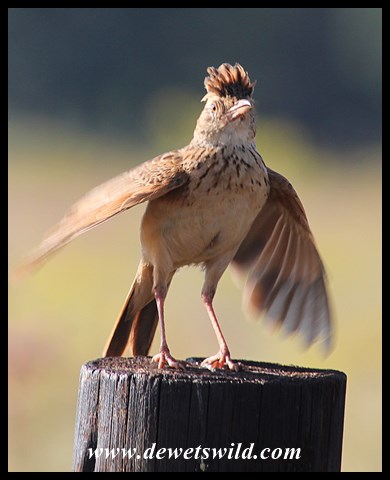
Mirafra africana
The Rufous-naped Lark is a common and conspicuous inhabitant of agricultural fields, open grasslands and savannas, where males display prominently atop perches like tree stumps, fence-posts and termite mounds. They follow a mixed diet of insects and seeds. Adult Rufous-naped Larks measure around 17cm in length and weigh about 44g.
Rufous-naped Larks are usually found singly or in pairs, being territorial and monogamous. Their nests are domed structures built of dry grass at the base of a bush or tuft of grass. They breed almost throughout the year, though there’s a distinct peak in the summer months. Clutches of 2-4 eggs are incubated for 2 weeks, with the female taking most of the parental responsibility after the eggs have hatched. The chicks leave the nest before they’re 2 weeks old and before they can fly.
The IUCN lists the Rufous-naped Lark as being of least concern, though it does mention a probably declining and fragmenting population in the north of the species’ range. In South Africa they occur in the Eastern Cape, Free State, Northwest, Gauteng, Kwazulu-Natal, Mpumalanga and Limpopo, and north of our borders they’re distributed patchily over much of sub-Saharan Africa.


 DeWetsWild
Such a sassy top knot. Love it! 😍
They’ve got quite a lot of attitude and then some to spare in those tiny bodies!
I love the opening picture. I enjoy hearing them calling, especially in the mornings. They are such a dynamic presence in our wide open spaces. Theirs is the only lark call I recognise as it is somehow distinctive.
Their clear whistled call is just as distinctive – one of the first lark calls I got to know and I’ve spent many an hour birding in grasslands with its call almost constantly in the background
Lovely photos!
Thanks, Don!
I’m still trying to learn the different lark calls – seems like an easier way to distinguish the “LBJ’s” than trying to rely on my colour-blind impressions of their plumage…
Looks like one third bird and two thirds attitude!
That’s a great description, Montucky!
What an interesting looking little bird.
What it lacks in colouration it certainly makes up in attitude!
Oh dear. Poor little guy. My first reaction when I saw the opening photo was that he had a Kim Jong-un hairstyle. Rather a distinctive look for a bird 😆
He had better update his style urgently, else President Trump might be visiting South Africa soon for a summit…
Gaaaah!
Great picture of the beautiful little bird!😊 I can see that many chicks leave the nest after just a few weeks, like this birds chicks do. How do they manage? They can’t fly and the parents must take care of them, I think.
I think that with there being so many predators around here in Africa, sitting around in a nest for too long is a really dangerous undertaking. And surprisingly, even though this one doesn’t, most of the different birds we’ve featured on our blog before do actually fly by the time they leave the nest, even if it is with a little bit of difficulty.
Hy is te kostelik met daardie wipkuifie! Pragtige foto’s, Dries.
Die wipkuifie maak hom ook een van die makliker “LBJ’s” om uit te ken!
Ek doen gladnie lewerike nie…heeltemal te moeilik vir my!😄
Your captures of this little fellow are absolutely stunning!!
Thanks a lot, Tina!
I love that funky bit of “hair” on top. Kind of a Mohawk look. 🙂
janet
Ha! Janet–I was thinking the same thing. Expected this bird to break into an Elvis song any minute now!
All that showing off just to attract the ladies!