
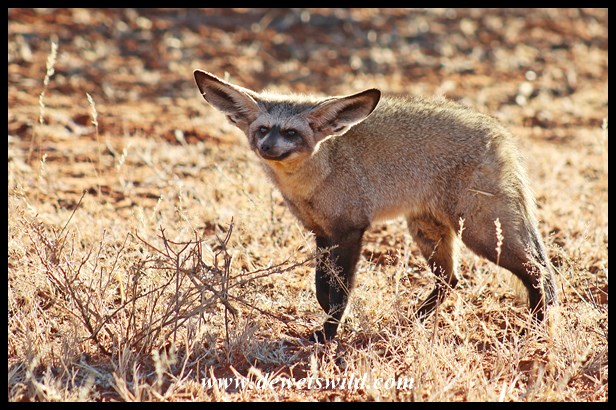
Otocyon megalotis
The Bat-eared Fox is probably the most attractive Canid occurring in South Africa. Adults weigh in the region of 4kg and stand up to 40cm high at the shoulder. They inhabit open, dry areas – scrublands, grassland, semi-desert and open savanna – where their favourite prey, the harvester termite, occurs. While termites constitute up to 80% – 95% of their diet, they also consume other insects and invertebrates, some small vertebrates, eggs and wild fruit that they come across. They find their prey underground using their exceptional hearing, for which the outsized ears come in very handy, and then dig it out with their front paws. They can survive without access to drinking water, sourcing enough for their needs from their food.
Bat-eared Foxes are active by day and night, warming up in the early morning sun and resting up in burrows (which they dig themselves or take over from other mammals) or deep shade during the heat of the day. They are usually seen in groups numbering from 2 – 13, consisting of an adult pair (that may remain together for life) and their offspring. The female gives birth to litters of 1-6 pups annually, usually in the rainy season. Both parents take an active part in raising the pups, with the male being more involved in their care than is the case with most other members of the dog family. The youngsters grow quickly and are fully grown by the time they’re 4 months old. Bat-eared Foxes may live from 6 to 12 years in the wild, being susceptible to various diseases and drought (due to the negative impact it has on their preferred prey) and featuring on the menu of all the larger carnivores.
Bat-eared Foxes occur in two discrete parts of the African continent – one population in East Africa (from Somalia and Sudan to Tanzania) and the other in the western parts of Southern Africa (South Africa, Namibia, Botswana, Zimbabwe and marginally into Angola, Zambia and Mozambique). Though they are occasionally hunted for their pelts or as perceived stock thieves, this is thankfully not a major threat and the IUCN considers the Bat-eared Fox to be of least concern. Mokala National Park and the Kgalagadi Transfrontier Park are excellent locations to find and photograph the Bat-eared Fox.


 DeWetsWild
So like a Racoon, very unusual looking. Kind of looks like my cat when he tries to flatten himself when stalking a bird, ears flat to the head!
They’re pretty unique animals, and I think pretty cute too!
What an unusual animal. Beautiful.
Absolutely true, Maralee, on both counts!
They are exceptional. Their oddity is quite lovely. Thank you for all of the most interesting information on them.
They’re so well adapted to their place in the world, perfectly built for their job.
Quite unusual and apparently ready to take off! 🙂 S/he should be able to hear everything within an enormous radius! I probably should mention that s/he is quite ear-y looking. 🙂
janet
Thanks for the smiles, Janet! 😀
I think they’re very cute little animals, with those big ears and bandit-masks.
Beautiful!
They absolutely are!
Among my favourite animals. Sadly, we came across two that had been run over on rural roads today. Perhaps they are dazzled by headlights and halt in the road?
Sadly they do appear to be more prone to being hit by cars travelling at night than most other wild animals. On several of the roads we traveled recently in the Northern Cape we saw roadsigns warning of the risk of foxes in the road. The awareness may be working – on this trip we saw fewer roadkilled foxes than in previous years when we visited.
Beautiful and cute animals! We’ve only seen them once in Namibia.
Thank you for your kind comment and welcome here! Wonderful to know that you are among the comparably few who have had the opportunity to see these cute animals in real life!
Okay…I have never even heard of this crazy Yoda-like creature! What fun!
Our privilege to introduce you then, Kathy!
Wow – nice shots of an animal I have never seen before! Thank you for posting.
We’re so glad we could introduce you to this beautiful little animal, Ann-Christine!
I thank you for doing that!
That first shot is one very fabulous portrait.
Thank you very much, Tish!
Such endearing little creatures and lovely to see. Your photos capture their shyness and their hardiness.
Thanks, Carol. Getting a glimpse of these cute critters is always a special treat!
OMG.
I’ve not seen one of these before.
They’re very special little creatures, Gavin
Seems so odd looking to me but I suppose to another bat-eared fox he’s adorable!
Certainly odd-looking, but in a good way I’d say, Tina?
Definitely!
An amazing creature! I love the huge ears! Very well named!
These ears really are an endearing feature!
It’s a very beautiful animal! It’s a fox, but I can see what it get the name from!😊
They’ve really been given a very suitable name!
Oh wow…they are fascinating looking and quite adorable. Great shots, Dries. 🙂
Thanks, Jane! Seeing these little foxes is always a special treat for us.
This fox is really useful for termite control then! Great animal!
So perfectly adapted to its niche in the world, Hien.