
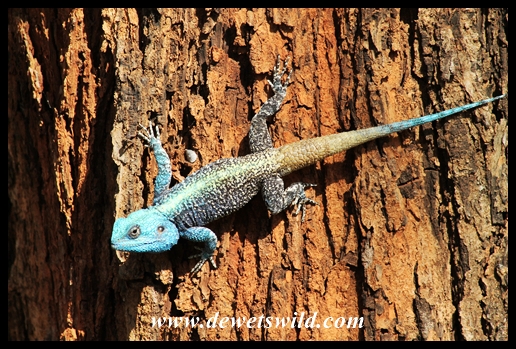
Acanthocercus atricollis atricollis
As their name would suggest, the Southern Tree Agama is a mainly arboreal lizard, coming to ground only to move from one tree to another and to feed on ground-living insects. They inhabit open savanna landscapes, especially those dominated by thorn and miombo (Brachystegia) trees, and feed on ants, termites, caterpillars, grasshoppers, beetles and other invertebrates. Adults grow to between 12 and 15cm long, excluding the tail. Breeding males are very colourful and not nearly as well camouflaged as the females, non-breeding males and young.
Southern Tree Agamas are diurnal, sleeping at night in hollow trunks or under loose bark. Males are territorial and will fight each other viciously. Their breeding season spans spring and summer, when females dig a hole in moist soil in which they lay between 5 and 14 eggs that hatch in about 3 months.
The Southern Tree Agama occurs patchily from eastern Africa southwards to South Africa, Namibia and Botswana. The IUCN considers this species of least concern. In South Africa they are commonly encountered in the provinces of Limpopo, Mpumalanga and nothern Kwazulu-Natal. They are very tolerant of humans and is a common sight in the rest camps of the Kruger National Park.


 DeWetsWild
Pingback: Satara Summer 2021 – King Agama of Circle E | de Wets Wild
Does it change to blue when it feels in danger?
Actually it is the males’ breeding colouration, Awa. so as to impress the females!
Hi, I’m putting together a colour post on ‘Pink and Blue’ and would love to use the photo at the top of the page. As you know I credit to your name as well as linking to your post and blog. If you’d be happy for me to use it, would you mind sending me a larger photo at 700 pixels wide to ecowburn at gmail dot com. Just if you’d like to. Thanks, Liz
Hi Liz! We’ve been away for a while and I am still catching up. It’s going to take a day or two to get the original photo for you – will you be able to wait for it?
Nice of you to get back thanks. I’ll be doing the posts over several days so I can include it in a later post so long as you send it before I’ve finished. Cheers, Liz
Just sent it off to your email now 😉
You are very kind Dries, thank you very much. I’ll be doing multiple posts and the lovely lizard will appear in one of them. Many thanks, Liz
We’re very glad to feature on your blog!
Kyk net so parmant
Hulle kan nogal windlawaai raak!
It´s a very beautiful lizard!😊 In Sweden we only have three species of lizards, and they are all pretty small, and very quick! There are, of course, lizards from other countries to buy on business, but I strongly oppose the keeping of wild animals in captivity. I have indeed had a corn snake myself. It took a while before I made the decision to buy it, my own motivation was not to buy me, it does anyone else. I think that in some way you should stop selling exotic animals, but how will it go when they are bred in all countries. I’m not better than others and I would like to buy a snake again, maybe a tiger python, (black-tailed python) if I have room for it.
The exotic pet trade really has become such a big money spinner that I think it will be a very long time before it comes to a halt. One can just hope that the animals being sold are captive-bred and that they are not being caught in the wild. Sadly that is often not the case and many kinds of birds, amphibians and reptiles are heading for extinction in the wild because of it.
Hello. He is a very bright blue! I have only seen these in Shingwedzi and Satara camps in KNP. I think, in or on, Fever Trees. I really like lizards and can spend ages watching them.
Kruger Park’s camps are excellent places to look for tree agamas, as well as marvel at their excellent camouflage!
Pretty little creature!
They absolutely are, Teresa!
The blue is what caught my eye. Very pretty little one.
Most unexpected on a lizard, isn’t it, Lois?
That one shot makes it look quite blue, which is pretty. But the others don’t look that way. Every time I see or hear anything about the Limpopo River, I think of Riki-tiki-tavi. 🙂
janet
It’s the breeding males that show off so terribly with their blue heads, Janet!
Look at the blue on this fellow! What amazing colors and interesting post.
Thanks a lot, Jane!
I have a great fondness for lizards, and this little one is a beauty!
And their camouflage is excellent! Well, apart from the showy males that is!