Turdus smithi
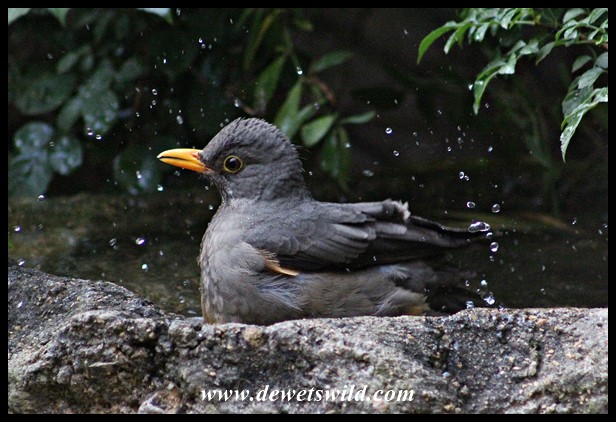
The Karoo Thrush inhabits arid scrublands and grasslands, preferring the denser vegetation along drainage lines in these otherwise open areas. They’re also one of the most common garden birds all over their range, a fact that has aided an increase in both their range and population. Karoo Thrushes are usually seen singly or in pairs and follow an omnivorous diet, searching on the ground and scrounging through leaf litter for insects, worms, other invertebrates, small vertebrates and fruits and seeds. Adults are about 23cm long and weigh up to 86g.
At the start of the breeding season, which stretches through spring and summer, female Karoo Thrushes build cup-shaped nests of wet grass and other plant material in the forks of trees. They incubate clutches of 1-4 eggs for about two weeks, with the chicks becoming independent about 2-and-a-half months after hatching.
The Karoo Thrush occurs mainly in the central and western parts of South Africa, extending marginally into Lesotho, Botswana and Namibia. The IUCN considers it to be of least concern. It was previously classified as a subspecies of the Olive Thrush, which is generally found in forests.


 DeWetsWild
I thought I’d share this
I have a Karoo thrush pair, with a fledgling in my garden.
The fledgling portrays almost amplified juvenile behaviour when its parents are around, including walking around with lowered wings, instead of flying. However, as soon as the parents fly off, its call changes completely, becomes more robust and it even flies around!
I see this article says the parents will still care for a fledgling for 2.5 months but this fledgling has been displaying this behaviour for over 3 months and with no sign of becoming independent!
I wonder if it is manipulating it’s parents into caring for it longer and, if so, if this is unusual or if this extended behaviour is natural.
Very Interesting little bird
This is a most interesting observation, CM – thanks for sharing! You might consider sharing it with the University of Cape Town’s Animal Demography Unit: http://bo.adu.org.za/
Ek moet net hierdie link vir jou stuur. Hierdie man is n wonderlike fotograaf en vriend van my. Hierdie stuk is te mooi geskryf. Hy is disleksies en vat lank voordat die skryfwerk gedoen is. Sy fotos is besonders. Hy is n voelkenner uit die boonste rakke. Hy praat van hulle asof dit ou kennise is. https://boneywhitefoot.wordpress.com/2018/04/24/invasion-of-the-road-buzzards/
Baie dankie Ineke, ek het dit vreeslik geniet. Gaan beslis ook van nou af hierdie blog volg. Dankie weereens!
Gaaf. Omdat die ou sukkel met sy spelling en skryf vat hy lank om sy stuk reg te kry. Hy probeer eenmaal n maand iets insit.
I see that not only the color is different from juveniles to adults, even the shape of the beak is different.
You’re right, John. It would seem the adults’ bills grow larger with age.
So lekker as hulle so mak raak en orals rond hop. Pragtige foto’s!
Dankie, Dina! Ja, die geelbeklysters en hul familielede kan nogal vrypostig raak as mens hulle nie verpes nie.
Nice pictures and facts about this bird. I have five different thrush species in my yard. Most are “plain” with beautiful songs. The bluebirds, however, have both a beautiful song and color.
That sounds like a lovely choir to wake up to!
Does this little one sing? There is a song thrush, which has repeated musical phrases and is often referred to in poetry. I am trying to remember if this one is also a weather predictor.
Indeed a close relative of the song thrush, Beth, and with a pretty decent voice as well. Have a listen here: https://www.xeno-canto.org/290125
Does it predict the weather?
Not as far as we’ve noticed, Beth
Another bird that is so well camouflaged, matching the colour of its scrubby dry habitat. I get quite a few Kurrichane and Spotted thrushes in my garden. They spend a lot of time pecking and scratching amongst the leaf litter under my numerous trees and shrubs. They are also another bird that nest in my garden.
You should start advertising as a bird-watching venue, Kim!
What a sweet little bird, Dries. 😍
I love how confiding they can become, Sylvia.
👍