
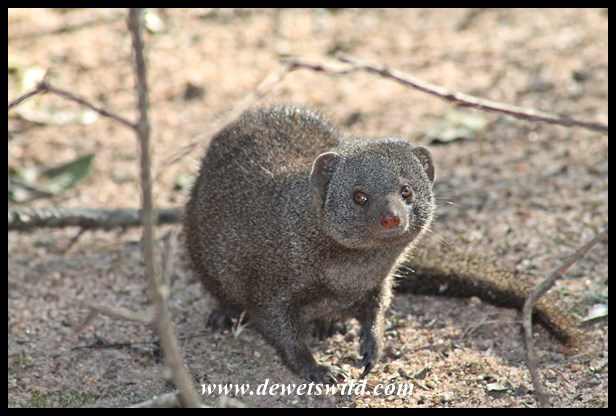
Helogale parvula
With a weight of only 350g and growing to a maximum length of 40cm (including its tail), the Dwarf Mongoose is the smallest mammalian carnivore in South Africa. They inhabit open savannas and woodlands with an ample supply of termite mounds and fallen logs and often in or near rocky outcrops. They prey on anything from insects, spiders and scorpions to reptiles (including snakes), birds and rodents, often banding together to overpower larger prey.
Diurnal in habits, Dwarf Mongooses live in clans of up to 40 members occupying a fixed home range within which they may have as many as 20 dens (often in termite mounds, tree stumps, rocky outcrops or in tunnels dug by themselves or other animals). These clans are controlled by a dominant pair that stays together for life. The dominant female gives birth to litters of 1-7 pups after a 2 month gestation, usually in the rainy season. While the babies will only suckle from their mother, all troop members assist in raising the young. Dwarf Mongooses are exceptionally curious, and even though they flee for cover at the slightest sign of danger it doesn’t take very long before they start popping up again to check out whatever it was that disturbed them. They have a life expectancy of only about 6 years in the wild.
The IUCN considers the Dwarf Mongoose to be of least concern. It occurs from Ethiopia and Somalia southwards to Angola and South Africa. In South Africa it is to be found from northern Kwazulu-Natal through Mpumalanga and Limpopo into the north-eastern corner of the North West Province.


 DeWetsWild
Ek wil ook een hê
Jy sal n hele troppie moet vat, Tina – hulle hou van hul maatjies!
Toe ek hier ingetrek het was daar baie maar hulle het nou getrek… maar my hartseer as die mens die natuur so verdring.
Ons lewens is soveel armer omdat ons so afgesny van die natuur probeer wees
Dis waar!
Small but stout of heart! And cute as well. 🙂
janet
Most definitely, Janet, on all counts!
They have such sweet but mischievous faces!
You can almost see them hatching their plans behind those tiny eyes 😉
You certainly can!
Skatlike diertjies…ek hou daarvan om hulle dop te hou. Pragtige foto’s, weereens Dries!
Ek is mal oor hoe nuuskierig hulle is. Hul eerste instink is altyd om te vlug, maar baie vinnig kry daai nusskierigheid die oorhand!
They look just like weasels except they probably don’t change colour like ours! 🙂
They certainly share the looks, Teresa, but being social animals the mongooses are quite different in many behavioral aspects to the weasels.
Your right, Weasels aren’t social and they are Carnivores and they stink!
I’ve always been fascinated by them although I’ve never seen one.
Watching them go about their business can be absolutely riveting!
Love them. Thanks for sharing
Thanks for spending a bit of time with us and the dwarf mongoose, Kelly!
In their own way, they are kind of cute. Just a little… 🙂
Really only a little, Lois? I think we need to introduce mongoose teddies to the world!
haha! Oh, please do!
Such a beautiful little animal!😊 I usually read about the animals you shoot and describe so well. This was actually a Swedish named Carl Jacob Sundvall, who first described it in 1847.
Sundevall actually introduced quite a few African species to science, John – how exciting it must have been in those days exploring the continent and finding new things!