
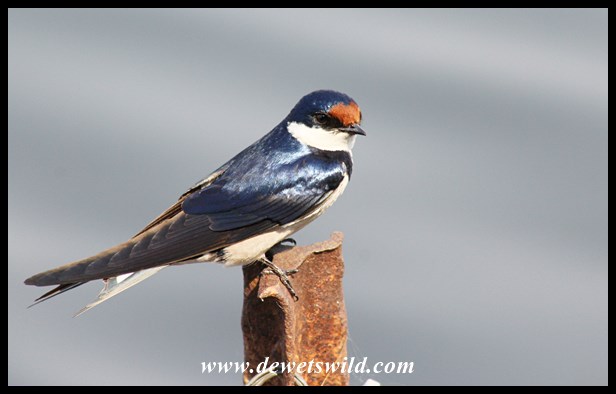
Hirundo albigularis
White-throated Swallows migrate in large flocks of up to 1000 birds to South Africa, Zimbabwe, Swaziland, Lesotho, Namibia and Botswana between July and September, in time for the breeding season, departing again for Angola, Zambia and the southern DRC around April and May. They are closely associated with rivers and open water, especially in grasslands, fynbos and mountainous areas, and feed primarily on insects caught in flight. Adults grow to a length of 15cm and weigh around 25g.
White-throated Swallows breed in our southern climes between August and March (peak between October and December). Pairs are monogamous and can raise multiple broods in a season, often returning year after year to the same nest. Their nests are small mud-cups lined with grass, fur and feathers, built against vertical surfaces (both natural and man-made) and often placed under overhanging rocks, bridges or roofs. Clutches of between 2 and 5 eggs are incubated for a little over 2 weeks, with the hatchlings fledging by about 3-4 weeks old and becoming independent about two weeks after that.
Being common with an apparently increasing population, the White-throated Swallow is listed as being of least concern by the IUCN. During their breeding season they can be found in every South African province, being absent only from the driest parts of the arid Northern Cape.


 DeWetsWild
So pretty!
Like little flying jewels!
Beautiful images! I always have trouble photographing swallows of any kind, but you seem to have done all right!
You are very kind, thanks Hien. These images took a few years to collect, in all honesty.
Hi guys. What a handsome bird. I have seen swallows in flight but never stationary and close up enough to see its markings, so I don’t know whether I have actually seen one of these. Wonderful photos as usual!
Thanks Kim! Being seen mostly on the wing, I also don’t have images of most of South Africa’s rich diversity of swifts and swallows. But we’ll keep striving to!
Pardon my selfishness here, but I recently wrote about the swallows who come up from Argentina to California.
Those swallows were part of the strong memories of my childhood. During WW2, when my family was living in San Diego, I saw them often.
Not at all, Beth. Isn’t it incredible that they travel all that distance, twice a year, and to such great timing!? There’s so much about the natural world we don’t know and cannot comprehend. Even our own impact on it.
Do you remember when we heard much about the Monarch butterfly migrations, and now we hear almost nothing? Texas was one state that was blessed to be in their northern flight pattern, but someone on the path just “had to cut a certain plant” to make way for progress. I can’t tell you more…
😦
Another blight on our human legacy…
Pragtig, veral die tweetjies wat langs mekaar sit! Ek neem selde swaeltjies af, want hulle is so besig. Wel gedaan, Dries.
Baie dankie, Dina! Inderdaad, hulle glip maklik weg voor die lens.
What an elegant little bird.
What a great description!
Fond memories of being buzzed by Swallows! lol.. Beautiful little birds!
Seems everyone has a soft spot for the swallows!
It’s interesting that they come back to the same nests. I always wonder whether the nests I see everywhere in the winter, when the seeing is good, get re-used, whether by the same birds or by others.
janet
So much energy and effort goes into building their mud nests that I am glad for them that they have the sense to re-use it! 😀
great capture.
Thanks, Kelly!
Beautiful shots
Thank you very much!
Very beautiful bird.😊 It reminds a little bit of the barn swallow.
You are right, John, and in flight they are very difficult to discern from one another as they swish overhead!
I bet they are welcome visitors. Very pretty birds!
Absolutely!