
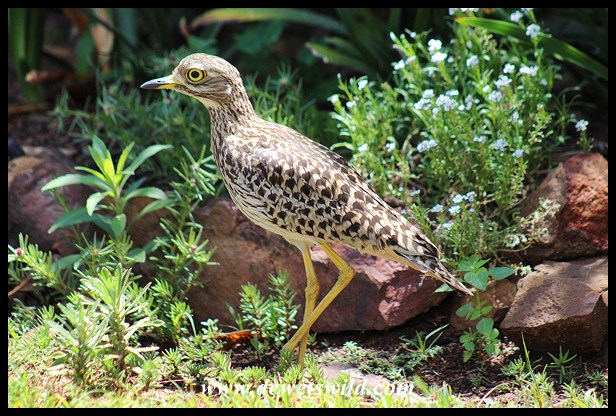
Burhinus capensis
The Spotted Thick-knee, or Spotted Dikkop, prefers open habitats, including fynbos, semi-arid scrublands, grasslands and savanna, but has adapted well to agricultural and urban environments and is often seen in fields, parks and gardens – at night their shrill call has become a familiar sound in our suburbs. They are mostly nocturnal in habit and feed primarily on insects and other invertebrates. Adults weigh around 500g with a wingspan of about 80cm.
Pairs of Spotted Think-knees are monogamous and solitary nesters, although they could assemble in groups of up to 50 outside the breeding season. Their nests are little more than a scrape in the ground, often out in the open but more usually in the shade of a bush or tree, and camouflaged with a few pieces of plants or pebbles, in which a clutch of 1-3 (usually 2) splendidly camouflaged eggs are laid. The parents take turns to incubate the eggs over a period of 4 weeks, and the chicks leave the nest within a day of hatching to move around with their parents. The chicks fledge at about 2 months old. Spotted Thick-knees breed through spring and summer and pairs can raise as many as three broods in a season.
Spotted Thick-knees occur over much of sub-Saharan African, being absent only from the equatorial forests, and is listed as being of least concern by the IUCN. In South Africa they occur over the entire country.


 DeWetsWild
Sjoe dis mooi!
Baie dankie, Tina!
Een vam my geliefde voëlsoorte. Hul is beslis goeie wegkruipers. Mens moet weet waarvoor jy kyk/soek as jy hul wil sien.
Ek stem volkome met jou saam, Ineke!
Ons het altyd saans op die stoep gesit. Sonder ligte aan dan sal hul soetjies verby kom op pad na waarheen ookal. Hul was later redelik mak en gemaklik met ons wat ook in veld(ons eie weiveld) geloop het.
Wat n voorreg!
What an odd name for such a pretty bird. The chicks are especially cute. I don’t think I have seen one of these birds before.
They are expert at camouflage, Kim, and quite common even in urban settings, though apparently not at their highest densities in your part of KZN according to the SABAP distribution map. You may have walked past one in your garden and not even know it!
Beautiful bird.😊 The female looks a little determined in her eyes.
Both parents will go to great lengths to keep the chicks safe!
Die kleintjies is opvreetbaar skatlik! Pragtige foto’s, Dries.
Baie dankie, Dina. Ja-Nee, hulle is die oulikste bondeltjies dons wat jy jou kan indink!
Hulle kom nie sommer in ons omgewing hier om die dam voor nie?
Hulle is eintlik baie volop, Una, en sekerlik is daar goeie habitat vir dikkoppe in jul omgewing. Dit is waarskynlik net dat hul so fantasties gekamoefleer is en maklik ongesiens bly!
Ek lê baie nagte en wonder watse voël skree so in die donker, was onder die indruk dat alle voëls net dagdiere is. Ook maar lekker stupid, soos ons sal sê. Gou hier rond uitgevra, en gehoor hulle is volop by ons. Dankie vir die inligting, De Wet, nou sal ek weet wat maak my soms wakker.
Daai skreeue snags kan n mens nogal laat wonder!
So oulik! Mal oor hulle roepgeluide snags…
Maar as jy klein is, alleen in n kamer in n donker plaashuis, dan kan hul skreeue jou nogal allerhande dinge laat verbeel! 😀
Those chicks are adorable!
Even with their enormous heads!
Such cute photos! They do have a rather strange way of sitting, don’t they?
Must be difficult to find a place to put those long legs!
They look like our curlews.
If Wikipedia is to be believed they are also known as “stone-curlews”, but not closely related to their look-alikes.
That’s interesting. Thank you for the information.
My pleasure!