
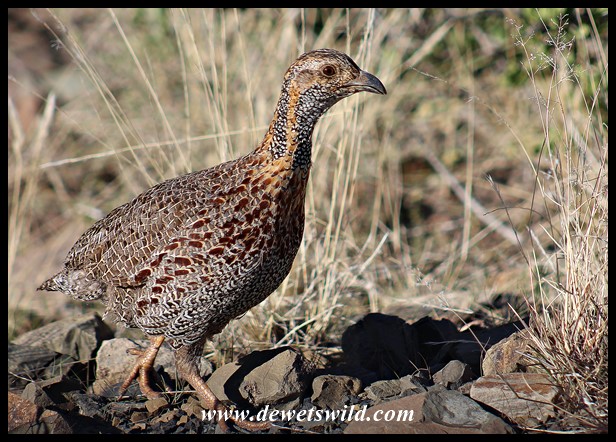
Scleroptila afra
A fairly common inhabitant of fynbos and mountain grasslands and scrub to elevations as high as 2750m above sea level, Grey-winged Francolins move around in groups of up to 25 birds, but more usually between 3 and 8. Insects and bulbous plants make up the majority of its diet. Adults grow to 33cm with a weight of up to 520g.
The breeding season in Grey-winged Francolins spans spring and summer, reaching a peak between August and November. Females lie 4-8 eggs, though nests with up to 15 eggs have been noted and must be the result of 2 or more females sharing a nest. The hen incubates the eggs for 3 weeks and the chicks start moving around with their parents soon after hatching.
The Grey-winged Francolin occurs only in Lesotho and South Africa, where it is distributed through most of the Western and Eastern Cape and into portions of the Northern Cape, Free State, Kwazulu-Natal and Mpumalange where suitable habitat is found. The IUCN considers the Grey-winged Francolin of least concern despite it being a popular hunting bird in parts of its range.


 DeWetsWild
My thoughts are very negative at present. Cats are making a meal of the Francolin chicks. We had 12 birds in September and now numbers have dwindled to 4 adults who had 7 chicks between them. Last lot of 4 surfaced yday and already only 3 are left today. The other breeding pair abandoned their 3 yday and today there are only 2 left, they’re strong and a bit larger than doves. But I’m very concerned as they’re terrified of cars passing and also people walking past. We live between two kloofs on the edge of a farm in Stilbay.
Can anyone advise how to protect the remaining 5 chicks apart from belling the cats?
Sadly domestic cats have become a real scourge to our indigenous wildlife, Bonnita, and I’m sorry to read about the impact they’re having on francolins in the beautiful area you live in.
You might find this article insightful on the subject: https://www.nationalgeographic.com/animals/2019/09/essay-to-save-birds-should-we-kill-off-cats/
Such a cute bird, Dries. I especially love photo #4. The look on his face. 😀
Isn’t it just the cutest little chick, Sylvia!?
Pragtige foto’s, ek is mal oor die kuikentjie!
Baie dankie, Dina. Ja, die ou kuikentjie het ons harte ook gesmelt!
I think these are the same type of Francolin that visit my sister’s farm in the midlands during certain times of the year, winter I think. But they occur in groups of about 50 birds, unless it is two groups moving around together.
The birds visiting your sister’s farm may also be the very similar looking Shelley’s Francolin, Kim. And her farm must be in a very pristine condition if they visit her in such numbers!
Beautiful bird.😊 The beak reminds a little of a birds of prey. What I longing for spring and all birds who will come here.😊
That beak must come in handy for digging grubs out of the soil. I share your love for the warmer weather and all the migrant bird species that come with it, John – we’re heading for autumn now and many of them will soon depart.
But you have many species that are unique for your country, so I can believe that you have a quite good bird life even during the winter.
Absolutely, John, you are 100% correct
Another bird with attractive markings.
janet
Agreed! Thanks, Janet!