
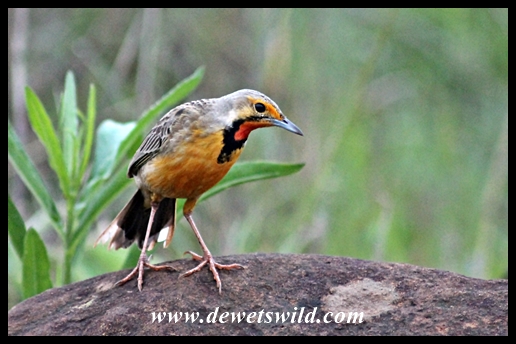
Macronyx capensis
The Cape, or Orange-throated, Longclaw, is an inhabitant of moist grassland and wetlands with dense grass cover, often at considerable elevations. They’re often seen standing atop large rocks, anthills or shrubs. It feeds mostly on insects, with seeds featuring occasionally in its diet. Adults weigh around 45g.
Cape Longclaws breed mostly in spring and summer. Pairs are monogamous and territorial. The female builds a well-hidden nest of grass and roots among dense stands of grass, in which she incubates a clutch of 1-4 eggs for around 2 weeks. Both parents feed the chicks, whic leave the nest at about 2 weeks old.
The Cape Longclaw occurs only in Zimbabwe, Lesotho, Swaziland and South Africa (Western and Eastern Cape, Kwazulu-Natal, Free State, Gauteng, North West and the Highveld regions of Limpopo and Mpumalanga) and marginally into Botswana and Mozambique. The IUCN considers the species as being of least concern.


 DeWetsWild
Beautiful colors on that bird!
They do stand out quite well!
Love that yellow!
janet
It really stands out, doesn’t it!?
Dankie Dries… nou’t ek weer lekker weggeraak daar onder in SA se skoonheid! Eendag…
Altyd lekker as jy kom kuier, AJ
Eendag…
Another beautiful bird you have in South Africa. 🙂 You have a lot of birds there and they are much more colorful then ours up here in the north. It´s leaving the nest already after 2 weeks, but can it manage it self, or the parents feed them? I can´t imagine they can fly so early.
Thanks a lot, John. We have around 850 recorded bird species in South Africa, one of the highest tallies in the world and reason to be proud.
As for the young longclaws: they are quite precocious and can look after themselves by the time they fledge – they have to out in the open savannas with so many predators around!
Wow, many birds. In Sweden there are about 245 bird species that breed. Then we have many temporary guests.
Dis darem ‘n mooie voëltjie…en daardie kloue is omtrent lank. Mooi foto’s Dries!
Baie dankie, Dina!
The almost look like our Robins (larger than European Robins) except for the colours, beautiful birds! 🙂
They really are eye-catching when they flash their orange bibs!
Beautiful birds ❤ ❤ ❤
That they certainly are, Nilda!
I notice that the two pics in the top middle show a much more pronounced black “bib” than the ones on either side. Are we seeing both the male and female of this species? Thanks. cheers.
You’ve got a very keen eye for detail, Dan! Indeed, the female has a narrower black band around the orange throat. Juveniles do not have either.