
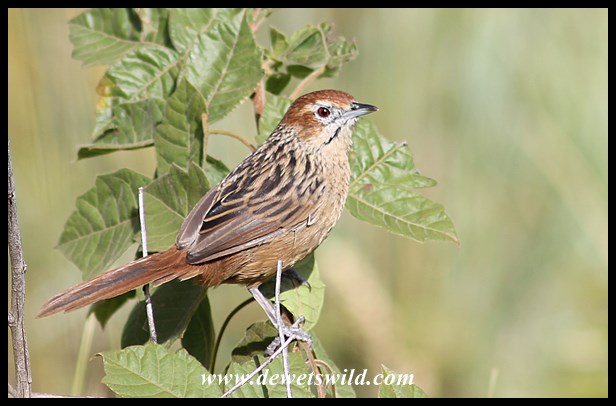
Sphenoeacus afer
As its name suggests, the Cape Grassbird lives in areas of rank, tall grass as well as thick low-growing fynbos and stands of ferns, often on hillsides and in river valleys and usually near water. They are normally seen singly or in pairs. Cape Grassbirds follow an insectivorous diet, catching most of their food on the ground. Adults grow to 19cm in length and weigh between 26 and 34g.
Cape Grassbirds breed almost throughout the year, with a peak in spring and early summer. Pairs mate for life. The female builds the bowl-shaped nest of twigs, grass and leaves near the ground in a tussock of grass or a bush. The female incubates the clutch of 2 or 3 eggs for just over 2 weeks. After hatching, both parents feed the chicks, which fledge at around 2 weeks old.
The Cape Grassbird occurs only in South Africa, Lesotho, Swaziland and in a limited area on the border between Mozambique and Zimbabwe. In South Africa they are found in the Western and Eastern Cape, Kwazulu-Natal, Free State, Gauteng and the Highveld of Mpumalanga and Limpopo. The IUCN currently lists it as “Least Concern” but also cautions that the population of the Cape Grassbird is decreasing due to habitat destruction (threatened by agriculture, urbanisation and invasion by alien trees).


 DeWetsWild
Nice photos of a striking little bird Dries, far cousin of our (Australian) reed warblers, which I’ve tried to capture on camera between dense reeds several times now – in vain.
That seems to be a common challenge with warblers then, Maurice, as they usually are so good at hiding and even when seen clearly are often difficult to identify. Luckily the Cape Grassbird is an exception.
A type of Sparrow? Similar to one of ours 🙂
Actually it is a rather large kind of warbler, Teresa, but I agree very similar looking to some sparrows.
Pragtige foto’s soos gewoonlik
Baie dankie, Tina!
Great photos and info on very chirpy looking birds. I have seen these a lot around KZN. My sister gets them on her farm.
We’ve also had our best sightings of them in KZN, Kim.
Beautiful bird who is like some species we have here in Sweden. 🙂
I think the warblers must be among the most diverse and widespread bird families on earth!
Ek het soms van hulle hier in my tuin!
Wat n voorreg, Aletta!
Mens kan hom maklik verwar met ‘n geelvinkwyfie.Dankie vir uitstekende inligting en mooi foto’s,Dries!
Dankie Dina! Die grasvoel is beslis een van ons moeiliker spesies om uit te ken maar dan is daar natuurlik ander wat nog moeiliker is!
Ek noem hulle die VVV’s….Vaal Vervelige Voëltjies…sukkel my dood om hulle uit te ken.Interessant Dries, ons het ‘n kleurblinde vriend ,wat dit goed regkry.Hy sien maklik detail omdat hy nie op kleur gefokus is nie.
Ek is ook kleurblind, en sien makliker n luiperd in n boom raak byvoorbeeld, maar vir my is die VVVs net nog moeiliker om uit te ken – as die boek eers aandui dat 2 soorte net verskil omdat die een n ligpienk snawel en die ander n ligblou snawel het slaat ek sommer my boek toe… 😀
Hahaaa,interessant hoe elke kleurblinde dit ervaar.Ons het ‘n hele paar hier in my familie en dis ongelooflik hoe hulle daarby aanpas.
An attractive bird. Habitat destruction is a problem for all sorts of species.
janet
And there’s only one species to blame for that, sadly.
Wonderful shots! We are going to South Africa soon so I hope to be able to spot this little bird! 🙂
We hope you’ll tick many of our endemic species in your list!
It looks a bit like a sparrow… Is it related to the Russet bush warbler?
It is classified in the warbler family, Cayenne, but I don’t think it is closely related to the species you mention.
It looks like such a sweet little bird. Are they pleasant to listen to?
Their call isn’t the most memorable you’ll hear out in South Africa’s wild places, Lois: http://www.xeno-canto.org/280678
At least it is not screetchy. Kind of a sweet little chirpy sound. Thank you for this!
Only a pleasure, Lois!