
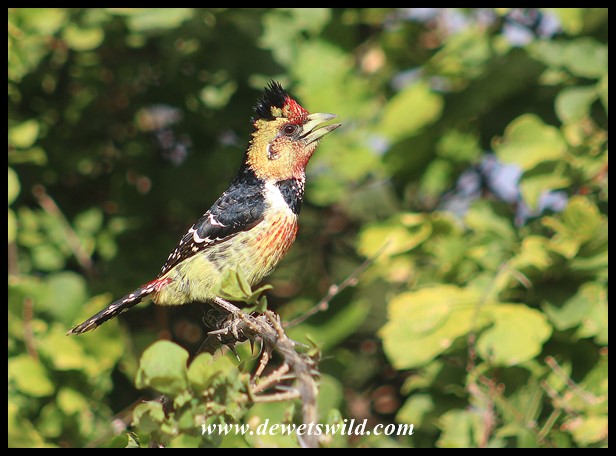
Trachyphonus vaillantii
Crested Barbets inhabit forests, riverine thickets, woodland and savannas and is a common sight in parks and gardens in our towns and cities. They feed on fruit, insects, eggs and occasionally chicks of other birds and small reptiles and mammals. Crested Barbets are great friends to gardeners, as they are especially fond of snails. They are usually seen singly or in pairs and act aggressively towards other birds, even species larger than themselves. Adults weigh between 60 and 80g.
Like other kinds of barbet, these birds nest in holes in trees that they peck themselves or take over from other birds. Pairs are monogamous and territorial when breeding, which peaks in spring and summer. Clutches consist of 1 to 5 eggs and are incubated mostly by the female for around 17 days. The chicks are fed insects by both parents and fledge when they’re around a month old.
Although currently considered common and of least concern, the IUCN does note that collection for the cagebird trade is causing some populations to decline. Apart from South Africa, where they occur in all provinces with the exception of the Western Cape, the Crested Barbet is found in Tanzania, DRC, Angola, Zambia, Namibia, Botswana, Zimbabwe, Mozambique and Swaziland.


 DeWetsWild
They are especially fond of snails? … we need a couple of them here! We were overrun by snails in our garden this past summer.
His appearance seems to be a bit ‘chaotic’ … a mess of different colours, but certainly distinctive.
I hate snails. So I take particular joy in watching our Crested Barbet pair taking care of that problem here in our garden!
After this past summer, I’m not so fond of them myself.
Wow, the barbets in ecuador are sleeker with more refined colors.. we have at poza honda the quite-special orange-fronted barbet, and then there’s the red-headed barbet with the male and female very different from one another yet both lovely. your crested barbets look like they’d tough scoundrels! it would be fun to put them all in a cartoon script and give them personalities to fit their appearance!
These guys would certainly be the playground bullies in that cartoon, Lisa!
Beautiful bird, and it looks very strong and powerful. It looks almost as if the head is one with the body, on some of the photos.
You are quite correct, John. Crested Barbets are quite strongly built and use that to great effect to dominate other bird species, often much bigger than themselves!
Interesting coloration! Nice pics.
Thanks a lot, John!
Het juis weer vanmiddag enetjie hier rond hoor sing. (Daar is heeltyd ‘n kwêvoël op “ons” nes – ek dink hulle broei eiertjies warm!)
Ek wonder hoe mooi (of lelik) is kwevoel kuikens!?
As hulle veertjies gekry het, sal hulle sekerlik pragtig wees – die enigste lelike klein dingetjie is ‘n veerlose voëltjie!
Vreemde voël
Maar baie goed om die slakke in jou tuin uit te sorteer!
hehehehe… hier het ons net mossies en die slakke is groter as die mossies
😀
Sulke pragtige fotos!
Baie gaaf, baie dankie!
Hi Guys. I love barbets and remember seeing the crested variety in our garden as a child. However they have disappeared from suburban gardens in Durban and even my sister in the Natal midlands only sees them occasionally now. Birds shouldn’t live in cages but in the wild where they belong!
I love their distinctive trill, but they can be hard to spot. My best ever sighting was when one crashed into a window and was sitting stunned on our balcony for a couple of minutes, meaning I got a really good look as its coloration.
Poor Barbet!
Birds flying into windows give me such a fright!
A toss up between a Woodpecker and a Kokuboro, strange looking bird!
I’ve never looked at the Crested Barbet that way, Teresa, but now that I do I agree with you!
Different perspectives from the other side of the world! 🙂 🙂
You’re right! I guess we’re so used to seeing them for what they are that we don’t see what they could be!
What an interesting bird!
Indeed, Cayenne!
With their bright colours those Barbets are very attractive birds! We’ll hope to spot some Asian cousins early next year 🙂
Where will you be visiting, Maurice?
We’ll be up in Bali near Bali Barat NP on the North Western tip of the island. The mission is to find the rare and endemic Bali Starling. After that we can relax 🙂
Now that sounds like something to look forward to!
Quite attractive, but they do look like they have attitudes. 🙂
janet
They’re in charge at the feeder and they know it all too well, Janet!