
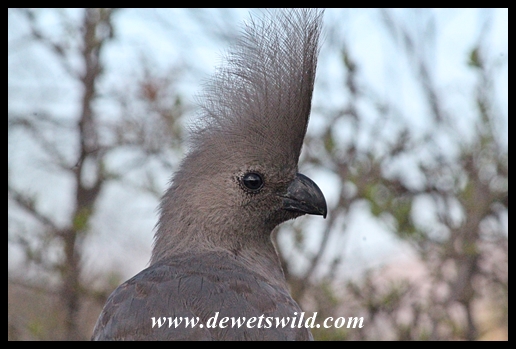
Corythaixoides concolor
Named for its distinctive call, often giving advance warning of approaching danger, the Grey Go-away-bird, or Grey Lourie, is a large (50cm long, weighing up to 300g) and easily recognisable bird occurring in groups numbering from 2 or 3 to as many as 30.
The Grey Go-away-bird inhabits open woodlands and savanna, rich in fruiting trees and with easily accessible water sources, and has of late become increasingly numerous in towns and cities across its range. They feed primarily on fruits and berries, but also consume flowers, nectar, buds, leaves, snails and insects.
Grey Go-away-birds breed throughout the year, with a peak in the spring and summer months. The nests are flimsy constructions of sticks and twigs, and clutches usually consist of two or three eggs (range 1-4). Parental duties of incubation, which takes about 4 weeks, and chick rearing are shared equally between the male and female. The chicks are fed on regurgitated food and can fly when they’re about 35 days old, although they already leave the nest at about three weeks old.
With a stable population distributed over the DRC, Angola, Tanzania, Malawi, Zambia, Mozambique, Zimbabwe, Botswana, Namibia, Swaziland and South Africa, the Grey Go-away-bird is considered of least concern by the IUCN. In South Africa, Grey Go-away-birds can be commonly found in the provinces of Gauteng, North West, Limpopo and Mpumalanga, with a small number in extreme northern Kwazulu-Natal. The population in the Kruger National Park alone is estimated at about 65,000 birds.


 DeWetsWild
Die kwêêêêêêê voël… say no more!! 😉
Jy onthou mooi!
Gorgeous absolutely great pics
Thank you very much, Elle!
Hulle kan darem baie vreet! Mooi foto’s dankie
Jy is reg, Tina – hulle is nogal vraatsugtige boelies wanneer n mens kos uitsit vir die tuinvoels.
I love the tufts on their heads, it makes them appear very mischievous! Seen and heard lots of these in Mpumalanga.
One “mystery” about the grey lourie is why it has now almost totally disappeared from KZN – until the 1970s they were quite common in the north of the province.
I know. As a child we had them in the bush areas of the Bluff in Durban, where I grew up and they would sometimes come into the gardens. But I haven’t seen them on the Bluff for thirty years or anywhere else in KZN. Maybe other birds such as the Indian Mynah have forced them out of their KZN habitat.
A Grey Blue Jay! sounds like he sounds like one also!
The Blue Jay sounds like a very cool bird, Teresa!
Ek onthou hoe opgewonde-bly my liewe buurvrou was toe die eerste kwêvoël in haar tuin opgedaag het, vele jare gelede…voorheen kon mens hulle net in die Wildtuin hoor!
Ek dink ons reaksie was dieselfde, Tannie Frannie – n stukkie Wildtuin in ons tuin! Nou is hulle baie volop in Johannesburg en Pretoria.
Ja! Ek en my kleinseuntjie het ons juis die week aan twee van hulle hoog bo in ons boom verwonder.
Danksy jou goeie beskrywing van hulle nes, kon ek nou sien dat die twee hulle nes in daardie boom gebou het!
Julle is so gelukkig dat julle die kwevoels se broeiproses van naby kan dophou, Tannie Frannie!
Ons is inderdaad!
Kwevoels, Love their crest!
A visit to Kruger wouldn’t be the same without the kwevoels, would it Maurice!?
Together with hornbills they are the antilopes of the sky – can’t miss them!
Beautiful bird! With its plume upright, it reminds me of a cockatiel.
I’ve always thought exactly the same, Lois – our own indigenous cockatiel!
What a lovely bird! I love its appearance and its name!
I hope you listed to its call, Deb?
I couldn’t get the link to work, but I found a YouTube video that featured the call. It’s quite unique!
I’m sorry you had trouble with the link, Deb, but glad you found another way!
What a good looking bird! 🙂
Thanks H.J. It has several cousins that are much more colourful though!