
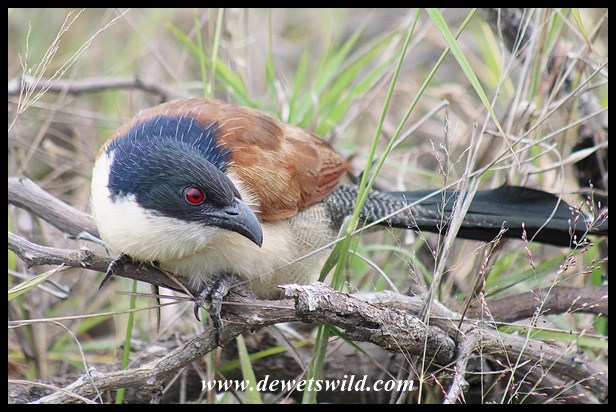
Centropus burchelli
Burchell’s Coucal is a common resident of South Africa’s wetter southern, eastern and northern provinces, where it is usually seen singly or in pairs in riverine thickets, dense, wet grasslands and marshes, reedbeds and densely planted parks and gardens. It is also found in Mozambique, Swaziland and parts of Botswana and Zimbabwe. They are carnivorous birds, preying on a variety of small mammals, birds, eggs, reptiles, amphibians, snails and insects, although they will consume a small quantity of fruit.
Breeding in this species takes place in spring and summer. Pairs are monogamous and males build the pair’s nest in thickets of low trees and shrubs or other dense vegetation. Clutches usually numbering four (range between 2 and 5) eggs are incubated for a little over two weeks, mostly by the male. Nestlings leave the nest at around three weeks old, but are still cared for by their parents for quite some time thereafter.
Adult Burchell’s Coucal grow to a total length of over 40cm and weigh up to 210g. Their distinctive call, like water flowing out of a bottle, is often heard at dawn and dusk. Some authorities consider Burchell’s Coucal to be a race of the White-browed Coucal (C. superciliosus).


 DeWetsWild
ons bly ook in PTA en hier by ons is hulle nie baie skaam nie. Hier het vandag ń kleintjie op die grond beland en ons hondjie het hom aangekeer. Ons het hom gered en het vir hom ń hoendereier oopgebreek. Hy is toegemaak en sal more kyk hoe gaan dit…hy moet net eers oor die skok kom. As iemand raat het hoe om hom te versorg tot hy sterk genoeg is, sal ek dit baie waardeer.
Vleiloerie-kuikens verlaat dikwels die nes voor hulle behoorlik, of selfs enigsens, kan vlieg, Heidi, en kruip dan maar in enige boskasie weg. Dis jammer dat hierdie outjie deur jul hondjie raakgesien is, want sy ouers sou hom goed bly versorg het andersins. Teen hierdie tyd het jul seker al die outjie na n veearts of diere-rehabilitasiesentrum geneem?
Dis ‘n voel wat mens nie sommer maklik sien nie, so asof dit skaam is… ons het dit altyd daar in Eshowe die reenvoel genoem. As jy die roep van die Burchell’s Coucal hoor was dit ‘n teken dat dit gaan reen!
En is dit nie die mooiste roep nie!?
Verseker! 🙂
gorgeous pics
Thank you very much, Stef, and welcome here!
You’re welcome! Thanks for following my blog too. Enjoy:)
Hi guys. I find that you normally hear the coucal before you see it as it is very good at hiding in trees. I have seen them frequently in the Hluluwe/Umfolozi reserves. I don’t think like suburban life!
You’re quite right, Kim – the coucals are very prominent inhabitants of most of the Zululand reserves. We’re lucky to have had a few visits to our garden here in Pretoria, and always so special to hear their call!
It is Kim.
Sincere apologies, Kim!
What a handsome bird. I agree with Lindy. Your posts always illuminate places and wildlife that I would not be able to see or fully appreciate without having you as a guide.
That’s very kind of you, Jane – thank you so much!
Sjoe dis mooi!
Baie dankie, Tina!
I love the red eyes on this bird.
Seems to be one of the Burchell’s Coucal’s most striking features!
Me, too. Very impressive!
Thank you for contributing!
Love that piercing eye!
I don’t think anything edible escapes it unnoticed!
Beautiful bird, and its eyes is red as an albino. The cuckoo we have in Sweden don´t hatch their eggs themselves, they lay eggs in other birds’ nests, and let the other birds do the job. 😀
We have several cuckoo species that employ the same strategy here, John. Why the coucal branch of the family is different I would be very interested to know!
The cuckoos that hatch then puts eggs in same species nest, where they hatched. They also know which kind of birds who find if there are other eggs in the nest, and then abandon the nests.
Breeding parasitism is a fascinating subject!
Love that bird call – those descending notes. Interesting close/up details – that sharp carnivore’s beak!
We’re lucky to hear them here at our home in Pretoria from time to time, and then always long for the bush…
Interesting looking bird!
Most interesting behaviour as well!
I would never see this bird were it not for your excellent informative website. Thanks again!
The pleasure is all ours, Lindy – thanks for visiting!
I like the alert posture of those birds, as if always on the lookout for the next snack. Thanks for another bird profile!
You’ve summed them up perfectly, Maurice. I don’t think they miss anything!
Beautiful!!!
Thank you, Silia, and welcome here!