
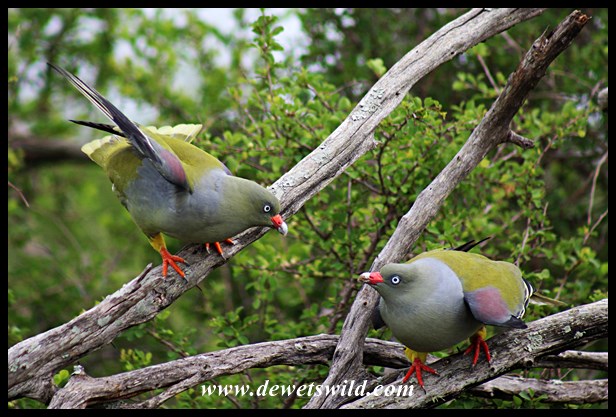
Treron calvus
You’d be forgiven for confusing the African Green Pigeon with a parrot at first glance, especially if you glimpse these colourful birds clambering among the branches or hanging upside down in the canopies of tall trees, foraging for fruit and seeds! African Green Pigeons inhabit forests, woodland, dense savannas (usually along river courses) and well-planted parks and gardens populated by various fruiting trees, showing a special fondness for wild figs (genus Ficus) and jackalberry (Diospyros). Adult African Green Pigeons are between 25 and 29cm long and weigh between 210 and 250g.
African Green Pigeon females build flimsy nests (of twigs and leaves gathered by the male) in the forks of trees at any time of year (with a peak in early summer in South Africa), the female incubating the small clutch (usually only 1 or 2 eggs) for around two weeks. The young pigeons leave the nest around two weeks after hatching. They are gregarious, and occur in small groups or flocks numbering up to 50 or more.
In South Africa, African Green Pigeons are common along the coast in the Eastern Cape, through much of Kwazulu-Natal, and into the bushveld and lowveld regions of Mpumalanga, Limpopo and Gauteng. North of our borders this species occurs widely over tropical Africa south of the Sahara. The IUCN considers them to be of least concern, though noting that loss of habitat and hunting is causing their overall population to decline.


 DeWetsWild
I will take a close up photo and send on to you. Please send me yr email. Any help appreciated. Wish I can get mate for this one. But di not know if it is male or female.🫣
I’m afraid it is impossible to separate the male from the female on external appearance. You’ll need a vet to perform an internal examination, Anne-Mari.
Many thanks. My friend who breeds Mc Caws said he will come and draw blood. But then he got sick praying for his recovery.
It is for sure pigeon pox. I cought him this morning and painted the 2 pox with Iodine and put some collodial silver in his beak and also his water. Busy now disinfecting his big aviary keeping him in parrot cage to do treatments until completely pox free.
Spotted one in our garden this morning Humansdorp
Your garden must be a bird paradise, Kobus!
Please help me!! I’ve been given a Green ‘Parrot’ Pigeon by a friend.
I reasearched what food to give him and did my best to provide him with the same diet. I was told he only eats bananas. I tried all the foods suggested on web but he refuses to eat anything else. I even mixed all the good stuff and made a hole in the banana and stuffed it with the good stuff…he eats around it only the banana. What else can I try? Please help.
Have you tried offering it figs, Anne-Mari? I suppose bananas aren’t all bad for it considering that at least it is a fruit, but I think your predicament is a case in point as to why our wild animals and birds should rather not be kept in captivity as we can’t provide them with the nutrition, space and social interaction they really need. Best wishes.
Thank you kindly for reply.
I do not like to keep animals in cages and the food biggest priority.
I take the inside of banana out with a syringe that I cut off the tip so it makes a neat hole in the middle. I grate apples pears and wild figs freeze it in round tubes and then stuff banana with it. But he is like a naughty child eating banana and leave the inside. I tried all the berries I could lay my hands on but no go.
Het hierdie duiwe die eerste keer gesien in ‘n wonderlike ou wildevyboom in ‘n voorstedelike tuin. Dit was ‘n verruklike oomblik!
Mens staan stomgeslaan dat n duif so mooi kan wees, ne Tannie Frannie?
We also have pigeons in Poland but they are mostly grey. Not at all that colourful as yours 🙂
I’ve seen these down on the Wild Coast about twenty years ago, but none since anywhere. They are very parrot like. Lovely photos.
They’re around, just experts at hiding!
They aren’t in suburban Durban and I don’t go further afield very much anymore to see them. It is nice to think that they are populating the coastal forests together with all the other birdlife, but as you say, their main enemy is habitat destruction.
Sometimes I think that the ‘generic bird’ prototype is presented to various artists in some futuristic studio, and they are told, ‘Have fun! Paint them whatever colors you’d like – the more bizarre the better!’ Then when painting, one artists leans toward another and asks, ‘May I use a bit of that color you just mixed?’ etc etc….
Those bright legs/feet and those stark eyes! What a combo and crazy mix of features!
Great analogy, Lisa! And even with these striking colours, they can hide wonderfully well!
I really love it! 🙂
Striking! I can’t say I’ve noticed any in and around Durban.
That’s just it – they are experts at hiding and easily go unnoticed!
I really like that first shot and how puffed up they are in many of the shots. 🙂
janet
Thanks Janet! I also liked that one where they’re “facing off” the most.
A mossy pigeon! Beautiful birds! We also have ring necked Doves plus regular Pigeons! :).
All our other pigeons and doves pale in comparison to these guys!
Those are very handsome pigeons, much better looking than those commonly seen here. Your photos captured them very nicely!
Thank you very much, Hien!
What beautiful birds!
Indeed Deb!
There are so many beautiful birds in Africa. It’s just amazing to me sometimes. Thanks for sharing!
We’re so glad to know that you find our posts on South Africa’s wildlife so interesting – thank you!
Many beautiful photos you’ve taken on the bird, and they are really colorful. 🙂 You can see that it is related to our pigeons we have here in Sweden, except that our pigeons are not colorful at all, except those who breed them.
They’re by far our most colourful pigeons as well, John
Fantastic bird! I saw them only once in Mokopane ( Potgietersrus). The tree in my front garden was dense with leaves and I could hear movement, went nearer and saw two green pigeons climbing up and down the branches.
That’s how most of our sightings of them also go, Ineke – they’re normally so well camouflaged!