

Procavia capensis
As their name suggests, Rock Dassies are closely associated with rocky habitats, be it mountains, hills, cliffs, ditches, canyons, gorges or just plain heaps of boulders – as long as there is rocks with caves and crevices to hide in, a sufficient supply of food, and a place where they can soak up the sun, Rock Dassies can be found from deserts to forests and from sea level to mountain tops, and even in city suburbs. Rock Dassies are entirely independent of drinking water, and feed on a wide variety of plantmaterial; grass, leaves, flowers, fruit, bark, twigs, roots, bulbs, herbs, and even poisonous plants that would kill other animals are all included in their diet.
Adult Rock Dassies are about 20 – 30cm high and weigh anywhere from 2 to 5.5kg, males being a little larger than the females. Notwithstanding their relatively small size, hyraxes are the closest living relative of elephants!
Rock Dassies live in colonies, usually numbering around 30 but up to 100 or more under favourable conditions, consisting of a dominant, territorial male and a harem of females and their young. Females also have a strict hierarchy and will fight viciously to maintain their place in the rank. Dassies are diurnal, and start their day basking on an exposed rock in the early morning sun. They’re rather lazy and spend only about two hours a day feeding, mostly in the morning and afternoon. While feeding they sometimes move a few hundred meters from their rocky abodes. At night and during the heat of the day they rest in caves and crevices among the rocks. Rock Dassies are excellent climbers, both of rocks and trees, are rather quarrelsome and downright aggressive amongst themselves, have very keen senses and have the remarkable ability to look straight into the sun without any apparent ill effect – a handy adaptation to detect their biggest natural enemy; the Verreaux’s Eagle. While the colony is feeding, one individual is always on guard for the eagles and other predators like leopard, caracal, jackal and other raptors. They’re also persecuted as a pest by many farmers, especially those with small stock. Rock Dassies seldom live past the age of 8 years in the wild, though they can get up to 15 years old in captivity.
Females give birth to between 1 and 6 babies at the end of the rainy season, after a gestation of almost 8 months – unusually long for such a small animal. The babies are weaned between 3 and 5 months after birth, and young males are driven from the colony when they’re about a year old.
Rock Dassies occur widely, if discontinuously due to its habitat requirements, over Africa (including parts of the Sahara) and much of the Middle East. Owing to its exceptionally wide distribution and overall large, stable populations, many of which in well protected conservation areas, and despite hunting pressure in some parts of its range, the IUCN lists the Rock Hyrax as being of least concern. in South Africa they can be found in all provinces, wherever their preferred habitat is available.


A related species with a more restricted distribution in South Africa, the Yellow-spotted Rock Hyrax, will be discussed in an upcoming post on de Wets Wild
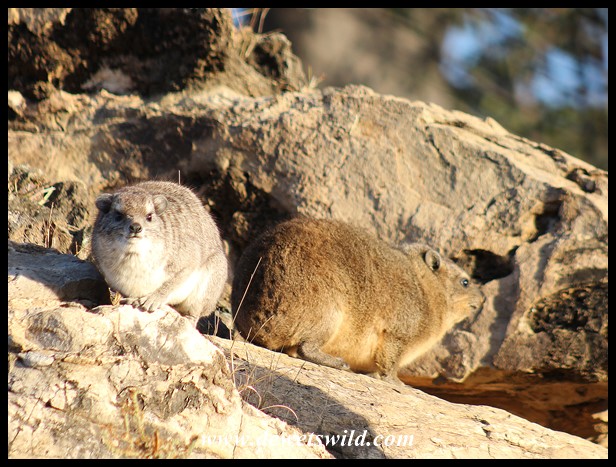
Yellow-spotted Rock Hyrax (left) and Rock Hyrax (right) sharing the sun in Mapungubwe
 DeWetsWild
We have a colony of dassies living in our garden. Once a year when the pups are about four weeks old, adult dassies will attack and kill several babies. It’s very upsetting. Can it be prevented?
What you describe is unfortunately something that is often recorded among captive dassies, knowcats and is thought to be a response to limited space and food resources. While your garden isn’t a captive environment the pressures could be similar. Obviously it wouldn’t be a good idea to try and feed the dassies as that would just allow them to increase their numbers even further and overrun your garden with other unwanted impacts in terms of damage and excrement for a while until the artificially created new population ceiling is reached, at which point the behaviour will resume. Letting nature take its course with as little interference as possible, upsetting as it may be, is probably the best route to take.
Pingback: Limpopo Ramble 2022: Yellow-spotted Rock Dassie | de Wets Wild
Hi guys. I’ve only seen these in KZN Drakensberg. They have such intelligent,inquisitive faces and remind me of the rabbits I had as pets as a child.
They really are very endearing creatures!
Interesting. They don’t look anything like elephants! Sometimes I wonder how these classifications are done.
In dassies and elephants the relationship was first suspected based on similarities in the structure of their teeth and feet, and confirmed in the fossil lineage of both – the first elephant, 60-million years ago, was tiny and looked very mush like a dassie!
They are so cute 😁
They are, but they’ll give you a nasty nip if you try to cuddle them – They’re not your typical touchy feely kind of cute…
I’d never heard of the Rock Dassie, so a really interesting post for me, and I do love rodent-type animals. In a few ways they seem like mere-cats – living in small colonies and having a hierarchy, but obviously a much larger creature. Love the pictures!
And much more quarrelsome! The “meerkat manor” series on television got so much attention, maybe we should start a soap opera called “hyrax house”! 😀
I’ll definitely watch it!
So cute animal! 🙂 It is amazing that animals are so different from each other as rock dassie and elephants, are relatives! The photo where the kid is on her mother’s back is so nice. 🙂
The link Verreaux’s Eagle don´t work.
Thanks a lot John! I admit that the systemics of species relationships is fascinating to me as well!
P.S. The link to the Verreaux’s Eagle will work on Sunday 😉
Can’t believe they are related to elephants! Manatees, too. They look a bit like woodchucks or prairie dogs…. a bit.
Some facts are stranger than fiction, isn’t it Cayenne?
Very true
I saw the name before the photo, I thought I was going to be looking at flowers! lol… Cute little guys! Love their smiles, very similar looking to gophers and marmots ! 🙂 Rock Daisies! ha! ha! ha!
Doesn’t seem that you were too disappointed finding a dassie where you were expecting a daisy, Teresa? 😀
lol.. Not disappointed at all! 🙂
Fascinating! I’ve never seen or heard of this critter. Imagine that- being a relative of elephants… they have no trunks or tusks. (Perhaps they are the lucky ones.)
Always fun to learn something new from the de Wets.
~Jane
It’s a great question for a pub quiz!
Chunky little ones, aren’t they?!
Indeed! Humans that spend most of their day baking in the sun develop a similar “look”
😀
Yes they do!
Adorable! They look similar to the N. American marmot. I bet they are related.
I think the similarities between dassies and marmots are an excellent example of “convergent evolution”, Alanna. They’re not related at all to each other, but exploiting similar habitats and food sources have resulted in both kinds of animals developing similar adaptations to their niche in the ecosystem.