Swainson’s Spurfowl is a fairly large (up to 800g) type of francolin. They are normally encountered in pairs or small groups numbering up to 6 in woodland, savanna, grassland and planted fields, where they subsist on seeds, berries, other plant material and insects.
In South Africa, these birds breed mostly in summer and autumn, although nesting has been recorded throughout the year. Nests are well-hidden scrapes in the ground in which up to 7 eggs are laid.
Swainson’s Spurfowl is a common resident of South Africa’s northern provinces (Kwazulu-Natal, Free State, Gauteng, North West, Limpopo and Mpumalanga). Outside of our borders they occur in Lesotho, Swaziland, Angola, Namibia, Botswana, Zimbabwe, Mozambique and Zambia, and marginally into Malawi. Despite being hunted as food, the IUCN considers Swainson’s Spurfowl as being of “Least Concern” owing to an abundant and aparently stable population.
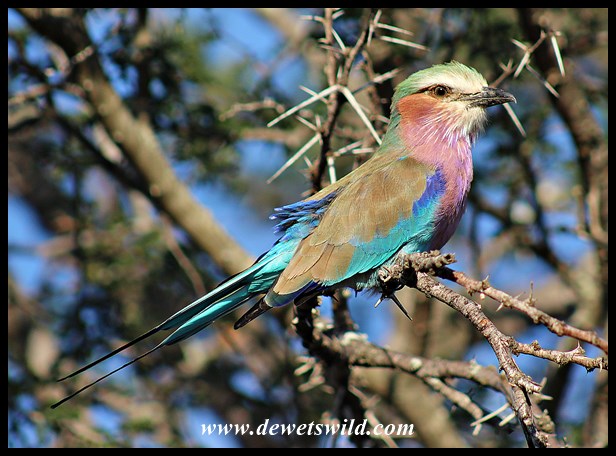
Few people would fail to be impressed by the beautiful plumage of the Lilac-breasted Roller, especially when seeing those electric colours swooping past in flight!
Lilac-breasted Rollers are inhabitants of the more open woodlands and savannas, often perching quite conspicuously on trees or poles, either singly or in pairs. They are mostly insectivorous in diet, though they will also take small reptiles, frogs, small birds and rodents when the opportunity arises. They’re often seen at veldfires, hawking the small prey items trying to escape the flames. They are acrobatic fliers, hence the name.
Pairs are monogamous and strictly territorial. In South Africa, this species breeds mostly in spring, nesting in abandoned holes made by other birds and animals in trees. Clutches contain 2-4 eggs and are incubated by both parents for just over three weeks.
These colourful birds are common residents of Eastern and Southern Africa, and considered of “least concern” by the IUCN. In South Africa they can be found from Northern Kwazulu-Natal through Mpumalanga, Limpopo Province, the North of Gauteng and North-West Province to the Kalahari regions of the Northern Cape.
The Northern Black Korhaan is a species of open grassland, dry savanna and semi-arid scrub. They feed primarily on insects and other invertebrates as well as seeds. Adults can weigh up to a kilogram.
Male Northern Black Korhaans are fiercely protective of their territory and attempt to mate with as many females as possible, whom they attract by an elaborate courtship dance. Females incubate the clutch (1-3 eggs) for about three weeks and then raise the chicks on their own. They don’t construct a nest, instead laying their eggs directly on the ground among tufts of grass, often under small thorn bushes. Most chicks are raised in the spring and summer.
Northern Black Korhaan occur on South Africa’s central Highveld, principally the provinces of the Eastern and Northern Cape, Northwest, Free State, Limpopo, Mpumalanga and Gauteng. Its range also extends into Botswana and Namibia. The IUCN considers the species of “least concern” as it has a stable population and appears to be common throughout its range.
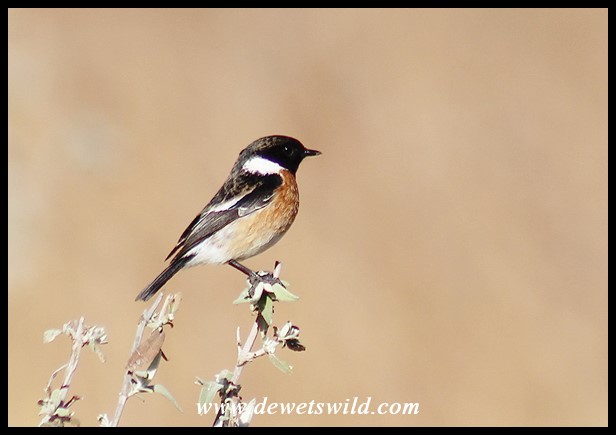
African Stonechats generally inhabit higher altitude grasslands with long, rank growth, though in South Africa they also occur down to sea level in suitable habitat, and especially so during the colder winter months. The African Stonechat has also adapted very well to large scale agriculture, though they avoid overgrazed areas. They feed mainly on small insects and other invertebrates. These are active little birds, only 13cm long and weighing only 12 – 17g.
African Stonechats are usually seen in pairs, and breeding occurs in spring and summer. Females build their nests of grass and softer material in the shape of a deep cup, usually positioned on the ground at the base of a bush or other plant providing good cover. Clutches, containing up to 6 eggs, are incubated only be the female for a period of two weeks, but both parents feed the chicks once they’ve hatched. Chicks leave the nest at about two weeks of age, and then stay with their parents for a further three weeks or so.
The African Stonechat is a common sight in South Africa, occurring all over the country with the exception of the arid interior of the Northern Cape Province. They are also patchily distributed over East and Central Africa, and is considered common throughout its range.
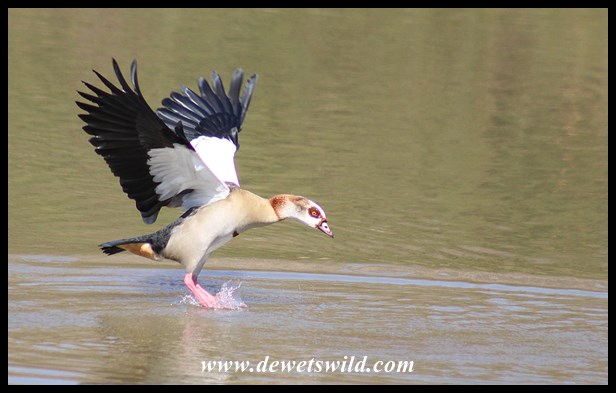
The well-known Egyptian Goose is a large (up to 3.5kg) duck that is probably South Africa’s most numerous waterfowl species.
Egyptian Geese inhabit almost every freshwater habitat, preferring rivers and waterbodies with open shorelines within easy reach of open fields for grazing. Their diet is mostly vegetarian, particularly including grasses and cultivated crops (which is why they are regarded as pests in some parts of their range).
Outside of the breeding season, which in South Africa mainly stretches from late winter to early summer, Egyptian Geese can be found in large flocks of hundreds, even thousands, especially so while moulting (which leaves them flightless for about a month). In the breeding season however pairs are more solitary in habit, viciously defending small territories around their nests and goslings from others of their kind. Nests, lined with plant material, are bult in a variety of places ranging from shallow depressions hidden on the ground in thick vegetation to burrows, the abandoned nests of other large birds, holes in trees, cliffs, caves and buildings. Pair bonds often last for life, and the females incubate the clutch of 5 to 11 eggs for about 4 weeks. Chicks hatched in elevated nests have to jump out after hatching, responding to the call of their mother below, and then follow the parents to water. Both parents take care of the young, which start flying at around 10 weeks of age.
The IUCN considers the Egyptian Goose as being of “Least Concern“, having a large (though likely decreasing) population distributed over most of Sub-Saharan Africa, with introduced or feral populations in many other parts of the world. Ironically they no longer occur on the lower Nile, where they were once considered sacred by the ancient Egyptians. They are however a very familiar sight all over South Africa.








 DeWetsWild