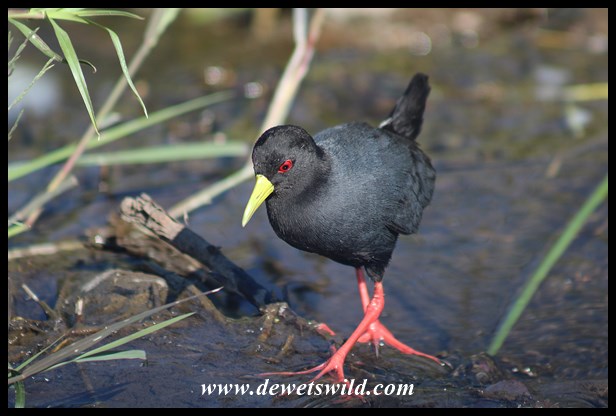
The Black Crake is a small (90g), diurnal species and not as shy as many of their close relatives, often emerging quite confidently into the open. They are mostly seen in pairs or small family groups, inhabiting densely vegetated wetlands and streams. These crakes subsist on aquatic invertebrates, small fish, frogs and tadpoles as well as seeds and waterplants.
Black Crakes breed throughout the year, with a peak in summer. The nest is a cup of plant material floating on or suspended just above the water, or built on the ground in a safe, densely vegetated area, in which between 2 and 6 (usually 3) eggs are laid and incubated for almost three weeks by both parents. While breeding they become extremely aggressive, even taking on birds much larger than themselves. Juveniles from previous broods often assist in raising the current clutch, which can fly from about 6 weeks old and become independent shortly thereafter.
The Black Crake occurs over all of Sub-Saharan Africa with the exception of the most arid areas. The IUCN estimates their population at 1-million and lists the species as least concern. In South Africa they are considered a common resident, absent only from the dry Karoo and Kalahari regions the Eastern, Northern and Western Cape Provinces.
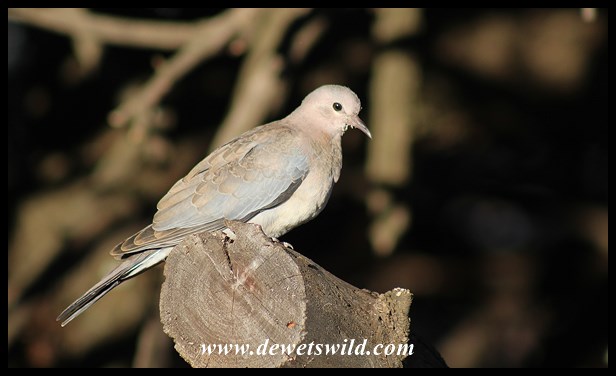
Occurring over the entire country, most South Africans would be familiar with the Laughing Dove as a common garden bird (to the point of being considered a pest by many). They inhabit a wide range of habitats, avoiding only forests and deserts, and being very much associated with human habitation. They feed primarily on the ground, pecking up small seeds and to a lesser extent include fruit and insects in their diet.
Laughing Doves usually forage in pairs or small groups, though larger aggregations may form at abundant food or water sources. Nests, built by both parents, are flimsy constructions of twigs in trees, against buildings or under roofs, in which clutches of two eggs are incubated by both sexes. The eggs hatch after two weeks, and the chicks fledge after about the same time. They nest throughout the year, with a peak in spring and summer.
The Laughing Dove has a wide distribution across Africa, through the Middle East to the Indian subcontinent, with an apparently stable population estimated at as many as 8-million, which is why the IUCN considers the species to be of least concern.
The Chacma Baboon is the biggest wild primate occurring in South Africa. Males can weigh up to 50kg, while females are more lightly built and weigh up to 28kg.
Evil-looking juvenile Baboon
Pensive baboon
Baby baboon missing out on attention
Baboons abound along the Sabie
Baboon near Satara
Baboon smile
Young baboon
Chacma Baboon
Coy Baboon (photo by Joubert)
Baboons grooming
Sleepy Baboon
Baboon
Young Chacma Baboons
Baboons can be found in virtually any habitat, provided there is a reliable supply of drinking water and safe places to sleep at night (usually in the form of tall trees, cliffs or caves). They are equally easy to please when it comes to their diet, taking fruit, berries, grass, leaves, flowers, mushrooms, roots and tubers, insects, scorpions, snails, eggs, small birds, reptiles and mammals (including the lambs of antelope) and, along the coast, molluscs, crayfish, crabs, etc. Unfortunately they quickly learn that humans and their waste is an easy source of food, and in many reserves, towns and cities have become quite adept at raiding human habitations.
Bold baboons frequent the camp at Giant’s Castle
And then quickly grabbing a loaf of bread from an unguarded kitchen
Preparing for their early morning raid on the camp
Baboon
Baboon scratching for grass roots
Baboon acrobats
Baboons
Baboons are a common sight at Giant’s Castle
Thirsty Baboon
Surveying the landscape
Baboons taking a swim on a hot day
Baboon
Baboons at Umbondwe Picnic Spot
Chacma Baboon on a cliff-face
Baboons at Umbondwe Picnic Spot
Chacma Baboon
You stuck what in there!?
Baboons frequent the camp in the mornings
Chacma Baboons keep to large troops, some over 300 animals in size, in which a strict hierarchy is maintained, sometimes through violent fights. This dominance hierarchy determines where an individual will feature when it comes to access to food, water, sleeping spots and mating partners. They also forge alliances and friendships strengthened by mutual grooming. Lower ranking adult males take turns to act as sentinels on the look-out for danger. Chacma Baboons are diurnal and mainly terrestrial and troops can cover as much as 15km in a day while foraging. Because they have such keen senses Baboons are often accompanied by other herbivores.
Bold baboons frequent the camp at Giant’s Castle
Baboon
Time for some mutual grooming before the game begins
Playful baboons at Kumasinga
Playful baboons at Kumasinga
Playful baboons at Kumasinga
Playful baboons at Kumasinga
Roofing thatch apparently make wonderful toys for little baboons
The big males are the most confident
Baboon
Baboons
A huge troop of baboons
Baboon beauty treatment
Baboons often pass through camp looking for scraps and stealing from the accommodation units
Male Baboon taking a break
Fast asleep in the early morning sun
Male Baboon taking a break
Baboons have learnt that unlocked cars could be an easy source of food
Yawn!
Baboon escaping from a chalet at Thendele Camp
Chacma Baboon
Time for grooming
Wet Baboon after a rainstorm
Baboon surveying the landscape
Baboons having fun at Lengau Dam
Baboons having fun at Lengau Dam
Baboons having fun at Lengau Dam
Baboons relaxing in the shade
Baboons settling in for the night
Baboon
Baboons huddling together in the rays of early morning
Baboon
Young Baboon disliking the attention of human onlookers (photo by Joubert)
Young Baboon
Chacma Baboon
Baboons
Baboon troop
Baboons
Female Baboons give birth to single young (rarely twins) at any time of the year. Newborn babies hang from their mother’s tummy when she’s walking, while older babies ride on her back like a jockey. Youngsters remain dependant on their mother until they are at least a year old. Females remain in their maternal troop when they reach adulthood, while young males join other troops. All animals in the troop are extremely protective of babies, and when attacked by a predator the large males will usually launch a counter attack. Leopards are the main threat to adult baboons, but they are not easy prey by any means. Chacma Baboons have a life expectancy of up to 45 years in the wild.
Like father, like son. Baboon spectators at Kumasinga
Baby baboon getting a piggy-back ride
Baby Baboon getting a piggy-back ride
Baboon jockey
Shingwedzi jungle-gym
Shingwedzi jungle-gym
Shingwedzi jungle-gym
Shingwedzi jungle-gym
Shingwedzi jungle-gym
Shingwedzi jungle-gym
Baboon family life
Baboon mothers make excellent vantage points!
Young Baboons hang from their mother’s tummy
Older babies ride on mom’s back like jockeys
Young Chacma Baboon
Young Baboons love playing
Sibling bonding
Baboon youngsters at speed!
Baboon youngster
Levitating Chacma baboon youngster
Female Baboon in oestrus
Baboons
Chacma Baboons
Chacma Baboons (photo by Joubert)
Chacma Baboons (photo by Joubert)
Chacma Baboons (photo by Joubert)
Chacma Baboons (photo by Joubert)
Baboons on the roof of the reception office at Potberg
Baboons are probably the most easily seen mammal in Giant’s Castle, as they move through the Rest Camp daily
A pair of mating baboons high in the mountains
Baboons are probably the most easily seen mammal in Giant’s Castle, as they move through the Rest Camp daily
Baboons are probably the most easily seen mammal in Giant’s Castle, as they move through the Rest Camp daily
Baboons are probably the most easily seen mammal in Giant’s Castle, as they move through the Rest Camp daily
Baboons use precarious beds
Baboons use precarious beds
Baboon chasing a Black-backed Jackal
Baboon
Baby baboon
Baboon
Baboon sentry
Baboon
Young Baboon
Curious baby Baboon
Baboons
Baboon
Chacma Baboon
Chacma Baboon
Baboons
Baboons in Mapungubwe National Park
Baboon feeding on water plants in Mapungubwe National Park
Baboons in Mapungubwe National Park
Baboons in Mapungubwe National Park
Baboons in Mapungubwe National Park (photo by Joubert)
Chacma Baboon
Male Baboon clinging to a log for his afternoon nap
Baboon spa treatment
Chacma Baboon
Chacma Baboon
Baboons occurring in neighbouring countries north of the Limpopo belong to a different subspecies, P. u. griseipes, and have a slight yellowish tinge to their fur.
Baboon of subspecies Papio ursinus griseipes
Baboon of subspecies Papio ursinus griseipes
Baboon of subspecies Papio ursinus griseipes
Baboon of subspecies Papio ursinus griseipes
Baboon of subspecies Papio ursinus griseipes
Baboon of subspecies Papio ursinus griseipes
Baboon of subspecies Papio ursinus griseipes
Baboon of subspecies Papio ursinus griseipes
Baboon of subspecies Papio ursinus griseipes searching for seeds in elephant dung
A denizen of rivers, wetlands, lakes, lagoons, estuaries, dams, ponds and pans with still water and surrounded by dense vegetation, the Red-knobbed Coot follows an omnivorous diet of aquatic plants, algae, molluscs, crustaceans, insects and the eggs of other waterbirds. Adults can weigh up to 1kg.
Red-knobbed Coots are solitary breeders, pairs establishing a territory in which to raise their young. They are very aggressive, both towards their own kind and other species of waterfowl. in South Africa they breed at any time of the year. Nests are platforms built of aquatic plant material on open water or among emergent vegetation. When not breeding they are more gregarious, occasionally congregating in flocks that number more than a thousand birds.
The Red-knobbed Coot has a wide distribution in East and Southern Africa and a population estimated at over a million, though declining mostly through habitat loss, and considered of Least Concern by the IUCN. There is an isolated, threatened population in Morocco and Southern Spain. They can be found commonly all over South Africa where suitable habitat exists, including on farm dams and rivers in the arid west of the country, expanding their range in response to the building of suitable artificial waterbodies.
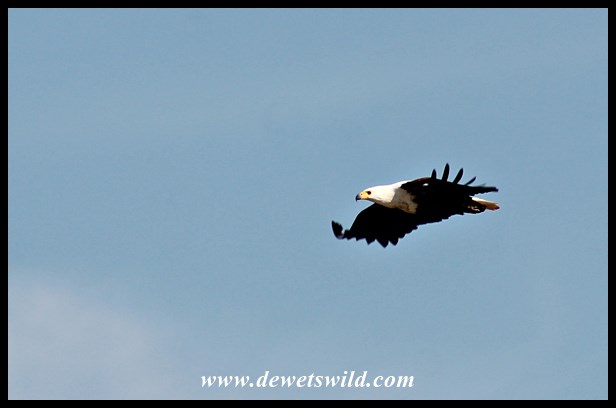
If there is one sound that is symbolic of Africa’s waterways, it must be the call of the African Fish Eagle. It is the national bird of several African countries, and the South African presidential jet carries its Zulu name Inkwazi. They occur over almost all of Sub-Saharan Africa in close association with rivers, lakes, dams, swamps, estuaries and lagoons. As can be deduced from their name, African Fish Eagles subsist mainly on a diet of fish (weighing up to 2kg) snatched from the water in flight, though they will also catch baby crocodiles, terrapins, small mammals and other birds (up to the size of flamingos), scavenge the catches of other waterbirds like storks and herons and feed on carrion. Adults can weigh over 3kg and have a wingspan of almost 2.5m.
African Fish Eagle pairs are monogamous, pair for life and maintain their territories year-round, nesting in tall trees or on cliffs near water. Their nests are large, built of twigs and reeds. In South Africa the breeding season coincides with the drier months of the year, when fish are easier to catch in dwindling pools. Clutches contain up to three eggs, and are incubated mostly by the female for about 6 weeks. The parent birds are usually successful in raising all their chicks to fledging at about two-and-a-half months of age, whereafter the young stay with their parents for another three months or so. Newly independent juveniles often congregate in flocks that can number as many as 75 birds. African Fish Eagles have a life expectancy of up to 24 years in the wild.
The IUCN lists the African Fish Eagle as being of Least Concern, siting its large, stable population estimated at about 300,000, wide distribution and no real threat from humans. They can be found in all South Africa’s provinces – even penetrating the arid west along the course of the Orange River and its tributaries.
African Fish Eagle on the Letaba River
African Fish Eagle
African Fish Eagle flypast
African Fish Eagle
African Fish Eagle in low-level flight over Midmar
African Fish Eagle
African Fish Eagle
African Fish Eagle
African Fish Eagle
African Fish Eagle
African Fish Eagle
African Fish Eagle
African Fish Eagle
African Fish Eagle
African Fish Eagle
Immature Fish Eagle at Batlhako Dam
Immature Fish Eagle in flight
Immature African Fish Eagle
African Fish Eagle
African Fish Eagle
Fish Eagle taking off (Photo by Joubert)
African Fish Eagle
African Fish Eagle
Fish Eagle (photo by Joubert)
African Fish Eagle
African Fish Eagle in flight with nesting material
African Fish Eagle
Immature African Fish Eagle
African Fish Eagle
African Fish Eagle
Young Fish Eagle overhead
Fish Eagle
Fish Eagle in flight
Fish Eagle keeping watch over a pool in the Nwaswitsontso.
African Fish Eagle in flight
African Fish Eagle
African Fish Eagle
African Fish Eagle (photo by Joubert)
African Fish Eagle
African Fish Eagle
Fish Eagle (photo by Joubert)
Fish Eagle with prey
Adult African Fish Eagle in flight
Immature African Fish Eagle in flight
Fish Eagle (photo by Joubert)
African Fish Eagle in flight over the Nuwejaars Wetland
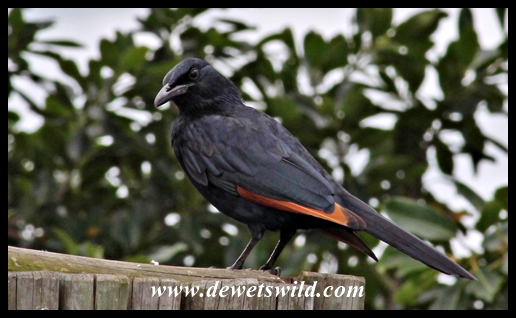
The Red-winged Starling is an omnivorous species feeding on a wide range of seeds, fruits and berries, nectar, invertebrates (even pecking parasites from large mammals), small vertebrates (such as the hatchlings of other birds) as well as carrion and human waste.
These large starlings (30cm long, weighing up to 150g) are closely associated with cliffs and rocky hills and mountains, occurring in a wide range of mesic vegetation types wherever these favoured breeding sites are to be found. They have also adapted to built-up environments, where they use buildings as artificial nesting sites. Monogamous pairs of Red-winged Starlings stay together for years, are territorial when breeding and aggressively protect their nests, even against humans. The nest is built of mud, twigs and grass on a ledge, and the female is responsible for incubating the 2 to 4 eggs over a period of about two weeks. Hatchlings fledge at about a month old. Outside of the summer breeding season they are highly gregarious and congregate in large flocks.
The Red-winged Starling commonly occurs in a band stretching from Ethiopia to South Africa and is considered of least concern by the IUCN, with a growing population as it continues to exploit man-made habitats. In South Africa this species can be found in the south, east and north of the country, being entirely absent from the arid parts of the Northern Cape. It is regarded a pest in orchards.
Red-winged Starling
Red-winged Starling atop a boulder
Red-winged Starling chick waiting for his parents
Male Red-Winged Starling
Female Red-Winged Starling
Female Red-winged Starling on her nest at our cottage
Female Red-winged starling
Red-winged starling looking after our car
Red-winged starling
Red-winged Starlings
Red-winged starling
Red-winged starling
Red-winged Starling
Female Red-winged Starling
Red-winged Starling
Red-winged Starling
Red-winged Starling
Red-winged Starling
Red-winged Starling
Red-winged Starlings raiding Village Weaver nests, presumably for nesting material
The Yellow-billed Duck is a common and widespread species of dabbling duck, found on or near almost any fresh water habitat, including farm dams, flooded grasslands, slow-flowing rivers and seasonal pans, and sometimes in brackish environments like estuaries. They avoid fast-flowing rivers. These ducks are omnivorous, feeding on terrestrial and aquatic plants, including crops, as well as insects, crustaceans and molluscs. Adults weigh around 1kg.
During the moult (which lasts for about 4 weeks at the end of the summer) or in times of drought they can congregate in flocks of up to 5,000, dispersing again at the onset of the rainy season to then be seen mostly as pairs or in small groups. Yellow-billed Ducks are mostly nocturnal, feeding from dusk to dawn.
Breeding takes place at any time of year, with a peak in summer. Nests are built of plant material lined with down, near to the water and on the ground in dense vegetation. Clutches contain up to twelve eggs. Only the female incubates the eggs and cares for the chicks. The eggs hatch after about a month and the female then leads the ducklings to the water. The ducklings can fly by the time they are two months old.
It is estimated that there are at least 100,000 Yellow-billed Ducks in South Africa, where they commonly occur almost everywhere except in parts of the arid west of the country. The construction of artificial impoundments has certainly benefited this species, aiding an increase both in their range and populations. North of our borders they occur throughout East and Central Africa, and thanks to their wide distribution and large, stable populations are considered of least concern by the IUCN. Hybridization with feral populations of the exotic Mallard is cause for concern however, especially in South Africa.
Yellow-billed Duck
Yellow-billed Duck
Yellow-billed Duck
Yellow-billed ducks
Yellow-billed Duck fleeing the area
Yellow-billed Duck
Yellow-billed Duck
Yellow-billed Duck
Yellow-billed Duck
Yellow-billed Duck
Yellow-billed Duck
Yellow-billed Duck
Yellow-billed Duck
Yellow-billed Duck
Yellow-billed Duck
Yellow-billed Duck family
Yellow-billed Ducks
Yellow-billed Duck
Yellow-billed Ducks
Yellow-billed Ducks
Yellow-billed Ducks
Yellow-billed Duck
Yellow-billed Ducks
Yellow-billed Duck at Austin Roberts Memorial Bird Sanctuary
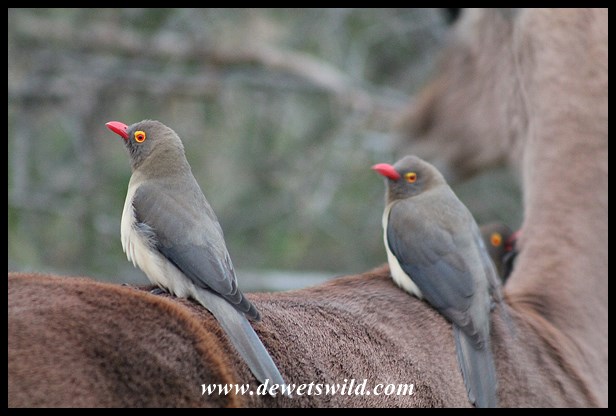
Red-billed Oxpeckers subsists almost entirely on a diet of ticks and their larvae, maggots and other ecto-parasites, picked from the hides and orifices of large mammalian herbivores. They will however also peck at open wounds to feed on the blood. They are therefore closely associated with savannas and woodlands inhabited by good numbers of these large host animals, associating especially with the hairier game species like giraffes and antelope, as well as cattle and donkeys. Adults are about 20cm long and weigh around 50g.
At night, Red-billed Oxpeckers sleep in small flocks in trees, being especially fond of lalapalms. These birds nest in holes in trees lined with the fur of wild and domesticated mammals, particularly in the wet summer months. Usually there are three eggs in a clutch, incubated by both parents.
Red-billed Oxpeckers occur from Eritrea southwards to South Africa, where they can be found in the provinces of Kwazulu-Natal, Mpumalanga, Limpopo, Gauteng and Northwest, while an isolated population seems to have become established in the Eastern Cape as well. The eradication of wild game and the dipping of cattle has a detrimental impact on the food supply of the Red-billed Oxpecker, causing their populations outside protected areas to decline and, while the IUCN still views it as being of Least Concern, they are considered Near Threatened in South Africa and regularly reintroduced to reserves in areas from which they were previously exterminated.
Red-billed Oxpecker
Kudu bull with an oxpecker irritation
Red-billed Oxpecker clinging to a kudu
Red-billed Oxpecker climbing into a zebra’s ear
Red-billed oxpeckers
Buffalo and oxpecker in discussion
Red-billed oxpeckers on a giraffe’s back
Immature red-billed oxpecker on juvenile impala
Red-billed oxpeckers
Red-billed Oxpecker
Red-billed Oxpecker
Red-billed Oxpeckers pecking at an open wound on a buffalo
Red-billed Oxpecker
Red-billed Oxpecker
Red-billed Oxpecker
Red-billed Oxpecker
Red-billed Oxpecker
Red-billed Oxpecker
Red-billed Oxpecker
Red-billed Oxpecker
Sleepy buffalo and red-billed oxpecker
Red-billed Oxpeckers
Red-billed Oxpecker
Red-billed Oxpeckers
Red-billed Oxpecker
Red-billed Oxpecker
Red-billed Oxpeckers
Red-billed Oxpeckers
Red-billed Oxpecker
Red-billed Oxpecker
Red-billed Oxpeckers
Red-billed Oxpeckers
Red-billed Oxpecker
Red-billed Oxpecker
Red-billed Oxpecker
Red-billed Oxpecker on buffalo
Red-billed Oxpecker lining nest with fur
Red-billed Oxpecker
Red-billed Oxpecker
Red-billed Oxpecker
Red-billed Oxpecker juvenile
Red-billed Oxpecker juvenile
Red-billed Oxpecker (photo by Joubert)
Red-billed Oxpecker (photo by Joubert)
Red-billed Oxpecker
Young Red-billed Oxpeckers
Red-billed Oxpecker
Red-billed Oxpeckers and flies hanging around the back of a White Rhino
Red-billed Oxpecker (photo by Joubert)
Red-billed Oxpeckers
Impala ewe with a heavy load of red-billed oxpeckers
Impala ewe that’s had enough of free-loading Red-billed Oxpeckers (photo by Joubert)
Red-billed Oxpecker diving into a White Rhino’s ear
The Southern Masked Weaver is a common inhabitant of savannas, woodlands, grasslands, riverine thickets in arid areas, and suburban gardens, feeding on insects, nectar and seeds.
The breeding season stretches through spring and summer, when the males don their brilliant black-and-yellow plumage and try to breed with as many females as possible, attracting them with neat nests weaved of grass or palm throngs on thin twigs or reeds (or wires and fences), usually hanging over water. Southern Masked Weavers normally move around singly or in small groups, but breed colonially. Only the female incubates the clutch and rears the chicks.
Considered a cunning creature of tricks and magic in local folklore and reviled by small stock farmers, Black-backed Jackals are the most common canid occurring in South Africa. Easily recognisable by their black-and-silver “saddles”, these jackals stand between 30 and 48cm high at the shoulder and weigh between 5 and 13kg.
Black-backed jackal
Black-backed jackal
Black-backed Jackal trying to hide from the camera
Hiding jackal pup
Black backed jackal
Black-backed jackal
Black-backed Jackal
Black-backed Jackal
Black-backed Jackal
Black-backed Jackal (photo by Joubert)
Black-backed Jackal
Black-backed Jackal with a bullfrog
Black-backed Jackals have a very wide habitat tolerance, and can be found from desert coasts to high mountain ranges, though they prefer drier, more open country and avoid forested areas. They are even known to live in the suburbs of many towns and cities. They are equally catholic in their diet and there’s very little that a Black-backed Jackal will not eat. Where they share their range with large predators, like lions, leopards and cheetahs, carrion makes up a large proportion of their intake, though they are quite capable hunters and will prey on anything from invertebrates to fish, reptiles, birds and small mammals up to medium-sized antelope like the springbok and seal pups. They will also eat berries, fruit and rizomes. Black-backed Jackals are independent of drinking water, but will drink when it is available.
Black-backed Jackal nervously approaching the carcass
Black-backed jackal
Black-backed jackal scaling a rocky outcrop
Daring jackals at a lion kill, seen on a night drive from Satara
Playful jackal pups
Black-backed jackal setting out to forage at dusk
Black-backed jackal
Black-backed jackal
Black-backed jackal are quite common near Orpen
Wet black-backed jackal
Black-backed jackal silhouette
Jackal jumping to catch a mole
Two jackals squabbling over a carcass
Black-backed Jackal in typical open habitat
Black-backed Jackal
Black-backed Jackal jumping after a rodent in long grass
Black-backed Jackals at Mavuso’s carcass
King of the castle: Black-backed Jackal at Mavuso’s carcass
Black-backed Jackals fighting over scraps
Black-backed Jackal
Black-backed Jackal (photo by Joubert)
Black-backed Jackals are nocturnal animals, usually emerging at dusk and returning to their dens at dawn, though they may at times be active throughout the day, and especially so in overcast weather. By day they sleep in thickets, caves or holes dug in the ground by other animals, The normal social grouping consists of a mated pair with their offspring, often of consecutive litters, defending fairly large territories. Apart from being very clever animals, Black-backed Jackals are quite brave and tenacious, and will even mob lions and hyenas on a carcass.
Black-backed Jackal
Black-backed Jackal
Black-backed Jackal
Black-backed jackal saying his morning prayer?
Black-backed jackal at Satara
Black-backed jackal
Black-backed jackal
Black-backed jackal
Black-backed Jackal
Black-backed Jackal
Black-backed Jackal
Black-backed Jackal
Black-backed Jackals
Black-backed Jackal
Black-backed Jackal (photo by Joubert)
Black-backed Jackals pairs usually have litters of 3-4 pups born on late winter or spring after a short 2 month gestation. Previous litters help the dominant pair to raise the youngest offspring by bringing food to the den (usually a cave or hole in the ground). Black-backed Jackals often fall prey to larger carnivores (leopards are especially fond of jackal meat), are also very susceptible to mange, distemper and rabies, and have a life expectancy of only 6 to 14 years in the wild.
Black-backed jackal at Tinhongonyeni, near Mopani
Leopard hunting jackals
Black-backed jackal
Black backed jackal
Black-backed jackal at the turnoff to Tamboti
Jackals suffering from mange
Black-backed Jackal
Black-backed Jackal seen from the hide at Nossob
Black-backed Jackal
Black-backed Jackal at Shipirivhiri Waterhole
Black-backed Jackal
Black-backed Jackal
Black-backed Jackal
Black-backed Jackal
Shy Black-backed Jackal
Black-backed Jackal
Black-backed Jackal
Black-backed Jackal
Black-backed Jackals
Black-backed Jackal
Black-backed Jackal
Black-backed Jackal
Black-backed Jackal
Black-backed Jackal
Black-backed Jackal
Black-backed Jackal
Black-backed Jackal and Blesbok
Black-backed Jackal
Black-backed Jackal
Black-backed Jackal
Black-backed Jackal
Black-backed Jackal pup
Black-backed Jackal
Black-backed Jackal
Black-backed Jackal
Black-backed Jackal
The IUCN considers the Black-backed Jackal as being of least concern, being common with a stable population over most of its distribution in East and Southern Africa, despite being persecuted as vermin by farmers. They occur all over South Africa, though they are understandably much easier to see in conservation areas than in farming communities. In our experience good places to go looking for Black-backed Jackals are the Kruger National Park (especially around Satara), Addo Elephant, Golden Gate, Marakele and Pilanesberg National Parks, Giant’s Castle in the uKhahlamba Drakensberg Park, and Rietvlei Nature Reserve.
Black-backed Jackal
Black-backed Jackal
Black-backed Jackal eating from the carcass of a Spotted Hyena
Black-backed Jackal
Black-backed Jackal
Black-backed Jackal
Black-backed Jackal
Black-backed Jackal
Black-backed Jackal
Black-backed Jackal
Baboon chasing a Black-backed Jackal
Black-backed Jackal
Black-backed Jackal
Jackal testing a lion’s patience
Black-backed Jackal
Black-backed Jackal
Black-backed Jackal couple.
Black-backed Jackal
Black-backed Jackal
Black-backed Jackal
Black-backed Jackal
Black-backed Jackal
Black-backed Jackal
Black-backed Jackal
Black-backed Jackal
Black-backed Jackal
Black-backed Jackal
Black-backed Jackal
Black-backed Jackal
Blesbok eyeing a Black-backed Jackal with some suspicion
Black-backed Jackal
Black-backed Jackal
Black-backed Jackal
Black-backed Jackal looking for a little shade at Tihongonyeni
Black-backed Jackal and Blue Wildebeest at Mooiplaas
Black-backed Jackal
Black-backed Jackal (photo by Joubert)
Black-backed Jackal
Black-backed Jackal
Black-backed Jackal
Black-backed Jackal
Black-backed Jackal
Black-backed Jackal
Black-backed Jackal
Black-backed Jackals
This warthog family almost ran straight into the jackal!











 DeWetsWild