
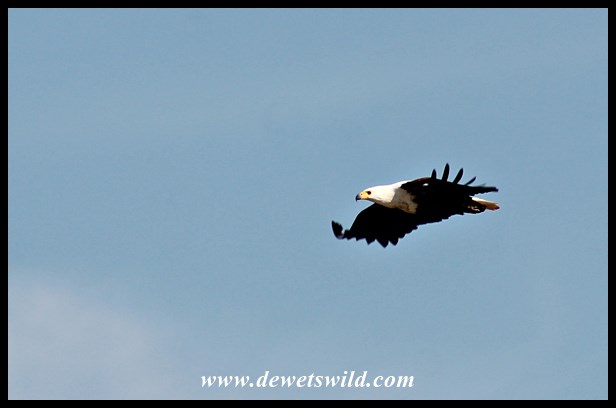
Haliaeetus vocifer
If there is one sound that is symbolic of Africa’s waterways, it must be the call of the African Fish Eagle. It is the national bird of several African countries, and the South African presidential jet carries its Zulu name Inkwazi. They occur over almost all of Sub-Saharan Africa in close association with rivers, lakes, dams, swamps, estuaries and lagoons. As can be deduced from their name, African Fish Eagles subsist mainly on a diet of fish (weighing up to 2kg) snatched from the water in flight, though they will also catch baby crocodiles, terrapins, small mammals and other birds (up to the size of flamingos), scavenge the catches of other waterbirds like storks and herons and feed on carrion. Adults can weigh over 3kg and have a wingspan of almost 2.5m.
African Fish Eagle pairs are monogamous, pair for life and maintain their territories year-round, nesting in tall trees or on cliffs near water. Their nests are large, built of twigs and reeds. In South Africa the breeding season coincides with the drier months of the year, when fish are easier to catch in dwindling pools. Clutches contain up to three eggs, and are incubated mostly by the female for about 6 weeks. The parent birds are usually successful in raising all their chicks to fledging at about two-and-a-half months of age, whereafter the young stay with their parents for another three months or so. Newly independent juveniles often congregate in flocks that can number as many as 75 birds. African Fish Eagles have a life expectancy of up to 24 years in the wild.
The IUCN lists the African Fish Eagle as being of Least Concern, siting its large, stable population estimated at about 300,000, wide distribution and no real threat from humans. They can be found in all South Africa’s provinces – even penetrating the arid west along the course of the Orange River and its tributaries.


 DeWetsWild
Pingback: Hali the Fish Eagle | de Wets Wild
Very informative. The pictures are impressive, too.
Thanks very much Cayenne, and welcome here!
Also, if you want you can check out my blog too
Already did, and signed up to follow!
Awesome, thanks!
Ai… om weer daai roep te hoor!! EEndag… 😉
Sjoe ja, AJ, dis darem maar n klank wat so in ons ingebore word hier in Afrika!
Beautiful bird. Yesterday, here in NJ, we visited the Delaware Bay. My sister saw a Bald Eagle for the first time in the wild. We’re so glad they are thriving once again in our area after years of decline due to pesticides.
They are such majestic creatures! It is good to hear that America’s national bird is making such a strong comeback.
Also, welcome here!
Majestic! Educational as always.
Thank you very much!
Glad to hear that these baby-croc snatchers can live in peace with us human 🙂
It is rather unusual these days to hear of animals that are not negatively impacted by humans, isn’t it!?
Beautiful birds! I love watching them soar on the wind, we have a few pair in our town and one pair live’s quite close, I watch them often! One even flew low to take a look at the dog while we were out in the yard one day…lunch maybe?? lol.. 🙂
That would have been our Fish Eagle’s close cousin – the Bald Eagle – and he most probably did size up your dog for lunch, or perhaps checked whether your dog has a titbit to steal. Especially small dogs are easy prey for big eagles -it makes the news infrequently here in South Africa when another pooch was snatched from a backyard…
Sjoe – dit bly maar een van die pragtigste voels.
Absoluut, Spokie!
Wow!!!
A good looking bird
Indeed – thanks for visiting!
Your welcome
I love your blogs it takes me out to the wild even when i’m looking at my screen
Reblogged this on Blue Ribbon F and commented:
For National Eagle Day, I thought I would share a great post from a great blog featuring a African Fish Eagle. Looks somewhat like a bald eagle. Beautiful. Check it out.
I heard it was “National Eagle Day.” Beautiful Eagle.
Thank you very much for sharing our post with your friends! Our African Fish Eagle is actually a close relative of your Bald Eagle – the family resemblance is clear I suppose.
😀
Happy National Eagle Day!
You are welcome.
Trotse koning … al wat kort is ‘n septer
O defnitief!
Gorgeous!
They absolutely are, thanks Kathy!
This is an impressive bird! I don’t know which stat impressed me more – a bird that has a lifespan of up to 24 years, or that it will catch and eat fish that have a weight that’s almost as much as their own.
This week I had a chance to see a bird fishing by diving into the water from quite a height. I’d never seen that before and it was quite the sight … including watching him fly off with his catch in his mouth.
I imagine that watching an African Fish Eagle would also be amazing.
Seeing a Fish Eagle snatch a fish from the water in flight is one of the most amazing things you could ever hope to see, Joanne – have a look: https://www.youtube.com/watch?v=7SdN30jd0ow
That was impressive!! … especially when you think about the coordination required to grab something out of the water like that. It should throw off their forward momentum because they are moving so quickly.
I would have thought that the sudden deceleration caused by yanking an object from the water would theoretically send them cartwheeling out of control over the surface of the water.
And you should see it happening at full speed!
It is a powerful and beautiful bird. Absolutely amazing photos you’ve taken on the beautiful bird. 🙂 I really appreciate all the information you write in your posts! 🙂
I’m very glad to know that you enjoy our wildlife features so much, John – thank you!
They look a lot like the American Bald Eagle, which also feeds on fish.
A very close relative!
They really are a beautiful bird.
Indeed, they are, thanks Lois!
Good looking bird and I love the Zulu name. 🙂
janet
I love the Zulu name too, Janet – it’s so evocative of Africa!