
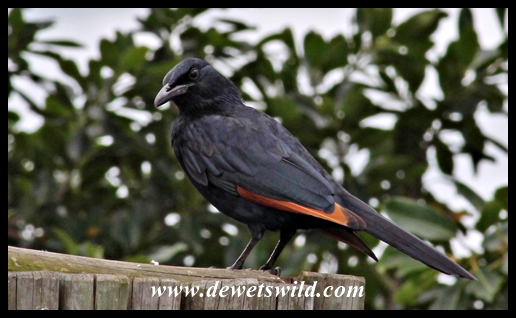
Onychognathus morio
The Red-winged Starling is an omnivorous species feeding on a wide range of seeds, fruits and berries, nectar, invertebrates (even pecking parasites from large mammals), small vertebrates (such as the hatchlings of other birds) as well as carrion and human waste.
These large starlings (30cm long, weighing up to 150g) are closely associated with cliffs and rocky hills and mountains, occurring in a wide range of mesic vegetation types wherever these favoured breeding sites are to be found. They have also adapted to built-up environments, where they use buildings as artificial nesting sites. Monogamous pairs of Red-winged Starlings stay together for years, are territorial when breeding and aggressively protect their nests, even against humans. The nest is built of mud, twigs and grass on a ledge, and the female is responsible for incubating the 2 to 4 eggs over a period of about two weeks. Hatchlings fledge at about a month old. Outside of the summer breeding season they are highly gregarious and congregate in large flocks.
The Red-winged Starling commonly occurs in a band stretching from Ethiopia to South Africa and is considered of least concern by the IUCN, with a growing population as it continues to exploit man-made habitats. In South Africa this species can be found in the south, east and north of the country, being entirely absent from the arid parts of the Northern Cape. It is regarded a pest in orchards.


 DeWetsWild
our pair of starling has been breeding on our verandah since 1999, she hatches about 12 chicks a season. Is this common for such a long lifetime? They both have become very tame as well. Im from KZN Port Shepstone South Africa
It is remarkable that they’ve nested so long in your garden, Elize, and congratulations on providing them a home where they feel so safe!
My guess would be that this is not the same pair that started nesting there in 1999 – they do change partners when one dies, and their usual lifespan is about 3-4 years (though the longest lifespan recorded was 19 years!) so, if for instance the female dies the male will take a new mate, when he dies that new female will take a new male, etc, and so several consecutive pairs may utilise the same nesting spot year after year where they feel safe and the new partner learns from the old one that your family is trustworthy.
Well done, again!
Interesting article thank you .. we had them deciding to nest on top of an outside light on our balcony. Three eggs were laid but it seems only two hatched. The mom and dad sure are aggressive and buzzed us every time we went outside even though we were not a threat! There is a problem now however as one of the fledglings has left the nest and we don’t know where they’ve gone .. however there is one still in the nest .. will the parents come back for it? If you see this please advise on email to peter.d.burgess@gmail.com thanks
Apologies for the delay in response while we were on tour, Peter.
By now I assume the other chick has probably also left the nest and both are accompanying their parents through your neighbourhood?
Congratulations on creating an environment where these birds felt safe enough to breed!
No problem at all re delay … yes, all three “kids” are now pretty much on their own, but still visit us from time to time for some worms, with mom and dad. We decided to assist them in feeding until the little ones were completely independent. So all is well thanks,
That is great to hear, Peter. Enjoy having them as your neighbours!
Those red “GT” stripes make them look more impressive! 😉
Interesting perspective, AJ, because that’s exactly the first thing you notice as they come flying past!
Interessant met mooi foto’s
Baie dankie, Tina!
I was trying to say when WP rudely posted for me, that we used to regard those ‘Spreeus’ as Enemy No 1 in Knysna Heads when they polluted our gutters, which supplied our only water in those days.
They obviously have not endeared themselves to you, Colonialist!
😀
Actually, now the sound of their call is nostalgic!
Hi guys. These starlings have taken over from the Indian Mynas in my part of Durban at the moment. They have a lovely call and voice,
Mynas are a scourge on our local birdlife, to put it mildly – I am so happy to hear that the Red-winged Starlings have put them in their place where you are, Kim!
That’s a pleasant variation to the starlings that I know here.
The starlings are quite a diverse group of birds – there’s over 50 species in Sub-Saharan Africa, of which 13 occur here in the RSA. I can just imagine how many kinds there must be the world over!
They look like a cross between a Crow,Starling and a Robin! We used to have Red winged blackbirds in Alberta, they were in huge flocks and a very messy pest!
I can imagine what a state your patio would be in after such a flock has visited!
We used them for pellet rifle practice!…I never shot one so don’t worry! 🙂 They would destroy our crops!
Like a swarm of locusts!
This bird adapts so well to its environment that it should be around for a long long time.
It is indeed becoming quite cosmopolitan, Hien