
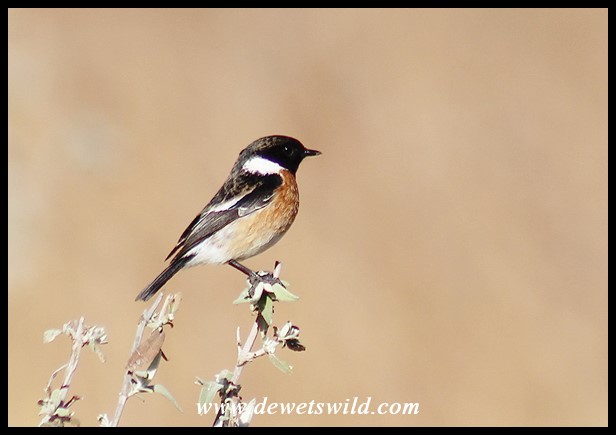
Saxicola torquatus
African Stonechats generally inhabit higher altitude grasslands with long, rank growth, though in South Africa they also occur down to sea level in suitable habitat, and especially so during the colder winter months. The African Stonechat has also adapted very well to large scale agriculture, though they avoid overgrazed areas. They feed mainly on small insects and other invertebrates. These are active little birds, only 13cm long and weighing only 12 – 17g.
African Stonechats are usually seen in pairs, and breeding occurs in spring and summer. Females build their nests of grass and softer material in the shape of a deep cup, usually positioned on the ground at the base of a bush or other plant providing good cover. Clutches, containing up to 6 eggs, are incubated only be the female for a period of two weeks, but both parents feed the chicks once they’ve hatched. Chicks leave the nest at about two weeks of age, and then stay with their parents for a further three weeks or so.
The African Stonechat is a common sight in South Africa, occurring all over the country with the exception of the arid interior of the Northern Cape Province. They are also patchily distributed over East and Central Africa, and is considered common throughout its range.


 DeWetsWild
Hello Dries
Hope you are well!
Whilst looking for a model for my birding calender I came accross your beautiful stone chat pics. Would you mind if I used your photographs for references to my bird paintings for a 2020 calender I am painting. I have just relocated to Hilton and still sorting out our new home so haven’t been blogging as no time for now..its Carol from healing footprints.
I wouldn’t mind at all, Carol – I’d be honoured! And I’d live to see the final product!
And all the best with getting those boxes unpacked!
Nice! Love it
Thank you – and welcome here!
Mooi fotos en goeie voorbeelde. Ek kan nie juis onthou of ek hul al gesien het nie(kan wel wees maar dat dit nie opvallend was nie.) Het hul n afrikaanse naam?
in Afrikaans is hulle naam “Bontrokkie” – baie gepas, ne!
Aaaa, ja jy sien, ek het hul nie werklik opgemerk nie. Dankie vir hul naam, hulle is beslis bontetjies.
A lovely little bird but we don’t get them on the coast.
That’s interesting, Kim. The SA Bird Atlas project shows them being quite common right down to the KZN coastline – wonder why it would be then that they’re avoiding your specific area? Perhaps there are not suitably long grass on the road verges, etc?
http://sabap2.adu.org.za/species_info.php?spp=576#menu_left
I now look at the Irish version with new interest, thanks to you! 😉
Introduce them to their African cousins!
I think I’m gonna do just that, thanks to your post! Would you mind if I do a copycat? Please? 😉
Natuurlik mag jy, AJ!
This bird reminds me very much of our Eastern Towhee: https://en.wikipedia.org/wiki/Eastern_towhee
Absolutely, Annette! It’s almost only the bill shape that differs!
What a sweetie!!! Reminds me a little bit of the American Robin (who is actually a Thrush), but the Stonechat is much cuter!!
Thanks Janet! Isn’t the variety of birds on this planet just astounding!?
What a terrific point! Absolutely astounding!!! All so similar and yet each variety unique! Lovely…
Lekker vaardig met die kamera
Dankie Tina – meer geluk as wysheid!
Oooo nee dit glo ek niks van
I photograph once one saxicola rubetra in Greece, they are really beautifull. But your Saxicola torquatus is so cute. Great pick !
Close relatives!
This is a very handsome bird and it’s good that it is so common in South Africa. Great information and pictures, Dries!
Thanks, Hien – glad you liked it!
I remember liking this bird in one of your previous posts. He really captures my attention and is so striking!
Precisely why I’d thought I’d go do a post on them, Kathy!
Wow, it´s such a beautiful bird. 🙂 The male remind little of robin on the stomach.
They also have a similarly confident disposition, John!
Pragtige foto’s Dries!!
Baie dankie, Aletta!
Very cute and colorful!
We agree wholeheartedly!
These guys are little cuties!
Definitely Ilex!
such a pretty little bird.
And to get them to sit still for 5 seconds!
For such a small bird it sure has big feet! lol..cute little guy!
All the better to grab onto those flimsy grassstalks! 😀
wonderful photos of a lovely little bird.. I especially like the reddish with the black and white colouring. Thanks for the info…
The male is definitely a little show-off compared to the drab female!