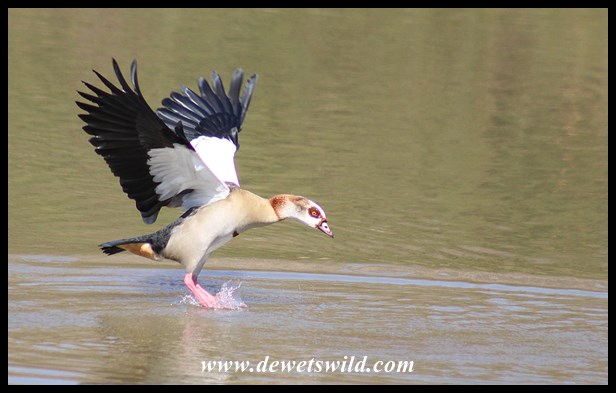
The well-known Egyptian Goose is a large (up to 3.5kg) duck that is probably South Africa’s most numerous waterfowl species.
Egyptian Geese inhabit almost every freshwater habitat, preferring rivers and waterbodies with open shorelines within easy reach of open fields for grazing. Their diet is mostly vegetarian, particularly including grasses and cultivated crops (which is why they are regarded as pests in some parts of their range).
Outside of the breeding season, which in South Africa mainly stretches from late winter to early summer, Egyptian Geese can be found in large flocks of hundreds, even thousands, especially so while moulting (which leaves them flightless for about a month). In the breeding season however pairs are more solitary in habit, viciously defending small territories around their nests and goslings from others of their kind. Nests, lined with plant material, are bult in a variety of places ranging from shallow depressions hidden on the ground in thick vegetation to burrows, the abandoned nests of other large birds, holes in trees, cliffs, caves and buildings. Pair bonds often last for life, and the females incubate the clutch of 5 to 11 eggs for about 4 weeks. Chicks hatched in elevated nests have to jump out after hatching, responding to the call of their mother below, and then follow the parents to water. Both parents take care of the young, which start flying at around 10 weeks of age.
The IUCN considers the Egyptian Goose as being of “Least Concern“, having a large (though likely decreasing) population distributed over most of Sub-Saharan Africa, with introduced or feral populations in many other parts of the world. Ironically they no longer occur on the lower Nile, where they were once considered sacred by the ancient Egyptians. They are however a very familiar sight all over South Africa.
Ha ha, hier in NZ ken hul nie van lekker braai nie. Selfs n kolgans wat gebrai is sal dalk heerlik wees op n boere braaivleis manier gedoen. Hul gebruik gasbranders om te braai!!!!
Mooi man. As ons braai dan gebruik ons ook hout want hier glo hul ook nie aan houtskool wat sulke lekker warm kole maak nie. Hier is wel n SA winkel waar ons regte Boerewors kan koop.
Ons SA winkel verkoop regte houtskool en soms ysterhout! Maar in die somer verkoop ‘n paar van die groot kettangwinkels ook redelike goeie gehalte koutskool! 😉
My computer hasn’t been loading pages well – slow internet to blame… your page today is especially difficult to read.. the dark/light/med values of the tree foliage conflicts with the text… the geese are lovely, and those little ones – ah, all babies are the darlings of our world!
They really are very beautiful birds. There are about half a dozen pairs in the area where I live and they often stalk around the school playing fields and have even come into my garden and spent some time in the pool.
Ek wil soms die twee kolganse wat my Sondagoggende vanaf my bure se dak, ons douvoordag wakker krys,se nekkies omdraai! ‘n Kolgans in vlug, is darem ‘n mooi ding, Dries. Weereens pragtige foto’s!
Ek wou juis vra of dit n kolgans is toe antw jy sommer my vraag. In Secunda waar ek n tyd lank gebly het het elke mensgemaakte dam kolganse en tonne eende gehad en dan saans die menigte bosluisvoëls wat die wilgerbome op eilande volsit om te oornag!



 DeWetsWild
Ek wonder… sal hulle lekker smaak? 😉
Hul sal darem n bietjie vleisies hê om af te kou!
Ek dink ons moet braai! 😉
Ha ha, hier in NZ ken hul nie van lekker braai nie. Selfs n kolgans wat gebrai is sal dalk heerlik wees op n boere braaivleis manier gedoen. Hul gebruik gasbranders om te braai!!!!
Ja… hie in Ierland is gas ook groot! Ek het vir my ‘n 44G drom gekry en ‘n braai gebou! Ek moet now weer so maak want my braai is vrot geroes! 😉
Mooi man. As ons braai dan gebruik ons ook hout want hier glo hul ook nie aan houtskool wat sulke lekker warm kole maak nie. Hier is wel n SA winkel waar ons regte Boerewors kan koop.
Ons SA winkel verkoop regte houtskool en soms ysterhout! Maar in die somer verkoop ‘n paar van die groot kettangwinkels ook redelike goeie gehalte koutskool! 😉
Jul is gelukkig. Hier is niks nie.
Volgens my boeke wou nie eers die Engelse “explorers” van ouds hulle regtig eet nie…
lovely-so reminded of the duckling in the Disneyland pond.
They’re just not as friendly though!
Beautiful pictures. It´s so many nice birds I never heard about before. Thanks for sharing! 🙂
Glad to know you like our series on South Africa’s wildlife so much, thanks John!
My computer hasn’t been loading pages well – slow internet to blame… your page today is especially difficult to read.. the dark/light/med values of the tree foliage conflicts with the text… the geese are lovely, and those little ones – ah, all babies are the darlings of our world!
Thanks for another kind comment, Lisa! Sorry to hear of that the slow internet connection you’re struggling with, hope it will be resolved soon.
They really are very beautiful birds. There are about half a dozen pairs in the area where I live and they often stalk around the school playing fields and have even come into my garden and spent some time in the pool.
Lucky you, Kim! Just goes to show how safe your garden must feel to them.
Lovely goose! But why has his wife given him a black eye?! 🙂
Probably because he’s always looking for a fight! 😀
Haha! 😁
Ek wil soms die twee kolganse wat my Sondagoggende vanaf my bure se dak, ons douvoordag wakker krys,se nekkies omdraai! ‘n Kolgans in vlug, is darem ‘n mooi ding, Dries. Weereens pragtige foto’s!
Ai nee Dina, jy is heeltemal te lief vir diere om tot daai uiterstes te gaan! 😀
Hehe,maar so deur die Sondag slaapnewels,koester ek diep donker gedagtes!
😀
Ek wou juis vra of dit n kolgans is toe antw jy sommer my vraag. In Secunda waar ek n tyd lank gebly het het elke mensgemaakte dam kolganse en tonne eende gehad en dan saans die menigte bosluisvoëls wat die wilgerbome op eilande volsit om te oornag!
Ek is bly ek kon help!
Very Cleopatra looking with the black circle around the eye’s! Also very regal! 🙂
Another reason why they seem to deserve their name, thanks Teresa!
Beautiful colors on the adults, but that little gosling….. adorable!
They’re very cute and fluffy, but don’t think the parents will let you get anywhere near them!
a relative of the magpie geese?
Not closely related, Kate – both species are of the same bird order (Anseriformes), but not in the same family.
ah good I am learning much from you, thanks 🙂
We learn together!