
Quelea quelea
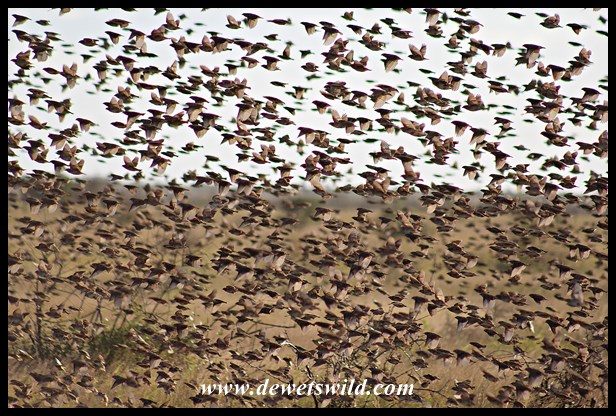
Some of the most impressive sights of our recent visit to the Satara area of the Kruger National Park was the enormous flocks of Red-billed Quelea occupying the grasslands of the central plains. Following the good rains that bought respite from an awful drought, the savannas are heavy with a rich harvest of seeding grasses, and literally millions of the little birds are making the most of the abundant foodsource. When their population reaches a peak, as it currently has, there could be as many as 33-million Red-billed Queleas swirling in cloudy swarms over the Park!


The Red-billed Quelea is a small (20g) seed-eating sparrow-like nomad inhabiting grasslands and grainfields (causing enormous losses to farming communities). Swarms that could number in the millions descend on watering holes at least twice daily. While feeding they “roll” over the grasslands in a wave-like motion, most impressive to witness! While seeds make up the vast majority of their diet they do catch small insects as well, especially when raising chicks.
Nesting occurs communally in the rainy months and hundreds, even thousands, of nests are woven per tree (prefers thorn trees) by the males. Breeding colonies could consist of more than 2 million monogamous pairs, and is a magnet for every imaginable predatory bird, reptile and mammal that is large enough to take adults and chicks. Clutches normally number three eggs and the female incubates them for only 12 days, whereafter the chicks fledge within another two weeks!
The Red-billed Quelea may well be the most abundant bird on the planet, with an estimated population as large as ten billion, and as such is considered as being of least concern by the IUCN. It occurs widely in the savannas of Sub-Saharan Africa and can be found in every one of South Africa’s provinces, where it must number in the hundreds of millions.
(The photos in the following gallery were taken on visits to the Kruger Park and elsewhere)


 DeWetsWild
Beautiful birds!
Awesome sightings. I saw this a few weeks back around Satara for the first time and didn’t expect it at all. What a sight to experience.
No picture could do the spectacle justice, Cal, making it an even more special privilege to experience it!
That’s so true. Have to be there to experience it.
Pingback: Camping fest at Satara | de Wets Wild
I love seeing swarms of birds swirling in the air, but I’ve never seen anything like this!! Was there all the chirping and calling to go with it?
An absolute cacophony, Joanne – useless to even try and hear yourself thinking when a swarm this size surrounds you!
I love that word *cacophony* 🙂
Ek het gewonder oor die voëls, bly ek ken nou hul naam.
Dis n skouspel, ne Spokie!?
Amazing! I had not heard about them.
Seeing such a flock of queleas really is a sight to remember!
They almost look like our European Starlings..except the coloured beaks!
They are also a lot smaller than the starlings, Teresa, but the aerial show they put on is just as impressive!
Wow, that’s a lot of birds! 🙂
janet
Awesome, isn’t it Janet!?
Great photos, Dries. I never saw these birds before.
Thanks Sylvia!
Once seen, never forgotten! Perhaps you’ll be lucky to see them next time you’re back in SA?
Amazing pictures you’ve taken on the beautiful birds. 🙂 They are so many that it looks like a grasshopper invasion! 🙂
And their effect on cultivated fields can be just as devastating, John! But despite that I am always awe-struck when we encounter these huge flocks of queleas.
What beautiful birds!
Pity that it is so hard to see the individual birds in a swarm this size!
Hierdie is wonderlike fotos, de Wet!
Baie dankie!
Great photos. The Queleas look like a locust swarm. I’m glad Mpumalanga has had rain. KZN is still very dry and the dams are low.
Thanks Kim! We visited uMkhuze Game Reserve in March and it was a lush paradise, with Nsumo Pan as full as we’ve ever seen it, so it seems that the north of the province did get some good rains. Of course this will be of little help for the metropolitan areas of Pietermaritzburg and Durban, and all those resorts along the coast. We’ll hold thumbs that you’ll get some more rain before winter arrives in full force.
Yes, it is Midmar dam that waters Durban and PMB, that is low. My sister’s farm in the natal midlands is also very dry and their dam is also low.
Sjoe dis besonders,Dries!Verlede winter toe ons deur Botswana gery het,was daar wolk op wolk van hierdie voëltjies!Die wonderlikste is dat hulle nooit bots as hulle so heen en weer swiep nie.Pragtige foto’s!
Die groot swerms is asemrowend, ne Dina!
Mens moet dit self sien om dit te waardeer!