
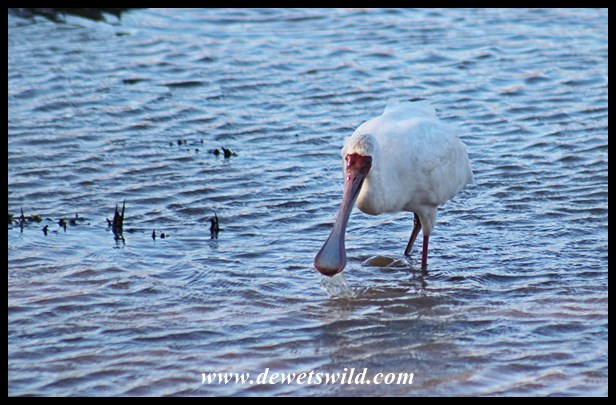
Platalea alba
The African Spoonbill is a large wading bird (90cm long, weighing up to 1.8kg) with a characteristic spoon-shaped beak.
They can be found at shallow bodies of freshwater – natural and man-made lakes, pans, rivers, marshes, floodplains, estuaries and even sewerage works – where they feed on small fish and aquatic invertebrates caught by moving their bills sideways through the water. Spoonbills can often be seen close to hippos and crocodiles, hoping that these large animals will flush something edible. Breeding is timed to start just before or during the rains. They nest colonially in trees, reedbeds or on rocky islands and ledges, usually in groups numbering from 5 to 250 or more monogamous pairs and often together with other species of waterbirds as well. The nests are platforms built of sticks and reeds in which 3 to 5 eggs are incubated for around 4 weeks by both parents.
The African Spoonbill has a wide distribution and stable population, and is considered of least concern by the IUCN. They occur over almost all of South Africa with the exception of the arid northwestern corner of the country, and further range over most of Sub-Saharan Africa (except the equatorial forests) and Madagascar.


 DeWetsWild
I jumped on the curiosity question and found out 🤓
Yes! Ours are pink from the shrimp 🦐🦐🐌🦀 and other things they eat here. They are not the same bird tho. Here’s some reading pleasure:
http://www.nhptv.org/natureworks/roseatespoonbill.htm
Isn’t nature just so fascinating! Thanks Ilex.
Beautiful pixs!!
I think we have a pink one over here. Maybe they are only pink from what they eat, like a flamingo?
That would be very interesting to know, Ilex! I’ll check if I can found out and will let you know if I do!
Ek kan nie meer hulle Afrikaanse naam onthou nie… lepelbek?? 😉
Lepelbek of lepelaar, AJ!
It’s always a joy to see a spoonbill, and how wonderful for you to see the African species in their native environment. Lovely photos.
I couldn’t agree with you more about seeing any creature where it belongs, Jet!
I have never seen one, really!! These pictures are beautiful…
Thanks a lot! And welcome!
Love these! We have yet to see any spoonbills, but in the meantime, we’ll just enjoy them through your photos!
Thank you so much, and welcome here!
Strangely, I can’t recall having seen any locally, and they are certainly distinctive enough for me to have noticed!
That is strange indeed, as we’ve seen lots of them in the Midlands.Would love to understand why they’re not venturing into your metropolitan areas as they do here.
I saw several of these in Costa Rica on a cruise excursion… unfortunately, they were doing everything they could to keep me from photographing them. I didn’t get one good photo of any of them. Your photos, on the other hand… very nice!
Thanks a lot, John! I think that’s why nature photography is such a rewarding hobby; you never know what you’ll see and how it is going to turn out!
Pragtige fotos, de Wet.
So gaaf soos altyd, baie dankie!
Pragtig. Hul is so rustig om voor te sit en kyk.
Dit is so Spokie! Dankie vir die inloer!
I would so love to see one of these in the wild…
Seeing any creature in its wild state in a pristine environment really is the best way to appreciate them, isn’t it Alanna?
Is dit nou n “lepelaar” wat hul in Hollands noem? Ek het nie besef ek is so ver agter met my lees nie. Klink of jul goed besig is met “what have you”. Onthou om darem bietjie stadiger asem te haal en arms en bene ook te strek. Die lewe jaag verby.
Baie dankie vir die goeie wense, Ineke! Was n rowwe tyd, maar van vandag af vat ons dit bietjie rustiger – dis amper weer langnaweek!
Jy is heeltemal reg, dis n lepelaar in Afrikaans ook.
Mooi so. Geniet die rustiger tydjie.
Terrific. I love spoonbills. Saw Rosette Spoonbills when I lived in South Texas. Thanks for bringing back some fond memories.
They’re fascinating birds, and so well adapted!