Leptoptilos crumeniferus
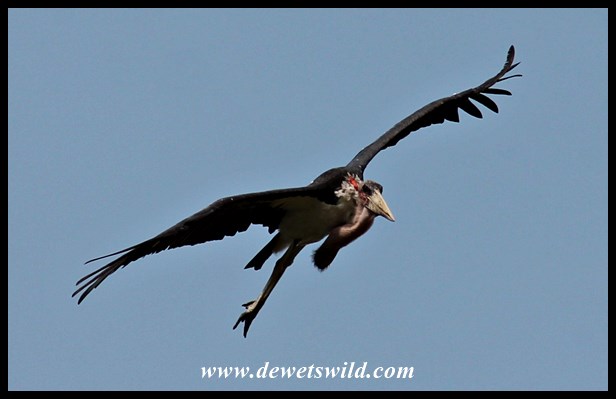
The Marabou has a reputation as the undertaker of Africa’s wild places. Even if you didn’t know about their love for the dead and dying (or rather, how those taste) you’d still think they just simply look the part when you see them solemnly striding around a carcass. Staining their otherwise dignified, albeit grotesque, appearance, their legs are whitewashed with excrement, thought to assist in keeping the bird cool. These enormous storks have a wingspan of 3m or more, weigh up to 9kg and stand up to 1.5m tall.
The Marabou occurs in savannas and grasslands where it can often be found in swamps and on the shores of rivers, dams and receding pools, though they spend much of the day soaring on the thermals kilometers above the ground. They feed on carrion, fish, eggs, insects and small vertebrates – even baby crocodiles! They also frequent the grounds of abattoirs (blogger Rondomtaliedraai has a great shot on her blog) and rubbish dumps, having learned that human waste is an excellent food source. Breeding in colonies numbering from twenty to thousands of pairs starts in the dry season, when nests (platforms of sticks) are built in tall trees, on cliffs and even on buildings, usually in close proximity to a reliable food source. Two to three eggs are laid.


The Marabou occurs over much of sub-saharan Africa, and their population appears to be growing. The IUCN evaluated their overall conservation status “Least Concern“, but in South Africa, where they are most often found in the large game reserves of Kwazulu-Natal, Mpumalanga, Limpopo and North West Provinces, they are considered near-threatened, with even the Kruger National Park‘s resident population estimated at only between 200 and 400 adult birds.
 DeWetsWild
Pingback: Camping fest at Satara | de Wets Wild
You write so well! Succinct and informative
And then the great variety of photos always delivers.
And yuck
Did u say human waste?
Indeed, their behaviour really lets down their “dignified” appearance…
And thank you very much for the kind compliments, it is deeply appreciated!
🌞
Oulike ou voëltjie!! 😉
Op sy eie manier!
Ek wet die kweevoëls dink nie so nie! 😉
Pingback: Saddle-billed Stork | de Wets Wild
Met so gesig moet hy ‘n goeie sin vir humor het!
Ek dink die Maraboe is al verby omgee wat ander van hom dink
😀
Grinnik… moenie ‘n mooi storie met feite bederf
Hmmm, I think we refer to these as buzzards in the states. Wonder if that’s truly a “species”? Regardless, their look really does fit their purpose 🙂
Would you believe, the Marabou is one of the biggest species of stork, Stacy! Here in SA the term “buzzard” is used for a couple of hawk-like birds of prey.
Thanks for the education! I do remember seeing you use the word “stork” in your post, but it didn’t quite sink in I guess 🙂
I have never seen this bird before. Great photos of these Marabou!
Glad we could introduce you, Amy!
Ons noem hulle ‘ouma Koeks voëls’. Glo na my man se ouma vernoem. Altyd ñ groot opgewondenheid oor wie hulle eerste in die wildtuin gaan raaksien. Maar voorwaar het ek ouma Koeks nog nooit so mooi kon sien nie!
Haai foeitog, arme Ouma Koeks!
Great post as usual. I must agree with their undertaker appearance. I once took a quick isolated gravel loop close to skukuza and there were about 30 of these storks sitting in the trees hanging over the road. It felt like driving through a grave yard!
I bet it was that short loop near the low bridge over the Sabie, Cal?
I can’t remember exactly which loop, but I know it was on the H4-1 close to camp.
I’m sure it’s the same one I’m thinking of – the marabous love that spot!
Dis darem loshande die lelikste gedierte op aarde,maar hulle vervul so ‘n belangrike rol!Pragtige reeks,Dries.
Dankie Dina!
Dit is nou regtig ‘n eienaardige voël ! Pragtige reeks foto’s!
Dankie Aletta! Ja-Nee, arme Maraboe sal nie Mej. SA word nie.
HA HA!! 😀
They are quite humourous-looking birds. You can see the dinosaur heritage for sure.
That’s so true! Amazingly well adapted to their lifestyle, aren’t they?
It almost looks prehistoric. Great shots.
Thanks Maralee! Closest thing we have to a pteradactyl these days…