If you enjoy de Wets Wild as much as we enjoy sharing our love for South Africa’s wild places and their denizens with you, please vote for us in the 2016 South African Blog Awards.
We’ve entered the categories for “Best Travel Blog” and “Best Environmental Blog”, and you are allowed to vote for us in both. Clicking on the badge below will bring you to the voting site. After voting, you’ll receive an e-mail requiring you to click on a link to confirm your votes.
These easily recognisable, medium-sized birds (1-2kg) are extremely gregarious, flying and roosting in large flocks, and can be found near inland and coastal wetlands of all description, including sewerage works. Their natural diet consists of insects, worms, crustaceans, molluscs, fish, frogs, eggs, nestlings and carrion, and they are often to be found on the outskirts of towns scavenging at rubbish dumps and abattoirs. African Sacred Ibisses start breeding at the onset of the rainy season, in mixed-species colonies of up to 2000 pairs. Nests, in which 2 to 3 eggs are laid, consist of sticks and branches and are built in reeds or trees or on the ground on rocky islands.
African Sacred Ibis
African Sacred Ibis
African Sacred Ibis flocks typically fly in V-formation
African Sacred Ibis flocks typically fly in V-formation
African Sacred Ibis
African Sacred Ibis
Sacred Ibis
African Sacred Ibis
AfricanSacred Ibis
African Sacred Ibis
African Sacred Ibis
African Sacred Ibis
African Sacred Ibis
African Sacred Ibis
African Sacred Ibisses
African Sacred Ibis
African Sacred Ibis
African Sacred Ibis
African Sacred Ibis
African Sacred Ibis
African Sacred Ibis
African Sacred Ibis
Sacred Ibis on a tiny nest at Kubu Dam
African Sacred Ibis
African Sacred Ibis
African Sacred Ibis
African Sacred Ibis
African Sacred Ibis
Sacred Ibis
Sacred Ibis
Sacred Ibis
Sacred Ibises coming to roost
Sacred Ibis
Sacred Ibis
Sacred Ibis
Sacred Ibis
Sacred Ibises
Thanks to a wide distribution across most of Sub-Saharan Africa, and a large though probably declining population (200,000 to 450,000), the IUCN considers the African Sacred Ibis to be of Least Concern. The species is a common resident in most parts of South Africa, local numbers often swollen in summer by individuals migrating southwards from the equator, and have been introduced to Europe, the USA (Florida) and Taiwan. They are now extinct in Egypt, where they were once considered a sacred symbol of one of the Egyptian deities, and often mummified.
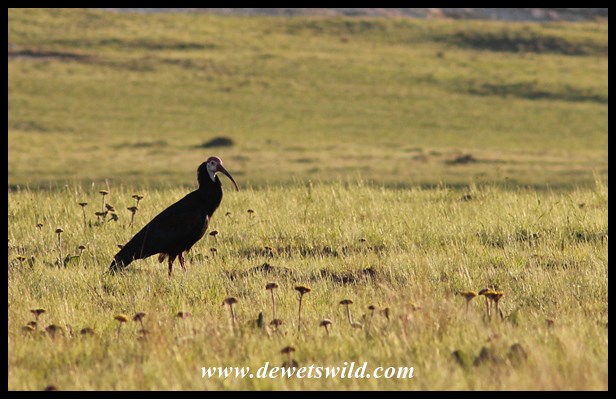
The Southern Bald Ibis is an endemic Southern African bird that occurs in high rainfall, high altitude, short grasslands, and has a special preference for areas where recent burns occurred. It will also forage in recently ploughed fields and cultivated pastures. These birds feed on insects and other invertebrates, usually foraging in small flocks though at times up to 100 can congregate together. Bald ibisses breed in colonies on ledges on high cliffs, laying 2 or 3 eggs that are incubated for four weeks in nests built of sticks and grass. They weigh about a kilogram and are about 80cm long from head to tail.
We had daily sightings of the rare bald ibis on the Oribi Loop at Golden Gate
We had daily sightings of the rare bald ibis on the Oribi Loop at Golden Gate
We had daily sightings of the rare bald ibis on the Oribi Loop at Golden Gate
The Hamerkop is a unique bird that is found only in Africa and Madagascar. Their name is Afrikaans for “Hammer Head”, in reference to their oddly shaped heads. These medium-sized birds weigh about 500g and reach a length of 50cm. Hamerkops are diurnal birds, mostly seen in mated, territorial pairs or family groups. Their diet consists of amphibians, small fish, crabs and other water-inhabiting invertebrates, and thus they are to be found at aquatic habitats such as lakes, dams, marshes, estuaries, seasonal pans, streams and rivers.
Hamerkop
Hamerkop
Hamerkop
Hamerkop
Hamerkop
Hamerkop
Hamerkop
Hamerkop
Hamerkop
Hamerkop
Hamerkop
Hamerkop
Hamerkop
Hamerkop
Hamerkop
Hamerkop silhouette
Hamerkop (photo by Joubert)
Hamerkop
Hamerkop
Hamerkop
Hamerkop
Hamerkop at sunset
Hamerkop
Hamerkop
Hamerkop (photo by Joubert)
Hamerkop
Hamerkop (photo by Joubert)
Hamerkop (photo by Joubert)
Hamerkop (photo by Joubert)
Hamerkop (photo by Joubert)
Hamerkop (photo by Joubert)
Hamerkop
Hamerkop close-up
Hamerkop
Hamerkop
Hamerkop
Hamerkop
Hamerkop
Hamerkop nests are enormous structures, often over 1.5m wide and able to support a man’s weight, built of sticks and twigs over the course of many months, in big trees or on cliffs, with a small side entrance to a tunnel leading to the nesting chamber deep inside. Although the Hamerkop pair may use the same nest for many seasons their nests are often take over by small mammals and other birds, mostly owls. They breed throughout the year, laying between 3 and 7 eggs that are incubated by both parents for around 4 weeks, with the chicks then leaving the nest about two months after hatching.
Hamerkop Nest
Hamerkop nest on a cliff
Hamerkop Nest
Hamerkop Nest
Hamerkop nest
There are many traditional beliefs about the Hamerkop in Africa, such as that it heralds the death of a family member or that it can attract lightning. The Hamerkop has a wide distribution in Madagascar and sub-Saharan Africa, with a large, stable population, and is therefore considered of least conservation concern by the IUCN. They occur all over South Africa where suitable habitat is to be found, and are thus more common on the wetter eastern sides of the country than in the arid west.
Woolly-necked Storks (weight ∼ 1.8kg) inhabit a wide range of wetland habitats, ranging from the banks of rivers, streams, lakes, dams and ponds to estuaries and mangrove swamps, where they subsist on a diet of frogs, fish, crabs, insects, molluscs and worms. They are normally seen singly or in pairs, although they will at times congregate in large flocks when migrating or at favourite roosting sites. Woolly-necked Storks breed in solitary pairs, mostly at the end of the dry season, in nests built of sticks in tall trees, often over water and regularly used by the same pair year after year.
Woolly-necked stork feeding in the mangrove swamp
Woolly-necked stork
Woolly-necked stork taking flight
Woolly-necked Stork
Woolly-necked stork
Woolly-necked stork
Woolly-necked stork
Woolly-necked stork
Woolly-necked stork
Woolly-necked stork
Woolly-necked Stork Buffet at uMkhuze
Woolly-necked Stork Buffet at uMkhuze
Woolly-necked Stork Buffet at uMkhuze
Woolly-necked Stork Buffet at uMkhuze
Woolly-necked Stork
Woolly-necked Stork
Woolly-necked Stork
Woolly-necked Stork
Woolly-necked Stork
Woolly-necked Stork
Woolly-necked Stork
Woolly-necked Stork
Woolly-necked Stork
Woolly-necked Stork
Woolly-necked Storks
The Woolly-necked Stork has a wide distribution across Africa and with a stable population is considered of least conservation concern by the IUCN. In South Africa they are considered near-threatened, being found only in the Lowveld of Limpopo and Mpumalanga (where around 80 occur in the Kruger National Park) and the north of Kwazulu-Natal (where Umlalazi Nature Reserve is an excellent location to go looking for them)
The Yellow-billed Stork is a medium sized (up to 2kg), gregarious species that is usually seen in pairs or small flocks of up to 50 birds. They frequent shallow wetlands, estuaries and the banks of rivers and lakes, where they feed mainly on frogs, fish and aquatic invertebrates by moving their opened bills through the water, feeling for prey. They also roost and breed communally, in groups of up to 50 pairs, often together with other kinds of waterbirds. Breeding takes place when food is easiest to come by, usually when fish are concentrated in shrinking pools during the dry season. Nests are stick-platforms built in trees, often over water, in which 2 to 4 eggs are incubated by both parents for around 30 days.
Yellow-billed Stork
Yellow-billed Stork at Sunset Dam
Yellow-billed Stork
Yellow-billed Stork
Yellow-billed Stork at Sunset Dam
Yellow-billed stork
Yellow-billed Stork
Yellow-billed Stork
Yellow-billed Stork
Yellow-billed Stork
Yellow-billed Stork
Yellow-billed Stork
Yellow-billed Stork
Yellow-billed Storks
Yellow-billed Stork
Yellow-billed Stork at Mankwe Dam
Yellow-billed Storks at Sunset Dam
Yellow-billed Storks
Yellow-billed Storks
Yellow-billed Stork
Yellow-billed Stork (photo by Joubert)
Yellow-billed Stork
Yellow-billed Stork (photo by Joubert)
Yellow-billed Storks
Yellow-billed Storks
Yellow-billed Stork
Yellow-billed Stork
Yellow-billed Stork
According to the IUCN, the Yellow-billed Stork is of least conservation concern, although their population is apparently slowly decreasing . They’re a common sight over most of Sub-Saharan Africa and Madagascar, and in South Africa they can be encountered in all provinces except the Northern and Western Cape.
The African Openbill is a fairly small stork (up to 1.3kg) that migrates across the African equatorial zone following the rains to areas where their favourite food is in easy supply. Their preferred habitat is shallow wetlands and quiet backwaters of large rivers and lakes, where they feed mainly on aquatic molluscs (snails and mussels) which they easily open using their superbly adapted bill. They’ll also consume fish, frogs, crabs and other kinds of invertebrates they find while scouring the water. Breeding takes place colonially (up to 100 or more pairs, often in mixed groups with other kinds of birds as well) during the rainy season, when nests of sticks are built in vegetation over water or in reedbeds. Eggs are incubated by both parents for 25-30 days and the chicks fledge at about two months of age. African Openbills forage alone, in pairs or in dispersed flocks that can number up to 50 or more.
African Openbill
African Openbills
African Openbill
African Openbill
African Openbill
African Openbill
African Openbill
African Openbill Stork
African Openbill Stork
The African Openbill has a wide distribution and a fairly large, though decreasing, population in Africa south of the Sahara, being considered of “Least Concern” by the IUCN. In South Africa, where they’re classified as near-threatened due to loss of habitat, they occur mostly in the Lowveld of Limpopo and Mpumalanga (with a resident population of around 300 in the Kruger Park) and Kwazulu-Natal, although vagrants have been recorded in all the other provinces.
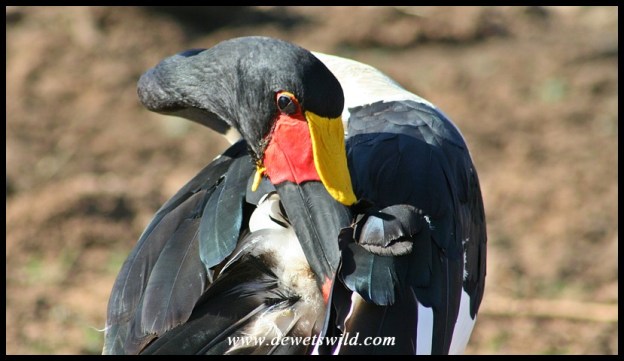
The Saddle-billed Stork is one of the most strikingly attractive bird species in South Africa (in stark contrast to their cousin, the marabou). They are very large birds, standing up to 1.5m high, with a wingspan over 2.5m and a weight of up to 7.5kg.
Saddle-billed Storks are usually seen singly or in pairs in wetlands, pans and along rivers and streams, where they feed predominantly on fish, frogs, crabs and other aquatic animals, occasionally taking small reptiles, mammals and birds. The breeding season coincides with the dry season to ensure food is in easy supply from shrinking pools. Nests are platforms constructed from sticks in large trees near water in which one or two eggs only are incubated for around 30 days.
Saddle-billed Stork
Saddle-billed Stork fishing at Nkuhlu
Saddle-billed Stork
Saddle-billed stork
Saddle-billed stork
Saddle-billed stork
Juvenile Saddle-billed stork
Saddle-billed stork
Saddle-billed Stork
Saddle-billed Stork
Saddle-billed Stork
Immature Saddle-billed Storks
Saddle-billed Stork
Saddle-billed Stork
Saddle-billed Stork
Saddle-billed Stork at Shitlhave Dam, Kruger Park
Saddle-billed Stork with nestlings
Saddle-billed Stork (Photo by Joubert)
Saddle-billed Stork
Saddle-billed Stork
Saddle-billed Stork
Saddle-billed Stork
Saddle-billed Stork
Saddle-billed Stork
Saddle-billed Stork (photo by Joubert)
Saddle-billed Stork
Immature Saddle-billed Stork
Immature Saddle-billed Stork
Saddle-billed Stork
Saddle-billed Stork
Saddle-billed Stork (photo by Joubert)
Saddle-billed Stork (immature)
Saddle-billed Storks
Saddle-billed Stork in silhouette at sunrise
Young Saddle-billed Storks
Saddle-billed Storks
The Saddle-billed Stork has a wide distribution in sub-saharan Africa, though despite being considered “Least Concern” by the IUCN they are uncommon throughout this range and their population is probably decreasing due to loss of habitat. In South Africa they are considered endangered and occur only in the north of Kwazulu-Natal and the Lowveld of Mpumalanga and Limpopo, with about 30 breeding pairs occurring in the Kruger National Park.
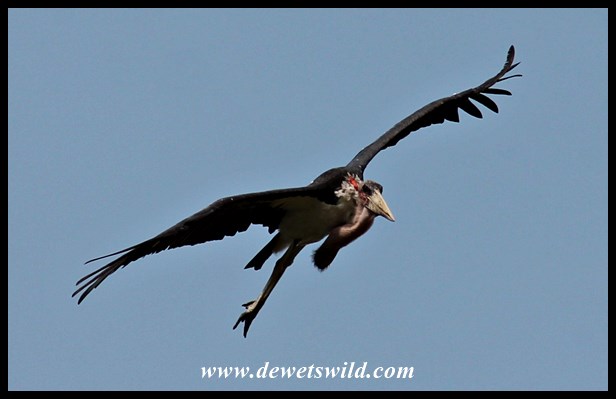
The Marabou has a reputation as the undertaker of Africa’s wild places. Even if you didn’t know about their love for the dead and dying (or rather, how those taste) you’d still think they just simply look the part when you see them solemnly striding around a carcass. Staining their otherwise dignified, albeit grotesque, appearance, their legs are whitewashed with excrement, thought to assist in keeping the bird cool. These enormous storks have a wingspan of 3m or more, weigh up to 9kg and stand up to 1.5m tall.
The Marabou occurs in savannas and grasslands where it can often be found in swamps and on the shores of rivers, dams and receding pools, though they spend much of the day soaring on the thermals kilometers above the ground. They feed on carrion, fish, eggs, insects and small vertebrates – even baby crocodiles! They also frequent the grounds of abattoirs (blogger Rondomtaliedraai has a great shot on her blog) and rubbish dumps, having learned that human waste is an excellent food source. Breeding in colonies numbering from twenty to thousands of pairs starts in the dry season, when nests (platforms of sticks) are built in tall trees, on cliffs and even on buildings, usually in close proximity to a reliable food source. Two to three eggs are laid.
Roosting marabou
Marabou Storks
Marabou Stork
Marabou roost near Skukuza
The marabous are rather suspicious of the approaching crocodile!
Marabou stork
Marabous perched in a dead tree
Marabou gathering
Marabou
Marabou
Marabous
Marabou in flight
Marabou in flight
Marabou
Marabou
Marabou roost at sunset
Marabou
Marabou
Marabou
Marabou
Marabou
Marabou Stork
Marabou
Marabou Storks
Marabou Stork
Marabou
Marabou catching frogs
Marabou
Captive Marabous building a nest
Marabou
Marabou
Marabou (photo by Joubert)
Marabou
Marabous
Marabou (photo by Joubert)
Marabou (photo by Joubert)
Marabou Stork (photo by Joubert)
Marabou
Marabou Stork
Marabou Stork
Marabou Stork
Marabou Stork
The Marabou occurs over much of sub-saharan Africa, and their population appears to be growing. The IUCN evaluated their overall conservation status “Least Concern“, but in South Africa, where they are most often found in the large game reserves of Kwazulu-Natal, Mpumalanga, Limpopo and North West Provinces, they are considered near-threatened, with even the Kruger National Park‘s resident population estimated at only between 200 and 400 adult birds.








 DeWetsWild