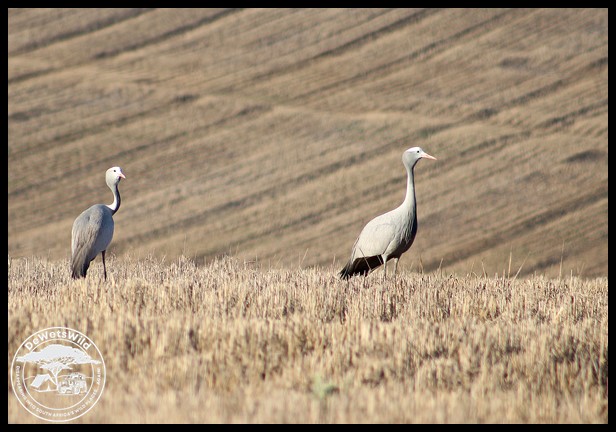
Anthropoides paradiseus
South Africa’s national bird is a relatively small, blue-grey species of crane that stands around a meter high, with a wingspan of up to 2 meters and a weight up to 6kg.
Blue Cranes inhabit open grasslands, karoo-scrublands, fynbos and marshes, and have adapted to feeding in grainfields and pastures where these intrude into their preferred habitat. Grass and sedge seeds are their primary food source, though they’ll also take insects, frogs, crabs, and small reptiles and mammals. Blue Cranes are diurnal, roosting in wetlands at night.
Outside the summer breeding season Blue Cranes congregate in large (from 50 to 1000 birds), nomadic flocks, while in the breeding season they can be found in pairs or family groups. They perform an elaborate courtship dance, involving running, jumping, flapping and calling. Two eggs are laid in a simple nest constructed of reeds or grass in marshes and grasslands, and parents take turns to incubate the clutch for around 30 days. Any animal – human, herbivore or predator – is relentlessly attacked when they come too close the nest.


The IUCN considers the Blue Crane “Vulnerable” as their population has been seriously decreased by poisoning, loss of habitat and collisions with power lines. Population estimates put their numbers in the region of 25,000 in South Africa (almost half of which can be found in the Western Cape Province) with less than a 100 in neighbouring Namibia.
 DeWetsWild
My gunsteling voël
Suid-Afrika se trots, sou mens hoop, maar as mens sien hoe hul gebiede vertrap en omgeploeg word sou jy dit nooit raai nie.
Dis die hartseer van sogenaamde vooruitgang.
Laat my so hartseer voel.Toe ons dertig jaar gelede hier in Benoni aan die Oosrand ingetrek het,was hier ‘n kraanvoëlpaartjie wat gereeld in die vlei gewei het.Ek het hulle altyd hoor krrr,as hulle oor die huis vlieg.Soveel uitbreidings het plaasgevind,dat hulle verdwyn het!Dankie vir mooi foto’s en inligting,Dries.
Dis regtig hartseer om te dink dat hulle byna heeltemal uit Gauteng verdryf is. Hul habitatvereistes en gewoontes is net nie aanpasbaar by al die ontwikkeling nie.
Ja hier was groot oop grasvelde en nou is daar net geboue!
😦
By poisoning? Why would anyone do that?
Most of it is accidental, Lois. Use of agricultural pesticides often cause deaths among unintended targets. Many of those kinds of poison are illegal, but the regulations are not always effectively policed until it is too late and a flock of dead cranes are found somewhere.
Oh, what a shame. Poor animals just cannot get a break.
how dad about the power lines and glad they are doing things to help the birds see them more – and as usual – love the photos – 🙂
Thank you very much! Indeed, it is very sad that our need for constant development inflicts so much unintended hardship on our wild neighbours.
🙂
and I hate when helicopters over here go down – does not happen too much – but so sad.
Especially when lives are lost
I know –
Die goeie ou “vyf sent voël”!! 😉
Nog al die tyd, AJ. Maar deesdae is die 5c so min werd hulle is amper net so skaars soos die kraanvoel self.
Sien julle nog ooit die blink “silver” 5c stukke? Hou vas aan hulle!! 😉
Ons het nog so paar iewers in n blikkie, saam met ou Jan van Riebeeck op n R2 noot.
Ou Jan… nou, daar’s ‘n ding!! 😉
Ja, deesdae kry die ou ook al die skuld vir SA se probleme, maar dit los ons maar eerder daar vir nou…
Ja-nee kyk… kom ons gaan eerder met Oom Thabo se “African Renaissance”! 😉
Dis sulke statige voëls. Hul lyk soos fluweel. In die 1960s was daar nog van hul net buite Pretoria. Daar was selfs een jaar n paartjie wat gebroei en wat “kuikens?” gehad het. Hul het altyd net buite ons grensdraad geloop. Toe was die veld nog oop en ongeskonde.
Wat n wonderlike gesig moes dit nie gewees het nie, Ineke! Vandag is mens regtig baie gelukkig om een van hulle in Gauteng raak te loop.
Hul is werklik iets besonders, in hul manier van loop, vlieg en self hul geluid as hul wegvlieg
Mens sal dit nooi vergeet as jy dit eers een keer gesien het nie!
Beslis. Ek is so dankbaar dat ek al die geleenthede gehad het om so na aan die natuur te kon lewe. Gelukkig is hier ook spesiale geleenthede. Hier is die Kereru(wood pigeon) wat my baie plesier gee. Dis n ouer paar wat in lente meer en meer sigbaar is. Daar word n duif telling elke Sept gedoen. Elke keer sien ek hul as ons moet tel. Hierdie keer was hul bietjie later en was ek bekommerd dat hul dalk weg is. Tog een oggend was eers een daar en volgende oggend sit beide op die kragdrade waar hul gereeld soggend sit.
Dis baie interessant, Ineke. Trek hulle na ander dele van New Zealand, of iewers anders, in die winter?
Jong hul trek maar na dele waar daar meer eetgoed is. Hul leef van bloeisels en vrugte. Hier is baie vrugtebome dis hoekom hul meer na die tuine toe kom. Hul is bv ook nie baie “wild” nie. Mens jaag hul nie maklik weg nie. Dis n beskermde voël, veral Maories het hul geval om te eet omdat hul groot en swaar is. Daar is juis een van hul hoofleiers wat 5 in sy tas gehad het toe hy huistoe gevlieg het. Doeane het hom gevang en hy is goed beboet. Kastig nie besef hy mag dit nie doen nie.
Ons sal nog ons planeet leeg eet…
Thank you, I’ve never seen a Blue Crane before. Sad to learn they are on the vulnerable list…
Apart from the very small population in Namibia they are breeding endemics of South Africa, and luckily not heavily exploited for the pet trade as some other crane species are.
Cranes for pets? Wonder if same market as for peacocks… Only more exotic?
Sadly so, Jane. Cranes are a favourite feature in many “water gardens” in several countries. The Crowned Crane, which we’ll feature tomorrow, suffers far more in that regard.
All so discouraging. I understand your love for wildlife, and feel sad for how very difficult it must be know the plight of so many African species… They are, after all, your beloved neighbors.
Ons sien deesdae gereeld ‘n paar as ons Kaapstad toe ry. Sulke pragtige voels!
Net nog ‘n byvoordeel van die lieflike wereld waar julle bly, Aletta!
ja, ons is baie bevoorreg 🙂
I know our possums and bats have problem with power lines, but not birds, wow
The ways we impact our environment negatively seems to know no limits, does it Julz?
No…. it’s quite sad
Collisions with power lines? Are they the only bird that has this problem? I have never seen one of these. Thanks.
Unfortunately no, Helen. Most of our large flying birds are prone to collisions with power lines (vultures, bustards, etc). The electricity supplier tries to minimize the risk by making the powerlines more clearly visible through various means.
Sad. Can’t they paint the wire in bright red or something? I am glad that they are trying to minimize the risk. Hope they will find a way soon.
Thanks. Have a great day/evening. 😉
Large red-and-white balls or pieces of bright reflecting metal attached to the cables seem to be the preferred method used now to make the wires more visible now. Problem is that most of the collisions occur in low light conditions as the cranes move from and to their nests at dusk or dawn, when visibility is more limited.
Thank you so much. Learned something from you again 🙂
Have a wonderful day!
We’re the lucky ones to have you visit us, Helen! Have a lovely weekend!