Monthly Archives: October 2016

Addo’s Diversity

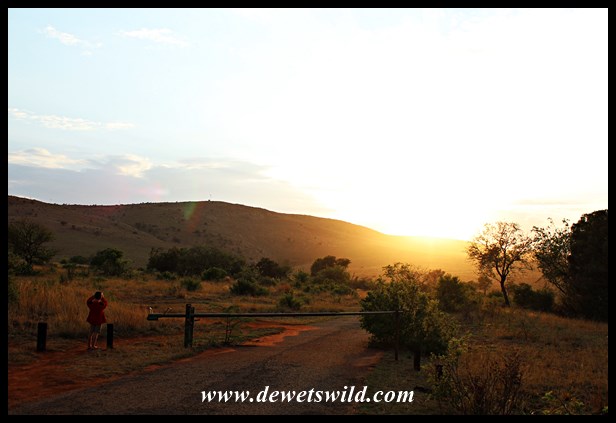
Addo Elephant National Park must be one of South Africa’s most diverse wild places, a fact really brought home as the plane flew over the Park on our way back to Johannesburg. What follows is just a selection of photos taken on a 24-hour working visit to Addo last week!

(I’ve shared pictures of Addo’s elephants and lions in seperate posts)


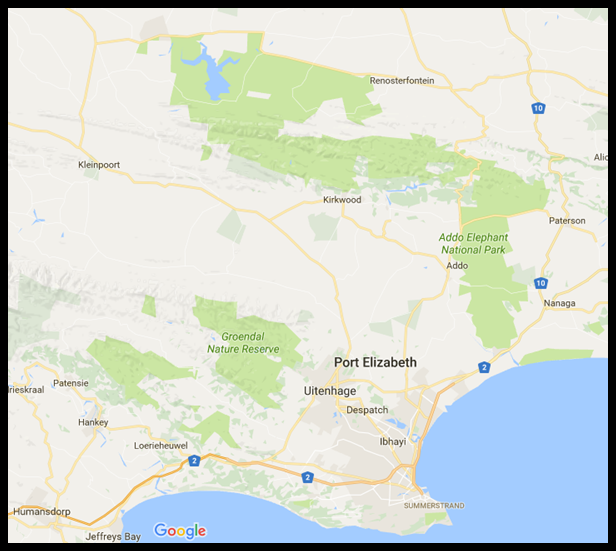
Addo Elephant National Park, managed by South African National Parks, is located in South Africa’s Eastern Cape Province, within easy reach of the city of Port Elizabeth’s modern airport along the recently upgraded N2 highway.

addo-location

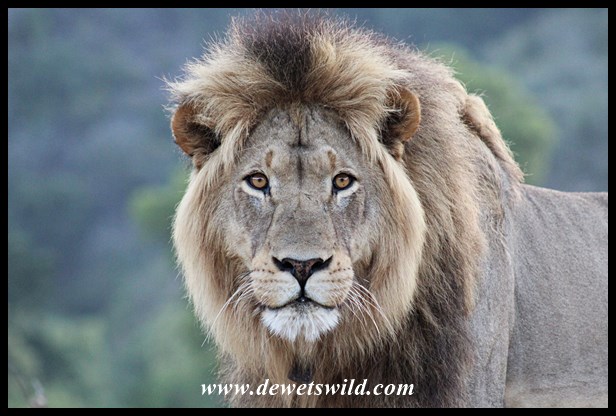
Kings of Addo

Two male lions waited for us next to the road as we were driving from Addo‘s new, soon to be opened Nyathi Camp early on Friday morning. We may only have spent a few minutes in their audience, but the experience will remain a thrilling memory forever.

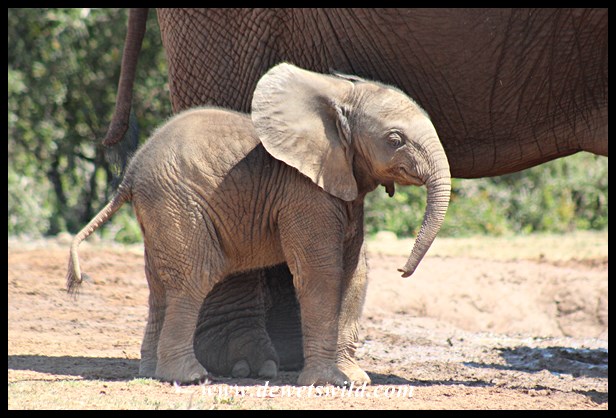
Addo wouldn’t be Addo without the elephants…

Last week I had the pleasure of a quick visit to the Addo Elephant National Park, and of course the Park’s star attractions delivered wonderful performances! Every herd had the tiniest and cutest of babies in attendance, and the massive aggregation of literally hundreds of elephants milling around Hapoor Dam is a spectacle I will never forget.


Return to Kgaswane

Joubert and I have been planning a father-and-son camping trip to beautiful Kgaswane Mountain Reserve, and invited a few other dads and their sons to join us there this past weekend. It’s amazing just how quickly a weekend in the fresh mountain air surrounded by amazing scenery can fly past, especially when you have good company! I am also happy to report that we didn’t miss out on Kgaswane’s majestic sable antelope this time! Have a read here to learn more about Kgaswane.

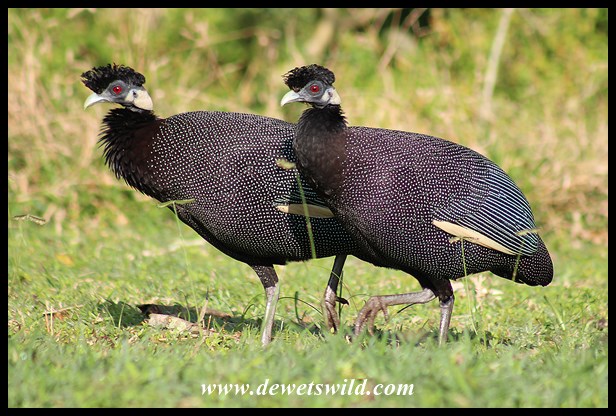
Southern Crested Guineafowl

Guttera edouardi

As familiar as South Africans are with the Helmeted Guineafowl, it may be surprising that relatively few people know that our country is home to another, slightly smaller, species of guineafowl, the Crested Guineafowl.

The Crested Guineafowl is an inconspicuous species that inhabits forests and dense riverine woodlands and occurs in pairs or small flocks, feeding on fruits, berries, seeds and invertebrates. They often follow feeding monkeys, pecking up any food items the primates drop from the tree tops. Breeding takes place in spring and summer, when hens lay small clutches (4-5 eggs) in scraped hollows hidden among thick vegetation.

The IUCN considers the Southern Crested Guineafowl as being of “Least Concern“, being found in large, stable populations over a wide area that includes Angola, Botswana, Malawi, Mozambique, Namibia, Swaziland, Tanzania, Zambia and Zimbabwe. In South Africa they are in no immediate danger of extinction, although they have a very limited distribution, occurring only in the north of Kwazulu-Natal and the north-eastern corner of Limpopo Province. Good places to go searching for them would be Cape Vidal and uMkhuze in the iSimangaliso Wetland Park and the areas around Pafuri and Punda Maria in the Kruger National Park.

Crested Guineafowl – iSimangaliso Wetland Park

Helmeted Guineafowl

Numida meleagris

The Helmeted Guineafowl is one of South Africa’s best known and most abundant gamebirds, occurring in a wide range of naturally open habitats, from forest edges to semi-deserts, as well as being regularly seen in farming areas. They can weigh as much as 1.8kg.

Guineafowl feather

Helmeted Guineafowl are gregarious, feeding and roosting in groups normally numbering around 25, but can congregate in flocks of hundreds. Like other guineafowl they are mostly terrestrial, and will only take flight when in extreme danger or to reach their roosts. Omnivorous in their diet, Helmeted Guineafowl will feed on seeds, fruits, invertebrates of all descriptions and even small amphibians, reptiles and mammals. Nests are little more than scrapes in a well-hidden place, in which the hen incubates a clutch of 6 – 12 eggs for 28 days during the summer months. Helmeted Guineafowl can live up to 12 years in the wild.

The IUCN considers the Helmeted Guineafowl “Least Concern” thanks to its extremely wide natural distribution range (almost all of Africa south of the Sahara, except the forests of the Congo and the Somali desert) and large and apparently stable population. In South Africa they are a common sight almost everywhere, even occurring in the leafy suburbs and parks of the big cities, and is one of the few species that have actually expanded their distribution range in recent years, despite fairly substantial hunting pressure. The species has also been domesticated and widely introduced to other continents. These domesticated strains often sport quite different plumage.

Red-crested Korhaan

Lophotis ruficrista

The Red-Crested Korhaan, also known as the Red-Crested Bustard, is a common ground-dwelling bird occurring in many of South Africa’s conservation areas, inhabiting arid thornveld, savanna-bushveld and woodlands. . They are about 50cm long and weigh up to 900g. Their diet includes insects, seeds, berries and tree-gum. Males perform an acrobatic aerial display during the spring-summer breeding season, involving flying 10 – 30m straight up into the air before tumbling out of the sky as if they’ve been shot, only to glide to a safe landing at the last possible moment. The red crest from which they take their name is shown by the male only when displaying for females, and males will mate with as many hens as they can impress in this fashion. Eggs are laid in shallow hollows, usually scraped beneath bushes. Their characteristic shrill call is a feature of the areas in which they occur.

Owing to its wide distribution in Southern Africa, few pressures on its habitat and apparently stable populations, the Red-Crested Bustard is considered “Least Concern” by the IUCN. In the Republic of South Africa, this species can be commonly found in all provinces, with the exception of the Eastern and Western Cape.

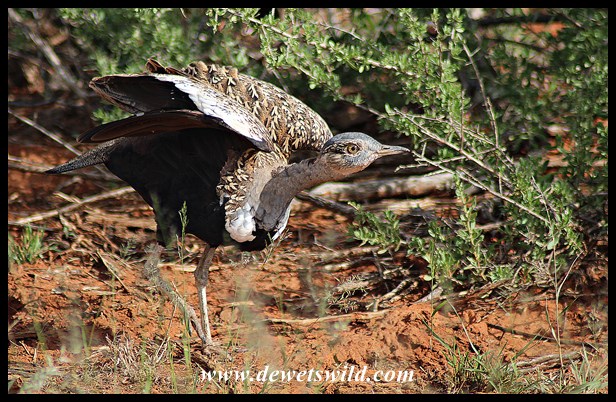
Kori Bustard

Ardeotis kori

Considered one of the world’s heaviest flying birds, Kori Bustard males weigh as much as 18kg or even more. They have a wingspan of up to 2.75m, and stand up to 1.2 meters tall. Females however are much lighter and seldom exceed 7kg in weight.

Kori Bustards occur in flat, open, dry habitats and have an omnivorous diet that includes carrion, seeds, berries, flowers, eggs, insects and small vertebrates, often following fires and herds of game to catch flushed prey. Their Afrikaans name, “Gompou“, comes from their liking for Acacia-tree gum. Where water is easily available, Kori Bustards will drink regularly. They normally forage alone or in small groups, but are sometimes seen in bigger groups numbering up to 40 in areas of abundant food or at waterholes. These bustards are mostly terrestrial, taking to the wing only when necessary and even preferring to escape threats by running or hiding, though they are strong flyers once airborne. They forage during the cooler hours of early morning and late afternoon, preferring to spend the heat of the day in the shade. Nesting occurs in the warmer months, when usually two eggs are laid in shallow hollows on the ground. Following an elaborate courtship display, males attempt to mate with as many females as possible, and play no part in incubating the eggs (which lasts for about 25 days) or rearing the precocial chicks. Large raptors and big mammalian predators prey on both adult and young Kori Bustards.

Ongoing declines in the Kori Bustard’s population across its range, which stretches from Ethiopia and The Sudan to South Africa’s Mpumalanga, Limpopo, North-West, Northern, Eastern and Western Cape Provinces, has prompted the IUCN to raise its conservation status to “Near Threatened“. The South African population is estimated at between 2,000 and 5,000, with hundreds dying annually due to collisions with powerlines. The threats of illegal hunting and habitat degradation is placing further pressure on their numbers, and the species may well soon be confined only to conservation areas like the Kruger National Park, where the population is estimated around 250 adult birds. They can also be found in the Mapungubwe, Mokala and Pilanesberg National Parks.

Secretarybird

Sagittarius serpentarius

The Secretarybird is a very unusual raptor, with a long neck, even longer legs and a bunch of quill-like feathers at the back of its head, like pens behind a secretary’s ear, possibly earning it its name. Another explanation for the name comes from a French corruption of an Arabic word, saqr-et-tair, meaning “hunter bird”, which is a great description of its lifestyle. They are up to 1.5m tall, with a wingspan of over 2 meters and a weight up to 5kg.

Secretarybirds roam savannas, grasslands and semi-deserts, usually singly or in pairs, walking along in search of prey, which ranges from eggs, insects and other invertebrates to small mammals (up to the size of hares), birds, amphibians and reptiles – even large, poisonous snakes – which they immobilise or kill by vigorously stomping on it with their feet. Secretarybirds breed throughout the year, in nests built of sticks atop flat-topped trees. Two to three eggs are laid and incubated mostly by the female for about 45 days, though both parents feed the chicks until they leave the nest at about 80 days old and then are taught how to hunt for themselves. At times they congregate in flocks of up to 50 birds at waterholes, but pairs are monogamous.

A Secretarybird features prominently on the coat of arms of South Africa, and can be found all over the country, although they are not very common and even less so outside the major conservation areas. Even in the Kruger National Park it is thought that the population stands at only about 250 – 300 adult birds. The IUCN considers them “Vulnerable” as their populations have declined severely, mostly due to habitat loss and hunting for traditional medicine (the belief being that their ground-up bones confers respect, power and fearlessness).

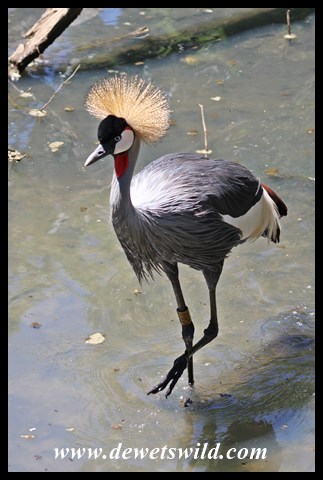
Grey Crowned Crane

Balearica regulorum

The Grey Crowned Crane with its eye-catching “hairstyle” must be one of the most easily identifiable birds in South Africa. Their Afrikaans name, Mahem, is a good imitation of their call. They stand about 1m high and weigh roughly 3.5kg.

Grey Crowned Cranes can be found in or near wetlands and flooded grasslands, and is one of the few crane species that will perch in trees. Their diet is omnivorous, ranging from grass-seeds and grains to insects, crabs and small vertebrates. Pairs are territorial during the nesting season, which stretches over the wetter seasons in South Africa. Nests are platforms built from grass and sedges in waterlogged areas. Courtship includes elaborate dances involving jumping and bowing. Two to five eggs are incubated for four weeks, and the precocial chicks fledge within 100 days of hatching. Outside the breeding season Grey Crowned Cranes flock and roost communally in groups numbering up to 200.

As a result of wide-spread habitat loss and illegal collection of eggs and live birds from the wild for the illegal wildlife trade and traditional uses, the IUCN considers the Grey Crowned Crane to be endangered, despite their wide distribution in Eastern, Central and Southern Africa. The population in South Africa is estimated at between 4,000 and 5,000 (out of a total population probably below 64,000 on the continent) and is mostly found in the provinces of the Eastern Cape, Kwazulu Natal, Free State and Mpumalanga.