
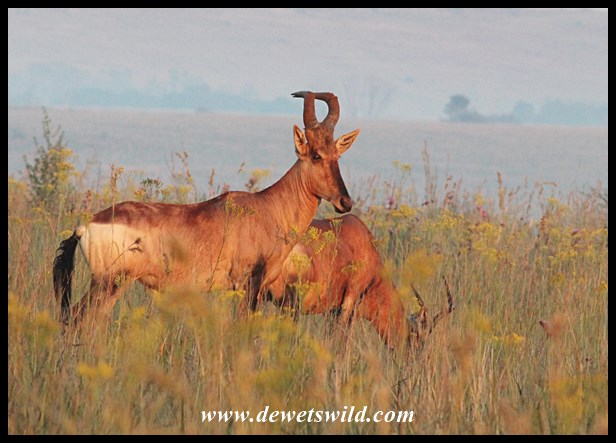
Alcelaphus buselaphus caama
The Red Hartebeest was one of the first animals encountered by Dutch settlers when they arrived at the Cape of Good Hope in the mid 1600’s, the “hart” in their name coming from the Dutch word for deer. On average, at 160kg, Red Hartebeest bulls weigh around 30kg more than the cows and grow to a shoulder height of about 1.3m.


Red Hartebeest occupy a wide range of habitats, from the edge of the Namib desert through the entire spectrum of semi-deserts, fynbos, grasslands and bushveld to mountainous highlands and floodplains. They are grazers, preferring medium to long grass, but in some areas they also include a substantial amount of browse in their diet. These hartebeests are independent of drinking water, though they will drink where it is available.


Red Hartebeest are social animals, at times congregating in enormous herds, especially when migrating. Breeding herds consist of cows and their calves, while mature bulls maintain territories, in some areas throughout the year, into which they try to herd harems of breeding cows. Bulls too young or old to compete for territories keep to bachelor herds. Bulls get involved in serious fights to protect their territories (which are demarcated with dung piles and scent glands and advertised through ritual displays), sometimes leading to the death of both combatants when their horns become inextricably locked. Like the tsessebe, the Red Hartebeest is a very athletic antelope, capable of running continuously over distances of up to 15km and reaching speeds of up to 75km/h. They are most active in the morning and evening, and at times throughout the night.


Red Hartebeest cows give birth to single calves at the the onset of the rainy season. The calves remain hidden in dense cover for the first few days of life, before joining “creches” in their maternal herds. Red Hartebeest are not easily preyed on, though they do feature in the menu of all Africa’s big predators on occasion, and have a life expectancy of up to 19 years in the wild.


The Red Hartebeest is one of seven subspecies of the Common Hartebeest occurring in Africa – six if you count the closely related Lichtenstein’s Hartebeest as a seperate species, although the Red Hartebeest is also considered a separate species in its own right by some authorities. The IUCN indicates that the Red Hartebeest’s population is increasing, estimating the current population at more than 130,000 and without any concern of threats to their continued survival. They can be found in state reserves and private game farms almost all over South Africa, with the exception of the Lowveld of Limpopo and Mpumalanga and the north-east of Kwazulu Natal (areas where historically the Lichtenstein’s Hartebeest were more likely to have occurred). In our experience good places to find and photograph Red Hartbeest would be Addo Elephant, Golden Gate, Karoo, Mountain Zebra and Pilanesberg National Parks, Ithala Game Reserve and Rietvlei Nature Reserve.


 DeWetsWild
Pingback: A Quick Nature Fix at Rietvlei | de Wets Wild
Pingback: Pilanesberg National Park: 10 – 13 May 2012 | de Wets Wild
Pingback: Exploring Golden Gate | de Wets Wild
Great photos. They are rather comical looking aren’t they! 😀
Thanks Elle! They do look as if they were put together with spare parts – until you seem them run at full speed!
What a magnificent animal and exquisite photographs, de Wets. 😄
Thank you very much, Jane!
Such magnificent animals. Great shots as always, Dries. 🙂
Thank you very much, Sylvia!
Good morning to you. Have a great week. 😃
And you, thanks!
Baie goeie inligting en mooi foto’s,Dries.Ek hou veral van daardie laaste foto,waar hulle so rooi vertoon in die gras…nou weet mens waar die naam vandaan kom!
Baie dankie Dina!
So mooi! So baie biltong! 😈
Nee wat, weereens heeltemal te seningrig (sou ek raai).
Mmmm… ek kon altyd ‘n ou stukkie toutjies biltong inwurg! 😉
Ek hou van soos gewoonlik!
Altyd wonderlik wanneer jy kom kuier, dankie Tina!
Ek mis dit nie graag nie
They almost look like horses with horns! neat colour! :)T
Thanks, Teresa! Indeed, they are like race horses when you see them galloping at full speed!
I can just imagine! beauty! 🙂 T.
They look like Tsessebe, don’t they? With their horns bend backward like that, how do they fight?
Thanks for sharing. 😉
You are spot on, Helen – they do look similar to the tsessebe, a close relative. And that backward curve is the reason why bulls’ horns get stuck together so easily when they fight – as soon as one animal starts pulling back it becomes a tug-of-war!
fabulous series, I have never heard of this animal before, thank you for sharing
Glad we could introduce you, Julie!
Pingback: Lichtenstein’s Hartebeest | de Wets Wild