
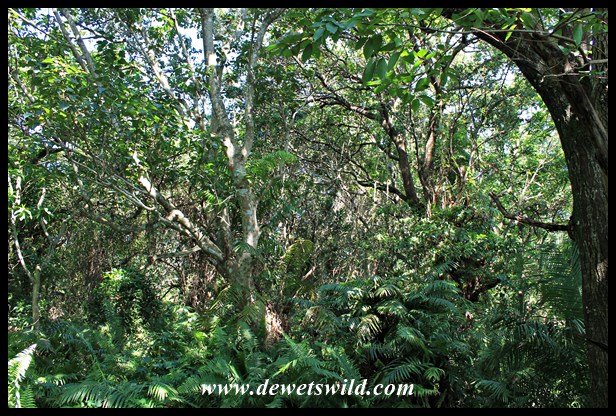
A visit to Umlalazi Nature Reserve would not be complete without exploring the extensive tracts of pristine forests protected in the reserve.
Umlalazi’s Siyaya Trail snakes through the forest, up and down over the densely vegetated dunes, for a distance of 3km. Enormous red and smaller white milkwoods (Mimusops obovata and Sideroxylon inerme respectively) predominate in the species-rich climax dune forests. The Siyaya Trail starts at the beach parking area and makes a large circle through the forest to end at the parking area again, but about half-way through a side-trail leads to a footbridge over the Siyayi stream and to the beach.
At the grove of Kosi palms (Raphia australis) a boardwalk has been constructed just above the level of the waterlogged forest floor, allowing easy access to these magnificent trees and the palm-nut vultures that feed and breed in them. Interestingly, the Kosi palms flower and fruit only once in their lifetime, when the tree is around 30 years old. Elsewhere in the swamp forests, a little further inland than the dune forest, ferns and the swamp fig (Ficus trichopoda) are the most noticeable species.
Umlalazi’s forests abound with insects and other invertebrates, numerous insectivorous and frugivorous forest birds, as well as forest dwelling mammals, of which the red duikers and vervet monkeys are the easiest to see.


 DeWetsWild
This looks like my kind of hike! I like being in the trees rather than in the open 🙂
When the day heats up you appreciate the thick canopy even more, Joanne 😉
Exactly my thinking 🙂
Die pill miltipede fasineer my nogal. Nog nie so iets gesien nie. Hoe groot is hulle? Ons het hier in die huis sulke klein grysetjies wat hulself in sulke klein bolletjies rol as mens aan hul raak. Dis hierdie tyd van die jaar dat hul in kom. Ek dink dis die koeler weer wat hul laat inkom. Pragtige foto van die rooi duikertjie!
Baie dankie Ineke!
Die “millipede” is nogal groot – so 7cm lank en 2cm breed, en as dit oprol omtrent so groot as n R5-stuk.
Gladnie baie klein nie. Interessante gogga!
so very beautiful.
Umlalazi’s really such a beautiful place, Gavin
It is beautifully maintained! J&A
A tiny paradise 😀
dit laat my terug verlang na Natal!
Gelukkig kan jy jou troos aan die mooi omgewing waar jy jou nou bevind, Aletta!
Dit is so! Ek is mal oor die Weskus!
It looks like Florida!
Our Eastern seaboard is very tropical!
Yes, it is beautiful – aren’t your children lucky! I have loved my travels in South Africa and I am thinking about the next expedition. I need to visit Oudtshoorn so I am considering travels in the Western Cape and the Karoo – what do you think? I will have 4-5 weeks.
4-5 weeks gives you ample opportunity to explore South Africa’s Cape Provinces – Western, Eastern and Northern, Candy. There’s some very special wild destinations, Parks like Kgalagadi, Augrabies, Karoo and Mountain Zebra, and if you visit in August and September the wild flowers in Namaqualand should be spectacular.
Is this a tricky post? The first photo doesn’t have any animal or bird, right? 😉 I kept looking for something in that phto…
I’m sure there must be a myriad unseen creatures in the photo, Helen!
😀
Wow, they are slow bloomers – do the palms produce offset before they die?
All my books mention that they’re not a suckering palmspecies and it would seem propagate by seed only, Maurice. This article gives a bit more detail about the Kosi Palm: http://www.plantzafrica.com/plantqrs/raphiaaust.htm
Thanks for the article!
It always amazes me – there is so much beauty in the world that I have never even heard of, like a Black-throated Wattle-eye!
The wattle-eye was a new tick on our list! They are restricted to the lowland forests along South Africa’s eastern borders and I was thrilled to finally see them in person.