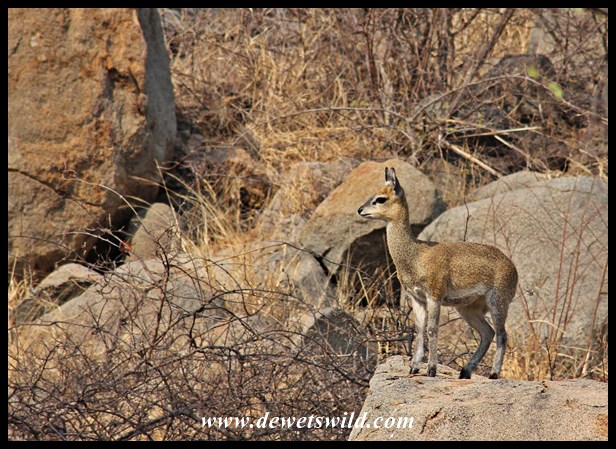
Oreotragus oreotragus
The Klipspringer is another of South Africa’s smaller, and cuter, antelope, between 49 and 65cm high at the shoulder and weighing between 9 and 19kg. Adult ewes are slightly heavier than the horn-carrying rams.


Uniquely among antelope, the Klipspringer walks on the tips of its hooves, allowing it to balance like a ballerina on exceptionally small areas. This is a handy adaptation to the rugged and rocky mountains, hills and outcrops they inhabit. Their very apt Afrikaans name literally means “Rockjumper”. More than 90% of their diet consists of browse; leaves, twigs, flowers, fruit and seeds, preferring young growth. They are independent of drinking water.


Klipspringer pairs mark and defend small territories, in which they stay together for long periods, often for life. Small groups normally comprise the territorial pair accompanied by one or more of their lambs. Klipspringers are well camouflaged, and usually only observed when they stand sentinel on a conspicuous vantage point. They move around their rocky abodes with amazing agility, and are most active in the early mornings and late afternoons. Single lambs are born at any time of the year and have a life expectancy of between 7 and 15 years.


The IUCN considers the Klipspringer’s conservation status as “least concern”, with a stable population of at least 42,000 on the African continent. Good places to search for Klipspringer in South Africa is the Karoo, Kruger, Mapungubwe, Marakele and Pilanesberg National Parks. Some authorities believe that three different species of Klipspringer occur in South Africa; the Angolan or Tyler’s Klipspringer (O. tyleri) in the extreme north-west corner of the Northern Cape Province, the Cape Klipspringer (O. oreotragus) in the south-west of the country and the Transvaal Klipspringer (O. transvaalensis) in the north-east, though these may well only be different subspecies based on slight variances in colouration, horn length and body size.


 DeWetsWild
Pingback: Mokala National Park | de Wets Wild
Very good info! You did answer one of my questions and that was about the tiptoe hooves. My other two questions are 1 y does it have an extra pair of eyes and what do they do? 2 What sounds does klipspringers make? Horses say neigh, cows say moo and pigs say oink for example.
Thank you for the kind comment and good questions, Jennifer!
What looks like an extra pair of eyes is actually a pair of scent glands that the klipspringer uses to mark its home range by rubbing the secretions onto prominent twigs and rock surfaces.
Klipspringers aren’t very noisy animals, but they do make a shrill “whistle” through their nose when alarmed.
Pingback: A month of monochrome memories: On the Rocks | de Wets Wild
Spring bokkies… spring!! Hoe gaan daai ou lietjie? Stadig, stadig oor kie klippertjies… 😉
Nie dat hierdie bokkies “stadig oor die klippertjies” is nie!
They are delightful!
Most definitely, thanks guys!
Dit lyk altyd of hul op die punte van hul toontjies(hoefies) staan. Hul klim ook die onmoontlikste rotse uit! interessant dat hul genoeg vloeistof uit plante kry om “nat” te bly. Lekker gelees, baie dankie hoor!
Ek dink mens sal lank soek voor jy iets ratser as n klipspringertjie kry! Dankie dat jy n draai kom maak het, Ineke!
They’re very shy, aren’t they? We were lucky to spot a small group in the Serengeti but they refused to turn around to look at us!
They are normally extremely skittish! But they do habituate easily where they occur close to people and are not harassed and then give excellent photographic opportunities 😉
Pragtige diere. Dankie vir die interessante feite.
Dankie dat jy kom saam gesels het, Zirkie!
BAie interessant, Dries! Dankie jou kosbare feite. Geniet dit altyd baie. So leer mens meer en meer omtrent ons pragdiere.
Dankie Spokie, dis lekker om te weet iemand wat ons natuur so goed ken as jy geniet dit ook!
Often overlooked in the wildlife documentaries, so good to read about them here. Very interesting!
Absolutely Gordon. Pity that the doccies focus so much attention on the big an scary animals, our knowledge of other animals could have been vastly enhanced if they’d spend some time following the lesser known creatures.
such a sweet face.
Absolutely Gavin! Almost as if they are smiling!
Looks awesome! Reminds me a bit of the pronghorns we saw in Yellowstone.
Even though they’re a lot smaller, they also have very “expressive” faces, like the pronghorns do.
Those are beautiful little creatures! I had never heard of them before.
It’s always a special treat for us when we find a Klipspringer or two!
They have the most beautiful ears!
Looks almost like a pattern was stitched into the inside of their ears, don’t you think?
I do! I just love it.
Wonderful photos of this little antelope. Love the position you caught in the first photo but they are all fantastic. What an amazing variety of antelope in Africa. A species for every possible niche it would seem. Great post!
Thanks Alison. I must admit I really like doing this series about our antelope that I feature every now and then. And you are absolutely correct, from the 900kg eland to the 4kg blue duiker there’s a place for each of them in the big picture.
they are so cute looking! But those horns look pretty darn sharp! ! 🙂
You are right, Teresa – he’d be able to do a lot of damage with those, and his sharp hooves, if you try to hug him 😉
Great post – Kings of the Rock. They’re so agile! Every now and then we sometimes get to see a pair at Cape Point, that’s always a buzz.
You are very lucky Liz; not many years have passed since they were reintroduced to Table Mountain National Park!
Baie leersaam.Dankie Dries vir al die mooi foto’s en inligting!
Dankie Dina, ek is dankbaar om te weet jy’t dit geniet!
What a lovely little creature!
No arguments from us, thanks Sue!
Wow, the first one is amazing – excellent captured… 🙂
Thank you very much, Drake!
Oulike klein ding!
Dit is hulle beslis, dankie Tina!