
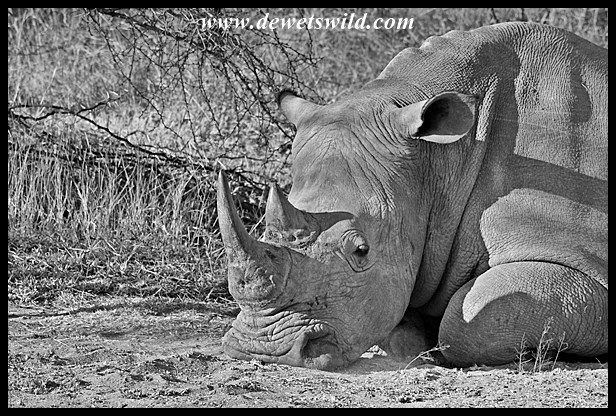
Is there a reason for this white rhinoceros to look so despondent on World Rhino Day? Ponder for a moment on the thought that there’s a good chance this white rhino, that we encountered in the Kruger National Park in August this year, may not be roaming around the wilderness anymore. There’s a good chance this rhino has been killed, its carcass left to rot under the African sun while its horns have already been ground to a fine powder somewhere in Asia.
The 22nd of September is World Rhino Day, a day to reflect on the large-scale slaughter these enigmatic animals are facing due to human greed and superstitious culture. This year alone, South Africa has already lost more than 769 rhinos to poaching (that was the figure as at 12/09/2014), following from 1004 in 2013, 668 in 2012, 448 in 2011, 333 in 2010.., well, the trend is clear.
It is also another chance to express our deep gratitude to those brave men and women out in the bush, fighting a war against the decimation of our wildlife, putting their lives on the line so that black and white rhinos remain a feature of Africa’s natural heritage for generations to come.
 DeWetsWild
This breaks my heart. God bless those brave people trying to save His creatures from the ignorant. And bless you for sharing and making more of us aware.
Thanks for the support and blessings Linda, and may God bless you too! There’s some very dedicated people fighting very hard to protect these icons of creation, and knowing that there’s people like you appreciating their sacrifices and hard-work is what gives them the motivation to keep at it.
Pingback: Rhinos: strong but oh so vulnerable | Tish Farrell
Thanks for sharing our post for World Rhino Day with your friends, Tish.
Ek raak sommer naar as ek daaraan dink.Ian Player se pogings om die renoster te red,lyk of dit in sy leeftyd weer op ‘n ramp afstuur.Totdat mense nie wetenskaplik na die wêreld om hulle kyk nie,sal hierdie tipe van agterlike denke,nooit gestuit word nie.
Ek kan nie anders as om met jou saam te stem nie Dina.
The slaughter will continue unabated as long as there is demand from Asia. In the meantime we need to use whatever tools are available to try to stop the supply. Last week we visited Ndumo Game Reserve. They have signs, prodominantly displayed, that their rhinos have had their horns infused with poison and dye and that they are not safe for human consumption. The ranger there told us that since the horns were infused they have not lost a rhino to poaching. Holding thumbs it stays like that.
The news that the poison-infusion at Ndumo seems to be an effective deterrent is music to my ears James. Considering that Ndumo is right on the Mozambique border, it seems the news has spread to that country too. I believe it is a very pricy strategy though, and requires regular re-application, so applying it in big rhino populations like Kruger and Hluhluwe-Imfolozi may be more difficult?
Also, I’m looking forward to your trip report from Ndumo James 🙂
So awful, such huge numbers being lost each year. Thanks for writing about it.
Thanks for the support MaameJ. We have to win this war.
Yes, a huge cheer for the rangers who risk their own lives to protect the world’s wildlife. And I agree with you too over curbing the market. Sanctions, I feel. Though I guess that’s unlikely. Global marketing must come first!
Sadly so true Tish. In the corrupt, money-driven world we live in we should please not step on the toes of any up-and-coming economic powerhouses just to keep a couple of animals alive…
Tragies…
Maak n mens skoon moedeloos Tina, ek kan net dink hoe die arme, opregte, veldwagters daaroor voel…
Such a tragedy. The idea that we could lose any animal, especially such a beautiful and majestic creature as the rhino, is appalling. Even more so that it comes as a consequence of a trade pedalling ineffective medicine, on the back of outdated cultural and traditional practices. And the tragedy is increased by the fact that it is not just the rhino, but also a whole host of other land and marine mammals, facing the same fate. What will our world be without rhinos, elephants, tigers, sharks, turtles, sun bears…to name just a few.
Absolutely Jenny. Wildlife trafficking means big money, and there will always be desperate people willing to do the killing as long as there’s someone prepared to buy…
So true. And every win in the favour of conservation and protection is so hard won and so slow, isn’t it? It seems like two steps forward, one step back a lot of the time.
Very sad and disheartening. Education and stricter penalties… this disregard for the animals is rampant. Thank you for your efforts in raising awareness.
Thanks for your support Jane!
Is a rhino’s horn really potent? To cure what? Cancer, AIDS, Ebola, man’s stupidity?
Bless you de Wets for spreading the word on the survival of these magnificent beasts. You have a good heart in you 🙂
Thanks for the support Raja. It’s a desperate situation and perhaps this post, and others we’ve done in previous years, will assist in raising awareness and winning hearts and minds over for the cause of rhino conservation. It is our and our children’s heritage being wiped out without reason.
It’s almost incredible to contemplate the fact that in a country like China, for instance, the economic upturn is reflected in increasing wealth, while their consumption of superstitious cures increases at around the same rate. 😦
Absolutely spot-on Margaret-Rose. There’s a multitude of newly affluent people in the Far East, China and Vietnam especially, with the means and desire to purchase rhino horn at prices higher than that fetched by any mineral on the planet, thus the exponential increases in rhinos killed for their horns in the recent past. These are not illiterate people, surely they know that chewing their own toe nails will do them just as much good as consuming rhino horn?
I believe it’s like the Japanese insisting on continuing with their ‘scientific’ whaling: scarcely anyone in Japan is eating whalemeat any more, but it’s become a matter of Culture, and of Tradition ! :-\
And at all and any cost…
This is sad, sickening and horrible. Aside from the men and women out in the bush, what else does it take to make this stop?
The only way to put a stop to it Lois, would be to curb the massive, and ever increasing, demand from Asia.