Tag Archives: wildlife

Dung Beetles

Family Scarabaeidae

It is estimated that South Africa is home to almost 800 species of Dung Beetles, varying in both size and colour. As manure is the chief source of food for both adults and larvae (some also feed on carrion), Dung Beetles perform a vital ecological function by clearing away the droppings of large animals and at the same time fertilizing the ground, planting seeds contained in the dung and keeping pest and parasite populations under control.

When it comes to breeding, Dung Beetles employ one of four strategies. Best known are those that roll the manure into perfect balls (sometimes 50 times their own weight!), roll it to a suitable location using the hind legs (with the female often sitting comically atop the ball), lay eggs inside and then bury the ball. Other kinds “steal” the ball after it was meticulously formed and deposited. Yet another strategy involves burrowing beneath a dung-pile, depositing some of it at the end of the tunnel and then covering it after the eggs are laid inside. The final option is to live and breed in the dung just where it fell. In South Africa, Dung Beetles are most active in the warmer and wetter months with most spending the winter in hibernation. They may live for up to 3 years.

The Addo Flightless Dung Beetle (Circellium bacchus) is a large beetle found only in and around the Addo Elephant National Park in South Africa’s Eastern Cape Province and one of only a few Dung Beetle species incapable of flight. If it wasn’t for the proclamation of the national park this species would have become extinct, as it feeds on and breeds in only the dung of elephants and buffaloes, both of which were almost exterminated from the Eastern Cape before the national park was proclaimed. It is a slow breeder, females lying a single egg on each dung ball and breeding but once annually. The Addo Flightless Dung Beetle is still considered vulnerable.

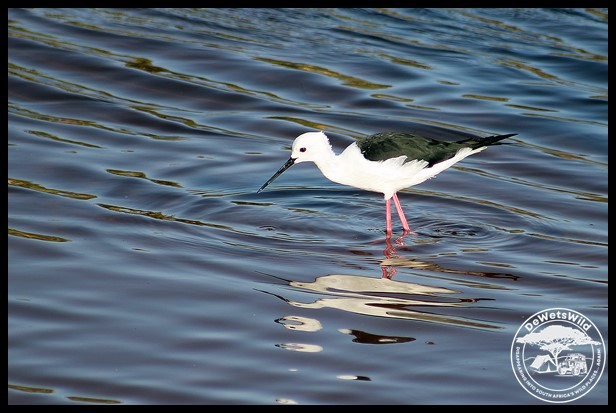
Black-winged Stilt

Himantopus himantopus

The very elegant Black-winged Stilt is one of the most widespread birds on the planet, occurring on every continent except Antarctica (though some authorities consider it to actually be as many as five different species). As a result it is listed as being of least concern by the IUCN. It is also widely distributed over all of South Africa, even occurring in the arid west of the country where its habitat requirements are met – basically any open wetland habitat, whether fresh or brackish, natural or man-made (even sewerage plants and salt works), is to their liking. They are nomadic birds, regularly moving from one body of water to the next. As is probably to be expected, Black-winged Stilts feed on aquatic invertebrates, tadpoles, frogs, small fish and fish- and frog-eggs.

Pairs of Black-winged Stilts are monogamous and usually nest alone, though occasionally up to 10 pairs may nest in close proximity. Their nests are mounds of mud and plantmaterial built by both partners at the edge of the water. They breed at anytime of year, but there’s a distinct peak in nesting behaviour in the spring months in our part of the world. The female is responsible for incubating the clutch of up to 5 eggs for almost 4 weeks. The chicks leave the nest within 24 hours of hatching to follow the parents around and feed themselves. By the age of a month they start flying and become fully independent by the time they are two months old. Black-winged Stilts are active both by day and during the night.

With probably the longest legs in relation to its body of any bird, adult Black-winged Stilts weigh in at about 165g and measure 38cm from tip-to-tip.


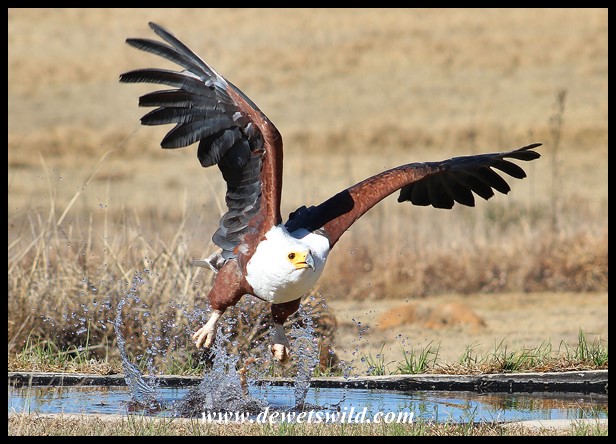
Hali the Fish Eagle

Hali is an African Fish Eagle that calls the Dullstroom Bird of Prey and Rehabilitation Centre home. She’s a majestic creature, and regularly and proudly announces her presence with that beautiful call that is so quintessential of Africa’s wild places. Hali is unfortunately hopelessly imprinted on humans and cannot be released back into the wild. This notwithstanding, she’s as adept as any wild Fish Eagle at snatching her food from the water.

As a registered NGO receiving no government support, the Dullstroom Bird of Prey and Rehabilitation Centre relies heavily on donors, sponsors and the visiting public to fund their very important work. Their tiny staff compliment is responsible for the rehabilitation of between 80 and 200 birds of prey every year, all of them injured by or negatively impacted in another way by humans, and then releasing them back into the wild when they’ve recovered sufficiently. If you can’t visit them in person, please visit their website and, if you are able to, assist them in their efforts by making a donation (monetary or in kind).

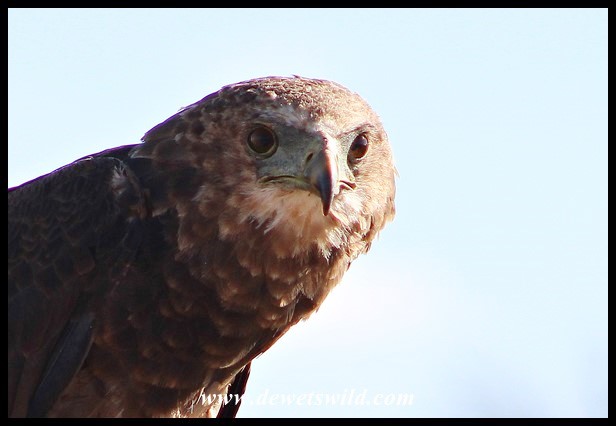
Ashanti the Verreaux’s Eagle

Ashanti the Verreaux’s Eagle was stolen from her nest as a chick to become someone’s exotic pet, and it was her good fortune that she ended up at the Dullstroom Bird of Prey and Rehabilitation Centre where she is now cared for with great affection. Ashanti’s quite the diva, and who can blame her when she is so entrancingly beautiful?

As a registered NGO receiving no government support, the Dullstroom Bird of Prey and Rehabilitation Centre relies heavily on donors, sponsors and the visiting public to fund their very important work. Their tiny staff compliment is responsible for the rehabilitation of between 80 and 200 birds of prey every year, all of them injured by or negatively impacted in another way by humans, and then releasing them back into the wild when they’ve recovered sufficiently. If you can’t visit them in person, please visit their website and, if you are able to, assist them in their efforts by making a donation (monetary or in kind).

Libra the Bateleur

Libra is an immature Bateleur that was badly injured after being hit by a vehicle. So badly injured in fact, that a vet advised she be euthanised. The dedicated staff at the Dullstroom Bird of Prey and Rehabilitation Centre decided neverthless to give saving her life their best shot, and today Libra is finding her wings again, so to speak. Libra’s a very shy youngster – reminiscent of a child hiding behind her mother when meeting a stranger – and the way she has bonded with her caregiver Magdali will melt your heart.

As a registered NGO receiving no government support, the Dullstroom Bird of Prey and Rehabilitation Centre relies heavily on donors, sponsors and the visiting public to fund their very important work. Their tiny staff compliment is responsible for the rehabilitation of between 80 and 200 birds of prey every year, all of them injured by or negatively impacted in another way by humans, and then releasing them back into the wild when they’ve recovered sufficiently. If you can’t visit them in person, please visit their website and, if you are able to, assist them in their efforts by making a donation (monetary or in kind).

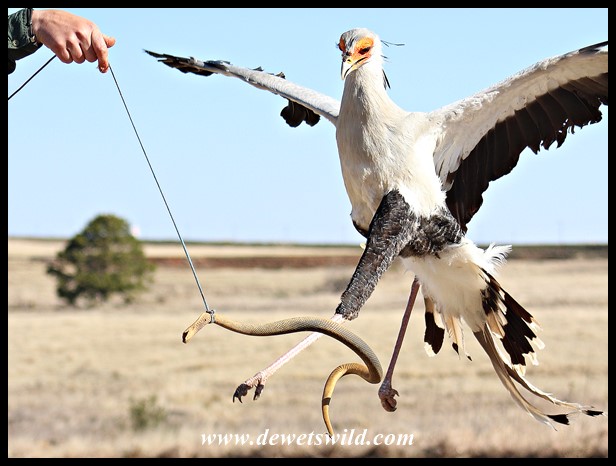
Rooney the Secretary Bird

Rooney the Secretary Bird was snatched from his nest as a chick, with the intention to be raised to adulthood and then killed for his body parts to be used in superstitious rituals. Thankfully the authorities could confiscate him before these cruel plans were brought to fruition and he now resides at the Dullstroom Bird of Prey and Rehabilitation Centre. Being imprinted on humans, Rooney wants nothing to do with other secretary birds and cannot be released back into the wild. If you are a sports lover Rooney’s name will quickly make sense to you when you see his powerful kicks (though he directs these to the head of a rubber-cobra rather than a football).

As a registered NGO receiving no government support, the Dullstroom Bird of Prey and Rehabilitation Centre relies heavily on donors, sponsors and the visiting public to fund their very important work. Their tiny staff compliment is responsible for the rehabilitation of between 80 and 200 birds of prey every year, all of them injured by or negatively impacted in another way by humans, and then releasing them back into the wild when they’ve recovered sufficiently. If you can’t visit them in person, please visit their website and, if you are able to, assist them in their efforts by making a donation (monetary or in kind).

Ginger the Lanner Falcon

Ginger the Lanner Falcon is one of the Dullstroom Bird of Prey and Rehabilitation Centre‘s success stories – she arrived at the centre having been shot through the wing, but has recovered so wonderfully that she is set to be released back into the wild before the end of the year! For now she is given regular flying exercise and sometimes the visiting public are lucky enough to witness her practice sessions, like we were when we visited recently.

As a registered NGO receiving no government support, the Dullstroom Bird of Prey and Rehabilitation Centre relies heavily on donors, sponsors and the visiting public to fund their very important work. Their tiny staff compliment is responsible for the rehabilitation of between 80 and 200 birds of prey every year, all of them injured by or negatively impacted in another way by humans, and then releasing them back into the wild when they’ve recovered sufficiently. If you can’t visit them in person, please visit their website and, if you are able to, assist them in their efforts by making a donation (monetary or in kind).


Daphne the Spotted Eagle-owl

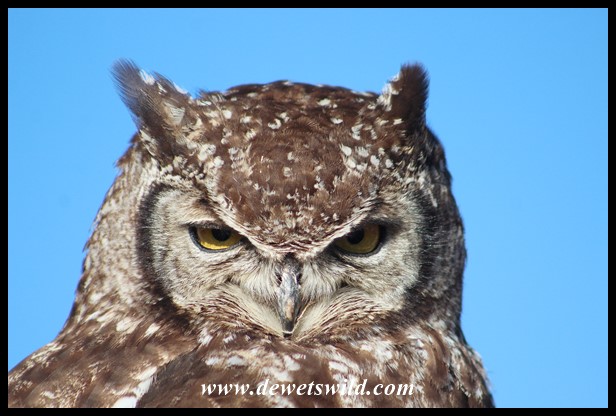
Daphne is the sweetest Spotted Eagle-owl you could ever hope to meet (though her table manners leave a lot to be desired). She has lived at the Dullstroom Bird of Prey and Rehabilitation Centre all her life. The tree her parents were incubating Daphne in was chopped down and, miraculously, Daphne’s egg was the only one of the clutch that didn’t shatter. The egg was brought to the rehab centre and, on detecting a heartbeat in the egg, they decided to hatch it and raise the chick by hand. While she is imprinted on humans and cannot be released, Daphne’s dear personality is just the ticket to dispel any ill-conceived superstition visitors may hold about owls. She’s a true ambassador for all owl-kind.

As a registered NGO receiving no government support, the Dullstroom Bird of Prey and Rehabilitation Centre relies heavily on donors, sponsors and the visiting public to fund their very important work. Their tiny staff compliment is responsible for the rehabilitation of between 80 and 200 birds of prey every year, all of them injured by or negatively impacted in another way by humans, and then releasing them back into the wild when they’ve recovered sufficiently. If you can’t visit them in person, please visit their website and, if you are able to, assist them in their efforts by making a donation (monetary or in kind).

Charlie the Peregrine Falcon

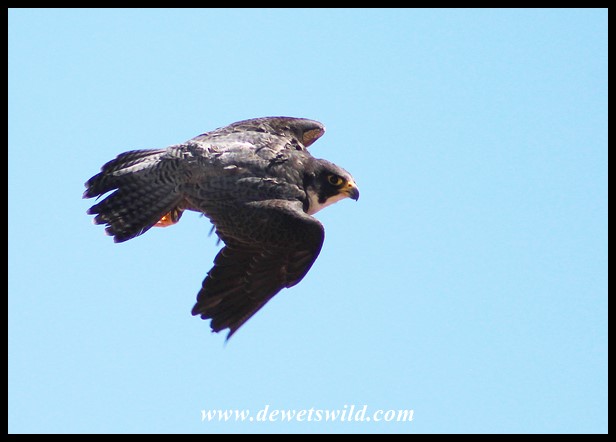
Charlie is a Peregrine Falcon that lives at the Dullstroom Bird of Prey and Rehabilitation Centre. He was raised by a falconer and imprinted on humans, which is why he cannot be released. Charlie is 13 years old now – quite old for a bird his size – but still possesses the incredible speed and agility his species is known for.

As a registered NGO receiving no government support, the Dullstroom Bird of Prey and Rehabilitation Centre relies heavily on donors, sponsors and the visiting public to fund their very important work. Their tiny staff compliment is responsible for the rehabilitation of between 80 and 200 birds of prey every year, all of them injured by or negatively impacted in another way by humans, and then releasing them back into the wild when they’ve recovered sufficiently. If you can’t visit them in person, please visit their website and, if you are able to, assist them in their efforts by making a donation (monetary or in kind).


Vinkel the Wood Owl

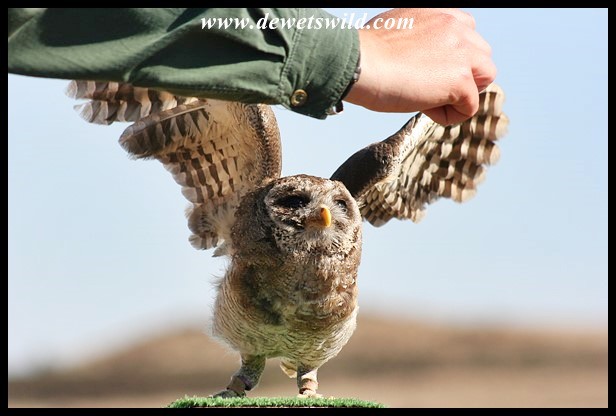
Vinkel is a little Wood Owl that lives at the Dullstroom Bird of Prey and Rehabilitation Centre. When he was a little chick he fell out of his nest. Well-meaning humans picked him up and tried to hand-raise him, feeding him a mix of minced meat and – shockingly – cotton wool; a horribly incorrect tip they found on the internet, supposedly meant to simulate the hair and feathers that owls normally ingest and then regurgitate as owl pellets. As a result, little Vinkel’s growth was stunted and he imprinted on humans, meaning that he can never be released into the wild – thankfully he made it to Dullstroom in time for his life to be saved. I think it is also necessary to mention at this point that any little bird found out of its nest is best returned to it or as close as can be to its parents if at all possible – it is not true that the parent birds, of any species, will reject a chick because it “smells” of human.

As a registered NGO receiving no government support, the Dullstroom Bird of Prey and Rehabilitation Centre relies heavily on donors, sponsors and the visiting public to fund their very important work. Their tiny staff compliment is responsible for the rehabilitation of between 80 and 200 birds of prey every year, all of them injured by or negatively impacted in another way by humans, and then releasing them back into the wild when they’ve recovered sufficiently. If you can’t visit them in person, please visit their website and, if you are able to, assist them in their efforts by making a donation (monetary or in kind).