Tag Archives: wildlife

Cape Shoveler

Spatula (Anas) smithii

The Cape Shoveler inhabits shallow freshwater habitats (including farm dams, flooded grasslands, marshes and sewage works), lagoons, estuaries and salt pans, where it feeds mainly on aquatic invertebrates and tadpoles with plant material forming a smaller portion of the diet. While they are usually resident, at times Cape Shovelers will cover enormous distances; the reason for these erratic movements aren’t yet understood. Outside of the breeding period they may form sizable flocks of more than a hundred individuals.

Cape Shovelers breed at any time of the year (peak from late winter to early summer) in monogamous pairs, with the female being responsible for the building of the nest – a scrape in the ground built up with twigs, leaves and down, usually on a thickly vegetated island. She lays a clutch of 5-13 eggs and incubates them for 4 weeks. Once hatched, it is mostly the female that takes care of the ducklings while the male guards against predators. The chicks can fly when they’re about 9 weeks old and become independent soon after. Fully grown they measure about half-a-metre in length and weigh approximately 600g.

The Cape Shoveler occurs only in Southern Africa, being found from southwest Angola, through Namibia, Botswana and Zimbabwe to Lesotho, Eswatini and South Africa, where they’re found at varying densities in all our provinces, with the largest concentrations on the Highveld and in the Western Cape. Considering that the IUCN estimates a growing population of up to 33,000 birds the Cape Shoveler is listed as being of least concern.

Silver Tree

Leucadendron argenteum

The IUCN lists the Silver Tree as “vulnerable”. During early colonial times the trees were heavily harvested for fire wood and its remaining natural occurrence is limited to 5-7 fragmented sub-populations on Table Mountain, with other populations away from the mountain considered to have been established by humans. Despite mainly being found within the Table Mountain National Park the remaining natural populations are also thought to be declining because of various factors, including urban expansion, unnatural fires and competition with exotic plants. The Kirstenbosch National Botanical Garden has some beautiful examples of the Silver Tree.

While plants die off during fires, the seeds require fire to germinate. Remarkably for a plant that seldom lives longer than 20 years and is mature at between 5 and 7 years, the seeds of the Silver Tree can remain viable for 60 to 80 years, waiting for a fire to trigger them into growing. They usually grow to 5-7m tall, with exceptional examples reaching heights of 16m, and owe their distinct appearance to a dense coating of velvety hairs on the soft leaves. Male and female flowers are carried on separate plants, and pollination is wind-dependent.


Grey Plover

Pluvialis squatarola

The Grey Plover is a bird that is found along the coastline of all the continents, with the exception of Antarctica, at various times of the year. With a worldwide population estimated at around 750,000 birds, the IUCN considers it to be of least concern. They arrive in South Africa from their Siberian breeding grounds around September and depart again by April, with an estimated 9,000 birds being found along our entire coastline during that time. The Langebaan lagoon in the West Coast National Park is one of the best places to see this species in South Africa. Some, usually younger individuals, will stay here through the winter and don’t join the migration back to the northern hemisphere, as they don’t breed until they’re two years old.

Grey Plovers feed on aquatic invertebrates pecked from exposed mud flats and sand banks on beaches and around estuaries and lagoons. They may roost in large flocks outside the breeding season, but usually forage alone or in pairs. Adults are about 29cm long and weigh around 230g.


Sundowner Moth

Sphingomorpha chlorea

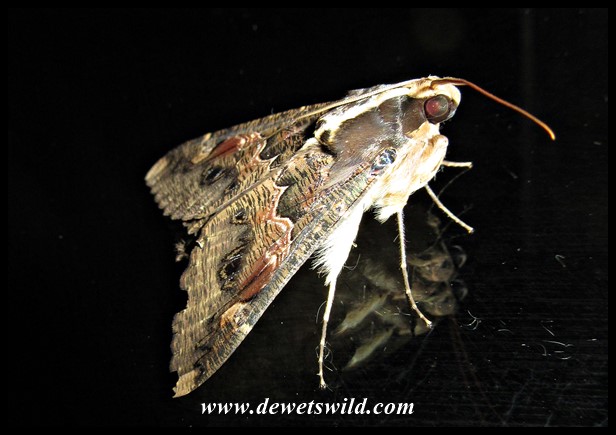
As with the English common name, one of the Sundowner Moth’s Afrikaans names, “Biermot” (Beer moth), refers to their attraction to alcoholic drinks – they’re naturally very fond of fermented fruit. Due to their habit of piercing fruit, it is considered a pest in orchards. They occur over most of South Africa, with the exception of the fynbos -areas in the Western Cape and the arid West Coast, and is especially common in forest and savanna habitats. This is a large moth, with a wingspan of between 6 and 8cm. The larvae feed on the leaves of a very wide range of plants.

World Wildlife Day 2023

In celebration of World Wildlife Day we take a look back at the 67 species of South African wildlife we featured in detail here at de Wets Wild through the past twelve months.

Rock Martin

Ptyonoprogne fuligula

A common resident in our part of the world, the Rock Martin inhabits rocky mountains, hills and outcrops, and has adapted to the built environment. They feed exclusively on flying insects and will even hunt at night around artificial lights.

Rock Martins form monogamous pairs and may breed throughout the year, though mostly in spring and early summer. They build their mud nests under overhanging rocks and even roofs and bridges. The parents take turns to incubate the clutch of 2-3 eggs over a 3 week period. The chicks remain in the nest for about 4 weeks, but even after they fledge return to the nest every night until they’re almost two months old before becoming fully independent. Outside of the breeding season they may roost in small groups on rocky ledges or against buildings.

in South Africa, Rock Martins are found in suitable habitat in every province. Beyond our borders they’re found as far north as Angola and Zambia. The IUCN evaluates its conservation status as being of least concern.

Cape Snow

Syncarpha vestita

The Cape Snow, or White Everlasting, when flowering is one of the most conspicuous plants from South Africa’s fynbos biome, growing in well-drained sandy or rocky soils from the Cape Peninsula to the area of George in the Garden Route.  The plants have a very dense growth form up to 1m tall and grow rapidly from seeds after a fire, forming thick stands of plants that flower profusely from October to January and make for beautiful scenery. The tiny purplish flowers, located on a disk surrounded by the eye-catchingly bright white bracts, are pollinated by several kinds of beetles and the inflorescences last for a very long time, even after being cut. Within about 7 years the plants start dying; by then the surrounding vegetation has grown taller than it already and they’re no longer as obviously seen. The seeds then remain dormant in the ground until a fire restarts the process. Cape Snow flowers are used commercially, being popular in flower arrangements (and often dyed different colours).

Soldier Pansy Butterfly

Junonia terea

A butterfly of coastal and riverine forests, the Soldier Pansy is restricted to suitable parts of Kwazulu-Natal and the Lowveld and escarpment of Mpumalanga and Limpopo (as far as its local distribution is concerned). Adults have a wingspan of up to 6cm and can be seen throughout the year, though their numbers peak in spring and autumn. They fly slowly through shady clearings and along pathways and settle often, usually on a leaf just above ground level.

Karoo Chat

Emarginata (Cercomela) schlegelii

Surprisingly common for a bird occurring in arid scrubland and grasslands, often in rocky or gravelly places, the Karoo Chat subsists on a diet of insects foraged on the ground. They’re usually encountered singly, in pairs or small family groups and normally stay well clear of areas of human habitation, in contrast with its better known cousin, the Familiar Chat.

The female takes sole responsibility for building the deep cup-shaped nest, using twigs and sticks, at the base of a shrub, the task taking her about a week to complete. Clutches of 2-4 eggs may be laid at any time of year, especially in response to unseasonal rainfall, but nesting usually takes place in spring and summer. Pairs are monogamous and territorial throughout the year, and both parents take care of the chicks. Fully grown Karoo Chats measure around 17cm in length and weigh about 32g.

True to their habitat preference, Karoo Chats are found in south-west Angola, western Namibia and arid western South Africa (particularly in the Northern and Western Cape and marginally into the bordering Free State and Eastern Cape). The IUCN does not consider it to be of conservation concern.

Four-colour Nudibranch

Godiva quadricolor

The Four-colour Nudibranch is a shell-less mollusc found naturally along the South African coast, but has also been recorded as an exotic alien in Australia and the Mediterranean, where it is thought they were transported to by commercial shipping. They live from the intertidal zone to a depth of up to 20m. Their cerata – the “horns” covering the 4cm long body in bold warning colours – are tipped with stinging nematocysts, which the slug uses to protect itself. These slugs are predators, feeding on other nudibranchs, hydrozoa and other small organisms, while also probably feeding on the remains of dead vertebrates. Like other slugs and snails they are hermaphrodites and produce masses of eggs that hatch within 4 days of being fertilized (internally) and laid.

While visiting with Marilize’s parents in Jeffreys Bay over the New Year we came across this beautiful slug in a rock pool at the main beach. I think its natural beauty is further enhanced by the multitude of colourful shell shards surrounding it in these pictures.