Tag Archives: wildlife

Announcement: DeWetsWild’s portfolio grows again!

Announcement!

We are delighted to announce that DeWetsWild portfolio of reservation services has grown again and now includes the following luxury lodgings in some of South Africa’s best known destinations!

In Addo Elephant National Park:

  • Kuzuko Lodge

In the Bushveld:

  • ANEW Resort Hunter’s Rest
  • Clifftop Exclusive Safari Hideaway, Welgevonden Private Game Reserve
  • KwaFubesi Tented Safari Camp, Mabula Private Game Reserve
  • Mabula Game Lodge, Mabula Private Game Reserve
  • Safari Plains, Mabula Private Game Reserve

In Cape Town:

  • ANEW Hotel Green Point
  • Cape Cadogan Boutique Hotel
  • More Quarters Neighbourhood Hotel
  • Oldenburg Residence, Stellenbosch
  • The Cape Milner
  • The Commodore Hotel
  • The PortsWood Hotel

In the Drakensberg:

  • ANEW Resort Vulintaba

In Johannesburg:

  • ANEW Hotel Parktonian
  • ANEW Hotel Roodepoort
  • DaVinci Hotel & Suites
  • Raphael Penthouse Suites
  • The Leonardo
  • The Michelangelo Towers

In the Kalahari

  • Tswalu Kalahari Reserve

In the Kruger National Park:

  • Hamiltons Tented Camp
  • Hoyo Hoyo Safari Lodge
  • Imbali Safari Lodge
  • Lion Sands Narina Lodge
  • Lion Sands Tinga Lodge
  • Lukimbi Safari Lodge

In the KZN Midlands and Holiday Coast

  • ANEW Hotel Hilton
  • ANEW Hotel Ocean Reef
  • ANEW Resort Ingeli Forest

In the Lowveld:

  • ANEW Resort Hazyview
  • ANEW Resort White River
  • Angels View
  • Elephant Point
  • Kruger Park Lodge

In the Marakele National Park:

  • Marataba Safari Lodge
  • Marataba Mountain Lodge

On the Mpumalanga Highveld:

  • ANEW Hotel Highveld
  • ANEW Hotel Witbank

In Pretoria:

  • ANEW Hotel Capital
  • ANEW Hotel Centurion
  • ANEW Hotel Hatfield
  • The Centurion Hotel

In the Sabi Sand Game Reserve:

  • Idube Game Lodge
  • Lion Sands Ivory Lodge
  • Lion Sands River Lodge

In the Thornybush Game Reserve

  • Monwana Residence

In Zululand and Northern Kwazulu-Natal:

  • ANEW Hotel Hluhluwe

Don’t forget that DeWetsWild can assist you in putting together the perfect itinerary for visiting our country’s most beautiful places with stays at any of 277 destinations right across South Africa.

DeWetsWild can assist you with reservations at all these destinations! (map courtesy of mapsland.com)

Klipfish

Family Clinidae

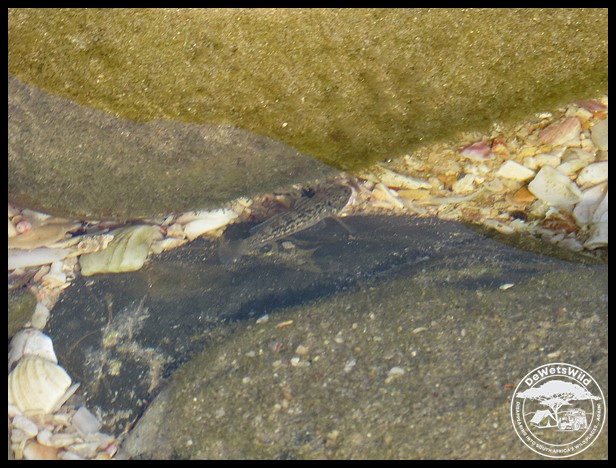
The Klipfish, probably one of the most familiar fishes occurring in the rocky pools along our eastern and southern shoreline providing hours of entertainment to children trying to catch them with nets and buckets, is actually a very diverse group with 33 species occurring in South African waters and 175 different kinds altogether in the oceans around the world.

Klipfish’s cryptically coloured blotches blend in very well with the pebbles, shell shards and pieces of seaweed in their rocky homes. Their camouflage is equally useful in catching their prey – smaller fish, shrimps, crabs and worms – unawares.

Klipfish are in essence solitary fish, though several individuals may live in close proximity in the same intertidal pool. Interestingly, Klipfish females are fertilised internally after the male performed his mating ceremony, and they then give birth to live young.


Cape Hare

Lepus capensis

The Cape Hare inhabits open and dry habitats ranging from desert to grassland, requiring only a little cover in the form of clumps of tall grass or low growing shrubs in which it can hide by day. By night they feed on green grass and, to a lesser extent, the leaves and young shoots of shrubs and bushes. They do not require access to drinking water as they glean enough moisture from their food and morning dew.

Cape Hares are usually seen singly except when several males may crowd around a receptive female, which often leads to intense fighting between them. When threatened they will try to hide until the predator is almost on top of them, flushing at the last second to run away at up to 60km/h, making quick turns as they go! Cape Hares are a favourite prey of most of the larger mammalian and avian predators sharing their range, and live only about 5 years in the wild.

Female Cape Hares may give birth at any time of year following a gestation period of around 6 weeks and often have four or more litters in a year. Litters may number from 1 to 6, 2 being the norm. The leverets are able to move around shortly after birth (one of the attributes distinguishing hares from rabbits) and become independent when they’re about a month old. Fully grown they may vary in weight between 1.5 and 3kg through their range, with females in any given population being slightly heavier than the males.

In South Africa, Cape Hares are found in the dry western provinces of the country as well as in the Lowveld, extending into adjacent Namibia, Botswana, Zimbabwe and Mozambique. They’re also found in eastern and northern Africa and in Asia from Arabia to northern Pakistan. Some authorities consider the isolated southern population to be a distinct species from those occurring elsewhere in Africa and Asia. The IUCN, while considering the Cape Hare in the broad sense to be of least concern, also advises that a taxonomic review of the species is urgently required.

Kittlitz’s Plover

Charadrius pecuarius

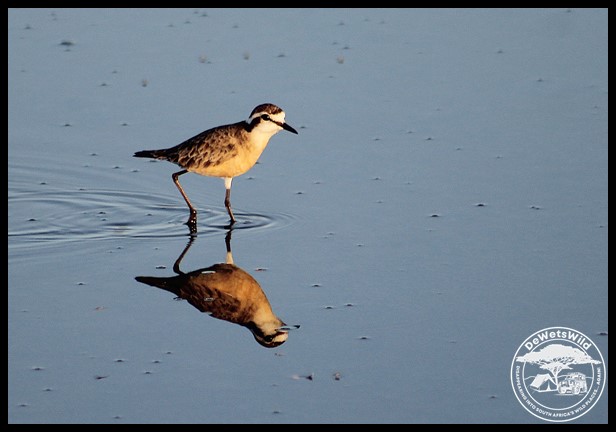
The Kittlitz’s Plover is a familiar bird occurring throughout South Africa. It is found in open areas – such as sandy beaches with washed-up kelp, salt pans, mudflats and other flat areas with short grass, like pastures, golf courses and airfields – and usually near water. It would seem that the huge number of artificial impoundments built all over our country has assisted this species to expand its range and numbers locally. They are highly nomadic and move around the south of our continent in apparent response to rainfall. Kittlitz’s Plovers feed on insects pecked from the ground.

These little plovers breed throughout the year, forming monogamous pairs of which both members take turns to incubate the clutch of 1-3 eggs in a nest that is little more than a scrape in the ground over a 3-4 week period. The chicks leave the nest within a day of hatching to follow their parents around on foraging excursions. The chicks start to fly when they’re about a month old. Adult Kittlitz’s Plover measure only about 13cm in length and weigh around 35g. When not breeding they’re usually seen in small groups of up to 20, though much larger flocks have been reported and is probably a feature of nomadic movements.

Kittlitz’s Plover is distributed throughout sub-Saharan Africa, the Nile Valley and Madagascar, and the IUCN lists the species as being of least concern.


Cape Chestnut

Calodendrum capense

In bloom the Cape Chestnut is a beautiful tree that flourishes in montane, coastal and riverine forests, occurring patchily along Africa’s east coast from Kenya southwards to the Western Cape of South Africa. In forests it can grow to 20m tall while in gardens – where it is a very popular feature plant – it grows to only about half that height. The striking flowers are carried in early summer and is popular with butterflies, many of which – including the Citrus Swallowtail – also uses the Cape Chestnut as a fodder plant for their larvae. Primates and birds love the seeds. An oil made from the seeds is used as a skin care product, and in days past the wood was used to make wagon parts and furniture.

Curlew Sandpiper

Calidris ferruginea

The Curlew Sandpiper is another wading bird that visits South Africa during our warmer months, arriving from about August and departing again by April before winter arrives in the southern hemisphere to return to their breeding grounds in Siberia. Some immature birds will however remain behind through the winter. While here they have a patchy distribution, occurring at coastal lagoons and estuaries and inland wetlands with muddy fringes where they probe for invertebrates living in the silt. Curlew Sandpipers are gregarious and often found in large flocks consisting of their own and other species of sandpiper and numbering into the hundreds and even thousands. Individual Curlew Sandpipers return year after year to the same area for overwintering. They measure about 20cm in length and weigh around 50-60g.

The Curlew Sandpiper has a rather interesting distribution range, with their occurrence during the breeding season fairly concentrated on Russia’s extreme northern reaches while their overwintering range covers an extremely large area of Africa, Asia and Australia. Locally, at the right time of year, they can be expected at suitable habitat along the coast as well as inlandThe IUCN considers the Curlew Sandpiper to be near threatened for, despite a fairly large population estimated still at over a million, it would seem their numbers are declining at an alarming rate, caused mainly by loss of habitat.

Southern Black Korhaan

Afrotis afra

The ground-dwelling Southern Black Korhaan is endemic to South Africa’s Eastern, Northern and Western Cape Provinces. The IUCN sites a loss of habitat as the major cause for its declining population and considers the species to be vulnerable. It is very closely related to the Northern Black Korhaan and the two were previously considered races of the same species.

An inhabitant of the fynbos, Klein Karoo and Namaqualand, the Southern Black Korhaan is an omnivore that feeds on a variety of plant material (mainly seeds and shoots), insects and even small reptiles. They are usually seen alone, except for females with their latest chick. During spring and summer male Southern Black Korhaans mate with as many females as possible and play no role in the incubation of the eggs or rearing of the chicks. The female doesn’t build a nest and lays her single egg (2 eggs in a clutch is exceptional) on the bare ground in an area where she feels well hidden. Fully grown they’ll measure about 50cm in length and weigh around 700g.

Ground Agama

Agama aculeata

Ground Agamas are, as their name implies, largely terrestrial by nature, though they will climb into low bushes to bask in the sun or, in the case of breeding males (distinguished by the blue sides of their faces), to display or look out for rivals.

Ground Agamas live in a wide array of habitats, ranging from semi-desert to savanna. They feed mainly on ants and termites and the occasional beetle, and hide in short tunnels dug in soft soil, usually at the base of a bush or rock. These tunnels are also used by females for laying between 8 and 18 eggs in the summer breeding season. The eggs hatch within two months. Fully grown adults measure up to 10cm in length (excluding their tail).

In South Africa, Ground Agamas are found in all our provinces, though there is disagreement in the scientific community as to whether the population in Kwazulu-Natal belong with this species or rather with Peter’s Ground Agama (A. armata). Beyond our borders Ground Agamas occur as far north as Angola and the IUCN lists it as being of least concern.

Cape Girdled Lizard

Cordylus cordylus

The Cape Girdled Lizard is endemic to South Africa’s Eastern and Western Cape Provinces; its distribution stretching from the Lesotho border to the Cederberg and Paternoster on the West Coast. The IUCN considers it as being of least concern though it is listed under CITES Appendix II (species that could be threatened by unregulated trade).

Cape Girdled Lizards are small reptiles – less than 10cm in length without including the tail – that live in dense colonies in suitably rocky habitat, where they will lodge themselves tightly into crevices and cracks to evade predators. Within these colonies the adult males have a strict dominance hierarchy, established and maintained by frequent altercations that involve the combatants circling each other while bobbing their heads and arching their backs and erupting into an all-out brawl if neither male is sufficiently intimated by the ritual. They are diurnal and prey on insects. Females give birth to 1-3 live babies in mid-summer.

Common Whimbrel

Numenius phaeopus

The Common Whimbrel is another wading bird that visits South Africa only during our summer months, with most birds arriving locally after an arduous trek from their breeding grounds in Russia at the start of spring and staying until early autumn. During their time in this country they’re seen quite commonly along the coast and (much less frequently) at inland bodies of water. Our largest single population is probably found at the Langebaan Lagoon in the West Coast National Park. A fairly significant portion of their local population, probably youngsters, overwinter in South Africa. The Whimbrel is found, for at least part of the year, on the shorelines of and at large lakes and wetlands on all the continents except Antarctica though some authorities consider the Hudsonian Whimbrel that lives in the Americas to be a separate species. The IUCN considers it to be of least concern.

The Common Whimbrel feeds on aquatic invertebrates, found by probing the wet sand and mud in lagoons, estuaries and marshes with its exceptionally long bill. The bill is in fact 2-2.5 times longer than their head! Fully grown Whimbrels measure about 43cm long and weigh around 400g. They’re usually seen singly or in loosely associated flocks, often in the company of other wading birds.