Tag Archives: wildlife

A special time at the Giant’s Castle

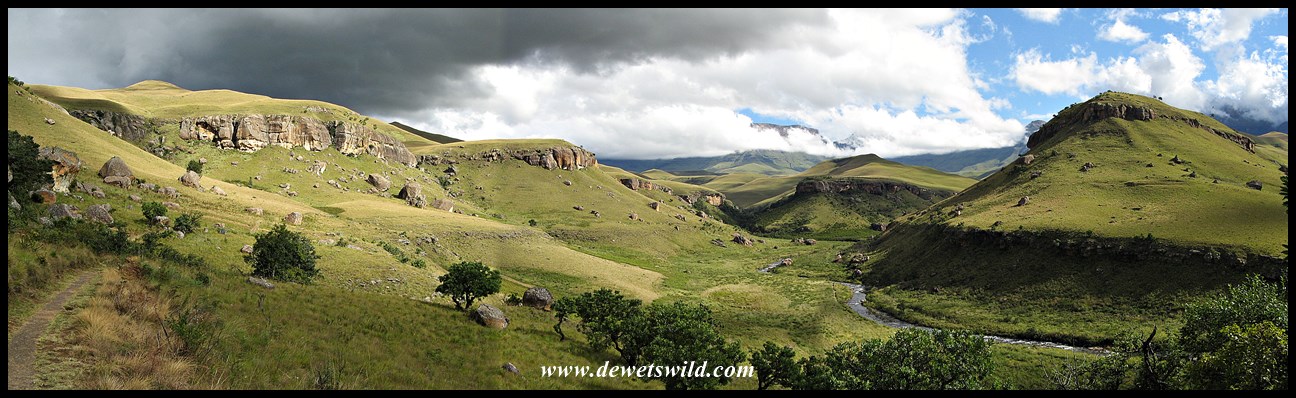
Spending Easter in a beautiful natural location is almost a given for the de Wets. Our original plans for this particular long weekend was to visit the uKhahlamba Drakensberg Park, and specifically the Cathedral Peak area, but a last minute change in reservations had us heading for the Giant’s Castle area of the Park instead. A special place to celebrate a special holiday!

While we had only three days to spend at Giant’s Castle, the weather made sure we experienced almost every climatic experience the Drakensberg mountain range can conjure (with the exception of snowfall). Dark thunder clouds one day gave way to heavy fog and a constant drenching drizzle the next, followed in turn by a day of glorious sunshine! Giant’s Castle must be one of the scenically most spectacular parts of the entire Drakensberg range, and you cannot help but stand in awe at the shear majesty of the landscape surrounding you.

Whether it rains or shines, Giant’s Castle’s grandiose scenery will keep your jaw dropping every so often. When that happens, and you bend down to pick it back up, take a moment to enjoy the magnificent juxtaposition of tiny beauties – pretty flowers, exquisite butterflies, delightful droplets, ornamental moss and lichens, and dainty insects – all around you!

It goes without saying that such a scenically attractive piece of earth wouldn’t be complete without a myriad of wildlife to round off the picture, even if, as at Giant’s Castle, they have to be content with taking a back seat to the surrounding landscape.

Giant’s Castle is one of our favourite destinations in the uKhahlamba Drakensberg Park, and we can’t imagine that we’d ever get enough of it (our previous visit was also over Easter, in 2014). Excellent amenities in the camp (managed by Ezemvelo KZN Wildlife) and a terrific network of short and longer walking trails ensures that every visit is a pleasant and fulfilling experience, one we can highly recommend!

Giant’s Castle Chalet #4, uKhahlamba Drakensberg Park, April 2017
Sitting pretty in the ‘Berg

Well, maybe not so much pretty as comfortably…

Grey Heron

Ardea cinerea

The conspicuous and well-known Grey Heron is widespread over most of Eurasia and Africa, being a seasonal migrant over much of that range. The South African population however is resident throughout the year. It is a large heron, standing a metre tall and weighing up to 2kg.

Grey Herons frequent shallow pans, dams, slow flowing rivers, marshlands, lagoons, estuaries and sheltered rock pools in coastal waters, and are seldom seen away from aquatic habitats such as these. They breed communally, often in mixed colonies together with other types of herons, egrets, ibisses and cormorants, in reedbeds, stands of tall trees near water or on cliffs. in South Africa nesting has been recorded throughout the year, with a peak in spring and early summer. Nests are platforms built of sticks and reeds, and often used year after year, being ever expanded until it becomes too bulky to stay intact. Clutches contain three to five eggs, incubated by both parents for around 25 days. Chicks fledge at about two months old. Grey Herons are active by day (especially around dawn and dusk), hunting for fish, frogs, crabs and other aquatic invertebrates, and small mammals and birds. At night they sleep in tall trees or on cliffs, often in groups.

The IUCN evaluates the Grey Heron as “Least Concern” thanks to its wide distribution and large population (estimated at as many as 3.7-million). They occur commonly all over South Africa, although in the drier western parts of the country they are concentrated along the coast and major river courses, and have benefited from the building of artificial waterbodies and planting of exotic trees in especially arid areas.

The Grey Heron closely resembles the larger Great Blue Heron that occurs in North America and the Caribbean.

Creatures Great and Small at uMkhuze

Despite the lush greenery making it a little more difficult than normal, we were treated to some amazing game-viewing at uMkhuze Game Reserve when we visited in March, and what better way to conclude our trip reports than with some photos of the “hairies and scaries” we encountered along the way?

With so many habitats, uMkhuze is home to an astounding variety of invertebrates, amphibians, reptiles and mammals (not forgetting the birds we showed you earlier), and the galleries to follow should give you some idea of what you could expect to see when visiting this wonderful place!

One would think that the bigger the animals the easier they are to see? Please go tell that to uMkhuze’s elephants, rhinos and lions that kept so well hidden during our visit!? Jokes aside though, we reveled in some wonderful encounters with plains zebra, nyala, kudu, impala, hippos, grey duiker, baboons, vervet monkeys, spotted hyenas, buffaloes, blue wildebeest and giraffe.

The arrival of autumn heralds the start of the rutting season for many antelope, and it was hard not to notice the testosterone flowing strongly in many male nyalas and impalas as they established their place in the hierarchy and started herding together their harems!

uMkhuze Game Reserve has so much to offer, and with every visit we’re given only a little taste of it, just enough to keep us going back for more!

uMkhuze Birding

With a list of over 400 recorded bird species, the uMkhuze Game Reserve (part of the iSimangaliso Wetland Park) is one of South Africa’s most highly-rated birdwatching destinations. The reserve is home to many commonly seen and well-known species, both residents and summer migrants, but also hosts several species rarely encountered in South Africa – we, for instance, had our first ever sighting of the African Pygmy Goose at uMkhuze’s Nsumo Pan when we visited the reserve in March, though we sadly didn’t manage a photograph of it. This gallery however shows just some of the almost 100 species we managed to find during our three day visit!


Celebrating nature’s resilience at uMkhuze

Not long ago, much of South Africa was in the grip of one of the most severe droughts in recorded history, and some parts of the country still are. Recent good rains in the north and east of the country has however had a positive impact, and while the effects of the drought will probably take some time to be reversed, seeing uMkhuze Game Reserve covered in swathes of lush, green vegetation and enjoying the spectacle of a full Nsumo Pan, one couldn’t help but feel optimistic!

Baboon antics at Kumasinga

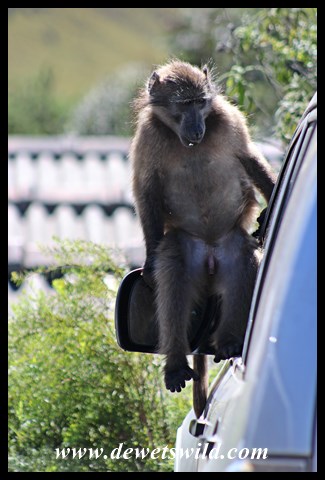
Joubert and I had great fun with the jolly baboons at uMkhuze Game Reserve‘s Kumasinga Hide – their fun and games kept us entertained for hours! Just confirmation again of why Kumasinga is one of the best and most popular photographic hides in the country.

Stork Buffet at uMkhuze

While driving around the uMkhuze Game Reserve one afternoon in March, we happened upon a seemingly insatiable Woolly-Necked Stork catching juvenile catfish in a drying mudpool. We watched the stork gorge itself on one fish after another, amazed at the ease with which it could grab its slippery, squirming quarry from the “all you can eat buffet table”, until there was no more splashing from the pool at his approach…

Addo’s new Nyathi Rest Camp

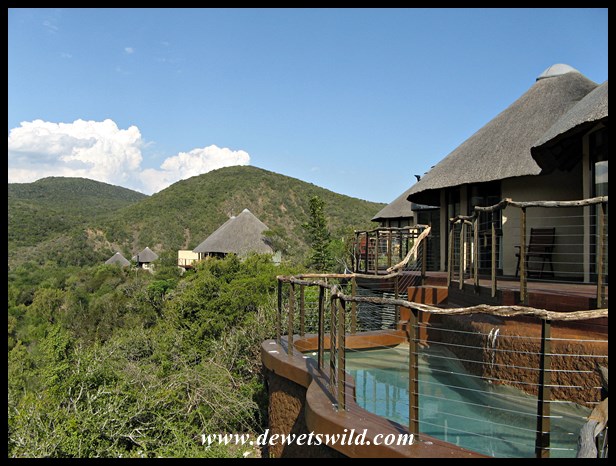
View from Addo’s new Nyathi Camp

SANParks has opened its newest accommodation offering in the Addo Elephant National Park: the luxurious new Nyathi Rest Camp. The new camp is set atop a hill with magnificent views from every spacious accommodation unit over the valley below and the rolling hills beyond, and a real possibility of seeing any of the “Big Five” from the comfort of your private veranda.

The camp offers eight 2-bed units, one 4-bed unit and two 6-bed units, each equipped with air-conditioning, satellite television, equipped kitchens, bathrooms with splendid views and private splash pools.

Amenities such as a restaurant, shop, fuel station and guided game drives are available at Addo’s main camp, an easy 20km drive away along sedan friendly gravel roads.


African Bullfrog

Pyxicephalus edulis

While I doubt it reached proportions that would convince the Pharaoh to allow the Israelites to leave Egypt, the “eruption” of little froglets we saw at uMkhuze Game Reserve during our recent visit was quite fascinating. Rain or shine, literally hundreds (if not more) of tiny frogs could be seen jumping around on the roads all over the reserve, making driving quite tricky if you didn’t want to squash them under the vehicle’s wheels.

Thanks to the help of the iSimangaliso Wetland Park the little ones were identified as juvenile African Bullfrogs (also known as Edible or Lesser Bullfrogs), a species that occurs over wide areas of Eastern, Central and Southern Africa, and indeed is eaten by humans in many countries where they occur. Though these newly metamorphosed juveniles were only about the size of a thumbnail, the African Bullfrog can grow to 12cm in length.

African Bullfrog

They can be found in seasonally flooded savannas and grassy woodlands, remaining dormant underground for most of the year (up to 10 months) and emerging only when sufficient rain has fallen for breeding to commence. During the breeding season males act very aggressively towards one another and will even kill each other. Eggs are laid in well vegetated, shallow, seasonal bodies of water where the males guard the eggs and tadpoles against other males and predators. Interestingly, when the tadpoles’ pools start drying up the males will dig channels to deeper pools. African Bullfrogs feed on a variety of invertebrates and small vertebrates, including other frogs, and feature in turn in the diets of various species of birds, reptiles and mammals (humans included).

During a visit to the Kruger National Park in December 2019 we witnessed the breeding habits of the African Bullfrog following a few days of continuous rain.