Tag Archives: wildlife

Back from the Bush

We’ve just arrived back home after a wonderful ten days in the bush, visiting the iSimangaliso Wetland Park and Hluhluwe-Imfolozi Park in South Africa’s Kwazulu-Natal Province.

While we get busy responding to the comments you left on the scheduled posts that published in our absence, here’s a small gallery of what you can expect when we report back on our trip in the coming days…

Water Thick-knee

Burhinus vermiculatus

The Water Thick-knee, or Water Dikkop, is a nocturnal bird species inhabiting riverbanks, lake shores, swamps, estuaries and occasionally beaches with sufficient cover in the form of shrubs and bushes. By day they hide in deep shade near the water. Their diet includes invertebrates like insects, crustaceans and molluscs, tadpoles and frogs, and seeds. They weigh about 300g, with a wingspan of about 75cm.

Outside of the breeding season the Water Dikkop congregates in groups of up to 30 birds. The breeding season usually coincides with the end of the dry season, preferring to nest on sand bars in low-flowing rivers or on the shores of other water bodies. The nest is just a scrape in the ground, usually adjacent to a rock, piece of driftwood or other similar structure, but the eggs and chicks are superbly camouflaged. 1-3 eggs are incubated by both parents for just over 3 weeks, with the chicks fledging at about 2 months old.

The Water Thick-knee has a wide, albeit patchy, distribution over Sub-Saharan Africa and is listed as Least Concern by the IUCN. In South Africa the species occurs along the coast of the Cape Provinces, through large parts of Kwazulu Natal, into the Lowveld of Mpumalanga and Limpopo Provinces, along the Limpopo Valley and south along the course of the Crocodile River into Gauteng.

Pied Kingfisher

Ceryle rudis

The Pied Kingfisher can be expected at almost any body of fresh or brackish water, and at times even at tidal pools, with suitable perches as vantage points from which it can hunt fish, tadpoles, frogs, crustaceans and aquatic insects, often hovering above the water before launching a diving attack. Large prey is pounded repeatedly against a favourite perch to kill it and soften it up before swallowing. They are usually seen in pairs or small family groups and have been recorded up to 5km from the nearest land over the open water of large lakes. With a weight of up to 110g, and a length of up to 25cm, it is the second biggest kingfisher found in South Africa.

Though nesting has been observed throughout the year, the breeding season of the Pied Kingfisher peaks in spring, when pairs nest in burrows of up to 2.5m long that they dig themselves in earth banks, with up to 7 eggs laid in a wide chamber at the end. Incubation takes about 18 days and is mainly the female’s responsibility. The chicks stay in the nest for another 3 to 4 weeks and then start to learn to hunt, becoming independent by about 3 months of age. Usually a pair has helpers from previous broods assisting in the feeding of the present clutch.

The IUCN considers the Pied Kingfisher to be of least concern, thanks to its wide distribution over Sub-Saharan Africa, the Middle East, Indian Subcontinent and South-East Asia. It may be one of the three most numerous kinds of kingfishers, but some populations however are in decline due to poisoning and habitat loss, while others are thriving. In South Africa they are commonly found from the Western Cape and along the coast and adjacent interior of the Eastern Cape, through Kwazulu-Natal into Mpumalanga, Limpopo, Gauteng, North West and the Free State. They also occur along the length of the Orange River in the otherwise arid Northern Cape.

Reed Cormorant

Microcarbo africanus

Reed Cormorants inhabit most freshwater habitats, with the exception of fast flowing rivers, preferring quiet, sheltered, shallow and well vegetated water bodies where they hunt underwater, primarily for fish as well as frogs, crustaceans and molluscs, either singly or in small groups.

Reed Cormorants are diurnal, being most active in the early morning and late afternoon. At night they roost in large communities, often mixed with other species. The Reed Cormorant is subject to some nomadic movements in response to fluctuating water levels. It is a relatively small cormorant, with a wingspan of 85cm and a weight of about half a kilogram. They often rest with wings outstretched to dry.

Reed Cormorants often breed in groups of 1 – 50 pairs in mixed-species colonies with herons, ibises and other cormorants. They nest at any time of year, though there is a peak in spring and summer. Their nests are built of twigs and other vegetation over water, either in trees or reedbeds or on cliffs, and clutches contain 1 – 6 (usually 3 or 4) eggs that are incubated by both parents for just over 3 weeks. The chicks become independent at about two months of age.

The Reed Cormorant occurs widely across Sub-Saharan Africa and Madagascar, and is considered as being of least concern by the IUCN, despite a declining population as a result of persecution by fish farmers and disturbance by human activities. In South Africa they can be found in all provinces, even occurring in the arid Northern Cape along the courses of the Orange and Vaal Rivers and their large tributaries.

White-bellied Sunbird

Cinnyris talatala

An inhabitant of open woodlands, riparian thickets, bushveld and suburban gardens, the tiny (6-9g) White-bellied Sunbird feeds mainly on nectar from a variety of flowers, although insects and other invertebrates also makes up a sizable portion of its diet.

White-bellied Sunbirds breed throughout the year, with a peak in spring and summer. The nest is built by the female, of dry plant material bound together by spider web, often in a very thorny plant or near a wasp nest. The female is also singly responsible for incubating the clutch of 1-3 eggs for about two weeks, but both parents feed the chicks until they fledge after another two weeks.

In South Africa, White-bellied Sunbirds occur in Kwazulu-Natal, the Free State, North West, Gauteng, Mpumalanga and Limpopo Provinces. It is also found in Angola, Botswana, Malawi, Mozambique, Namibia, Swaziland, Tanzania, Zambia and Zimbabwe, and with an abundant, stable population is regarded as being of least concern by the IUCN.

As you can see from this gallery, Joubert and I have great fun photographing the White-bellied Sunbirds visiting the Cape Honeysuckle and other flowering shrubs in our small garden.

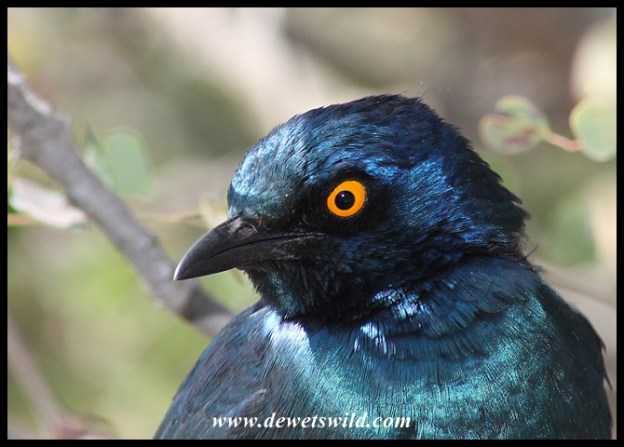
Cape Glossy Starling

Lamprotornis nitens

Cape Glossy Starlings are a common feature of bushveld-savanna (especially thornveld) and woodland habitats in Southern Africa, and have of late become increasingly abundant in towns and suburbs where it takes advantage of discarded scraps and garden bird feeders. Its natural diet consists of fruit and insects.

They are gregarious birds, forming large flocks outside of the summer breeding season and often also associating with other kinds of starlings. Nests are built in holes in trees (or similar artificial structures, even post boxes!) and often used for many consecutive years by the same pair. Clutches are made up of between 2 and 6 eggs, incubated by the female. Mating pairs often have as many as 6 helpers assisting in the feeding of the latest brood.

The Cape Glossy Starling has a common and stable population throughout its range, which includes Angola, Botswana, Lesotho, Mozambique, Namibia, South Africa (all provinces except the Western Cape), Swaziland, Zambia and Zimbabwe, and is considered of least concern by the IUCN.

Natal Spurfowl

Pternistis natalensis

An inhabitant of woodland, savanna, riverine thickets, wooded hills and coastal forests, the Natal Spurfowl subsists on an omnivorous diet of seeds, bulbs, roots, fruit and insects, often pecking undigested items from the dung of large herbivores. They’ll also exploit agricultural fields adjacent to their preferred habitats. Natal Spurfowl weigh in at around 400g.

Natal Spurfowl move around in pairs or family groups. Nests are scraped in the ground among dense vegetation, and lined with soft plant material and feathers. Clutches contain up to 7 eggs, incubated by the female for 3 weeks. Breeding has been recorded throughout the year, with a peak in summer and autumn.

The Natal Spurfowl occurs in Botswana, Zambia, Zimbabwe, Mozambique, Swaziland and South Africa, where they can be found in the provinces of Kwazulu-Natal, Free State, North West, Gauteng, Limpopo and Mpumalanga. They are common throughout their range and listed as “least concern” by the IUCN.

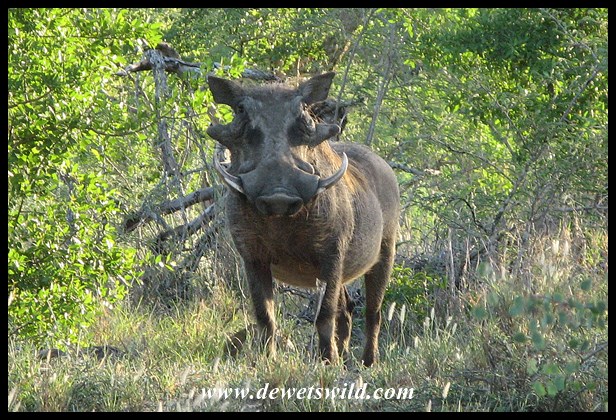
Warthog

Phacochoerus africanus

The comically-looking Warthog is a firm favourite for many visitors to South Africa’s wild places, who probably find it easy to relate to the lovable Pumbaa from Disney’s The Lion King movies. These large pigs – males weigh as much as 115kg – are tough in the extreme and can put those impressive tusks to good use defending themselves and their piglets.

Warthogs inhabit open savannas, short grasslands, floodplains and semi-desert scrub, avoiding more densely vegetated areas (particularly forests and areas with long grass cover). They primarily feed on grass, roots, fruits, seeds and bark, but have been known to scavenge from carcasses and have even been recorded robbing cheetahs of their prey! They can go for long periods without water but will drink daily where it is available. They prefer feeding on very short growth and digging for morsels with their snouts, often going down on their knees for better access.

Groups of Warthogs, called sounders, usually consist of related sows and young, sometimes accompanied by an adult boar and number up to 16 individuals, though the males are mainly solitary especially outside the breeding season. Warthogs are sedentary and will often remain in the same general area for most of their lives. They are diurnal in habit, taking shelter in the disused holes of other animals or in man-made culverts at night. They always enter these burrows backside first, so as to protect themselves with those formidable tusks. Warthogs love a mudbath and through their rolling in the stuff help to enlarge waterholes over many years. These pigs have excellent sense of smell and hearing but terrible eyesight, often relying on oxpeckers to give them advance warning of danger. They can run at speeds in excess of 40km/h, always with their thin tails held aloft like the aerial on a radio-controlled car!

Sows give birth to between 1 and 8 (usually around 4) tiny piglets in their burrows during the spring and summer. Lactating sows will accept any piglets as their own. Warthogs feature on the menu of all Africa’s large predators, although adults will defend themselves and their young viciously with their tusks. Piglets are prone to dying of exposure to cold, wet conditions. Warthogs have a life expectancy of up to 20 years in the wild.

Listed as “Least Concern” by the IUCN, it is estimated that there are at least 22,000 Warthogs in South Africa (and probably considerably more) where they seem to be expanding their range. There are free ranging populations of warthog in all South African provinces with the exception of the Western Cape. Good places to find Warthogs are the Addo Elephant, Kruger, Mapungubwe, Marakele, Mokala and Pilanesberg National Parks, Hluhluwe-Imfolozi Park, iSimangaliso Wetland Park, and Dinokeng and Ithala Game Reserves. Elsewhere in Sub-Saharan Africa Warthog populations are declining due to habitat loss, competition with livestock and severe hunting pressure, and are evermore being restricted to conservation areas.

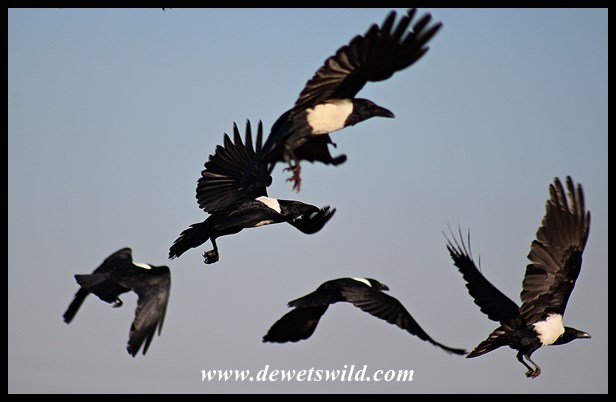
Pied Crow

Corvus albus

The Pied Crow is a distinctly cosmopolitan creature, adapting to almost any habitat and closely associating with humans and our wasteful activities wherever possible. They’re a common sight along roads, where they feed on road kills, and at slaughterhouses and dumpsites where they scavenge for discarded scraps. Apart from cleaning up after humans, Pied Crows include a wide selection of food items in their naturally omnivorous diet: insects and other invertebrates, small mammals, birds and reptiles, eggs, carrion, seeds, fruits, roots and mushrooms are all consumed, and they will mob large birds of prey to steal their food. They’ve even been known to kill lambs and sick sheep. Pied Crows have a wingspan of almost a metre and weigh around half a kilogram.

The Pied Crow is a sociable species, usually seen in pairs or small groups but at times coming together in enormous flocks numbering in the thousands at communal roosts or in response to an abundant food source. Both sexes work together in constructing nests of sticks and twigs in isolated tall trees or on telephone and electricity pylons and windpumps. Breeding takes place in spring and summer, when clutches of 3-6 eggs are incubated by the female for about three weeks. Both parents raise the brood, which fledges at about 45 days.

Thanks to an enormous distribution range covering almost all of Sub-Saharan Africa and Madagascar, its close association with humans and a large and stable population, the Pied Crow is considered of least concern in conservation terms. In South Africa too they are spread over the entire country, being described as increasingly abundant.

A not so wintry day at Walter Sisulu Botanical Garden

It is supposed to be mid-winter in South Africa, but with daytime temperatures in the comfortable low 20’s centigrade recently, we just couldn’t pass on the opportunity to visit the Walter Sisulu National Botanical Garden in Johannesburg again this past Sunday. We enjoyed a lovely day walking and picnicking with good friends, soaking up the glorious sunshine under a cloudless sky, and of course our cameras went along!

Even in winter the garden is a feast for the eyes, and especially the winter-blooming aloes and carpets of daisies are a sight to behold. You are seldom far from water anywhere in the garden, with the Crocodile River flowing serenely through it and the Witpoortjie Falls being the focal point for all visitors to the gardens.

Anyone with a love for or interest in birds, especially photographers, will really find a visit to the gardens worth their while. Apart from the highly visible nesting pair of Verreaux’s Eagles, the garden absolutely abounds with birdlife, even now in winter when so many of the summer migrants have departed for warmer climes. The hide at the Sasol Dam in a quieter corner of the garden must surely rank as one of the best facilities of its kind in the country in terms of the variety and quality of sightings on offer.

If you’d like to know more about the Walter Sisulu National Botanical Gardens, have a look at our post about our visit in November 2014 or visit their website.