Tag Archives: wildlife

Bearded Scrub Robin

Cercotrichas quadrivirgata

The Bearded Scrub-Robin inhabits dense woodland, thickets and riparian forests. They are excellently camouflaged as they search for insects and spiders in the leaf litter on the forest floor, and often go unnoticed. Adults weigh around 20-30g.

Bearded Scrub-Robins are usually encountered singly or in monogamous, territorial pairs or family groups, and breed in spring and summer in cup-shaped nests built of grass, leaves, twigs and roots, lined with mammal hair, in holes and cavities against the trunks of trees. Here the female incubates a clutch of 2 or 3 eggs for 2 weeks. The chicks grow rapidly and leave the nest at 2 weeks old, becoming independent of the parents about a month later.

In South Africa, Bearded Scrub-Robins are only found in the north of Kwazulu-Natal and the Lowveld and escarpment of Limpopo and Mpumalanga. Listed as Least Concern by the IUCN, the species has a wider distribution into Africa north of our borders, extending all the way to Kenya.

Bateleur

Terathopius ecaudatus

Considered an ill omen in the traditional folklore of many African societies, the Bateleur is our most colourful eagle and easily identified in flight by its short tail. They get their name from their acrobatic aerial courtship displays, “bateleur” being French for acrobat. Adults have a wingspan of just under 2 meters and weigh around 2.5kg.

Bateleurs inhabit open habitats, ranging from semi-desert shrublands and grasslands to savannas and open woodlands. They prey on a variety of smaller mammals, birds, reptiles (including venomous snakes), insects and even fish and amphibians, caught from drying pools. They also include a large percentage of carrion in their diet – in fact, they are usually one of the first species to arrive at a carcass. They spend many hours daily on the wing, gliding fast and low over the ground in search of food and covering as much of 400km a day in this way!

In southern Africa, Bateleurs breed in the summer rainy season. Pairs are monogamous, staying together for life, and territorial. Nests are stick-platforms built in the canopies of tall trees, usually along water courses, and lined with leaves. The single egg is incubated for almost two months. Both parents play their part in feeding the chick, which takes its first flight when it is 3 to 4 months old and becomes independent about 7 months after hatching. Young Bateleurs are highly nomadic until they establish their own pairbonds and territories.

The Bateleur’s natural distribution extends over most of sub-Saharan Africa, with the exception of the driest deserts and equatorial forests, with a small population on the Arabian Peninsula. Habitat loss, poaching and poisoning is causing Bateleur populations to decline all over their range and they are becoming increasingly restricted to the large game reserves and national parks. It is now listed as “Near Threatened” by the IUCN, and considered vulnerable in South Africa. South Africa’s biggest population occurs in and around the Kruger National Park, estimated at around 600 breeding pairs, while elsewhere in the country they are now only to be found in the reserves of northern Kwazulu-Natal, the Lowveld of Mpumalanga and Limpopo, along the Limpopo valley, and in the Kgalagadi Transfrontier Park while they were previously much more widespread.

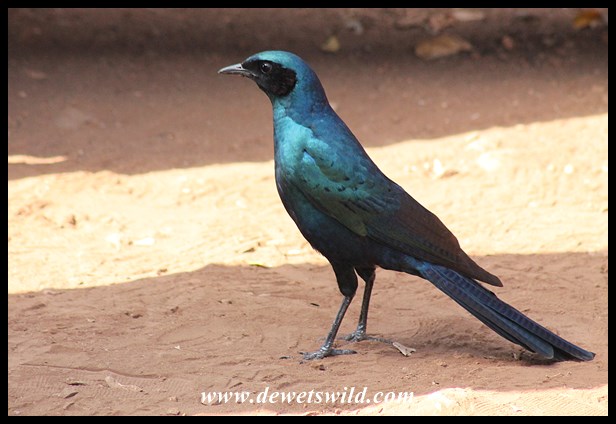
Burchell’s Starling

Lamprotornis australis

Burchell’s Starling inhabits savannas and woodlands with large thorn trees and patches of open terrain, foraging mostly on the ground for invertebrates, flowers and fruit. They also scavenge for scraps at picnic spots.

These large (34cm long, weighing 120g) starlings breed during summer, usually in cavities in trees lined with grass, leaves, feathers, snake skin and occasionally paper and other human waste material. The female lays 2-4 eggs and is responsible for incubation, which takes about two weeks, but both parents feed the chicks until they leave the nest at about 3 weeks of age.

Burchell’s Starling occurs in only a few southern African countries: marginally into Angola, Zambia, Mozambique, Swaziland and Zimbabwe, with the core of their distribution centred on Namibia, Botswana and South Africa, where they occur in the Lowveld of Mpumalanga, Limpopo and the North West with a few scattered records elsewhere. The IUCN considers the species of least concern.

Greater Blue-eared Starling

Lamprotornis chalybaeus

The Greater Blue-eared Starling is a common bird of savanna and woodland habitats. They are omnivorous, feeding on invertebrates, seeds, nectar, fruit and berries. They form fairly large flocks, especially outside of the breeding season, and often associate with other kinds of glossy starlings. Adults reach a length of 24cm and weigh from 68-105g.

Greater Blue-eared Starlings breed in spring and summer in holes in trees or inside the stick nests of larger birds like storks and ibises, lined with grass and feathers. Pairs are monogamous, and clutches contain 2-5 eggs that are incubated by the female for 2 weeks. The chicks fledge at 3 weeks old.

The IUCN considers the Greater Blue-eared Starling of least concern. It occurs in a band along the Sahel from west Africa to Ethiopia, and then southwards to northern South Africa, where it can be found in parts of the Mpumalanga and Limpopo provinces and is very common in the camps and picnic areas of the Kruger National Park.

Ant-eating Chat

Myrmecocichla formicivora

Open, dry grasslands and shrublands, with numerous termite mounds, is the chosen habitat of the Ant-eating Chat, a common little bird that occurs only in South Africa, Lesotho, Swaziland, Namibia and Botswana and is listed as “Least Concern” by the IUCN, despite certain farming practices having a negative impact on their preferred nesting sites. Adults are around 17cm long and weigh between 40 and 60g.

As its name suggests, they are especially fond of ants and termites, but also consumes a wide variety of other invertebrates. They are social birds, staying in small groups made up of a breeding pair assisted in their duties by offspring from previous broods.

Ant-eating Chats sleep and nest in burrows in the ground, excavating their own nesting chambers in earthen walls or inside the burrows of aardvarks, porcupines, springhares, ground squirrels and mongooses. These chambers are lined with dry grass and roots. The breeding season spans spring and summer. Clutches consist of up to 7, but more usually about 3, eggs, that are incubated by the female for two weeks. Chicks leave the nest before they are three weeks old but stay dependent on their parents for another week or two. Thereafter they usually stay part of the group and assist with the rearing of subsequent broods.

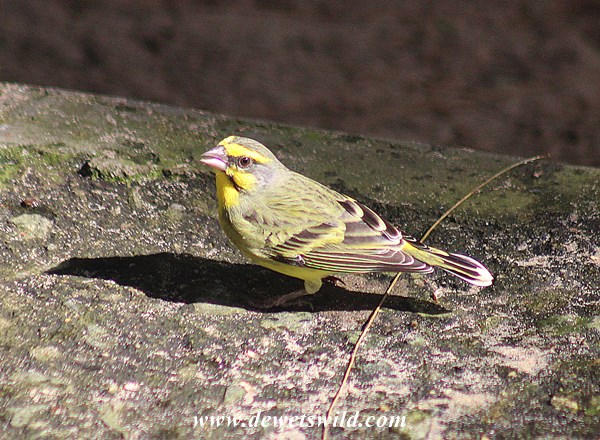
Yellow-fronted Canary

Crithagra mozambica

The Yellow-fronted Canary occurs in savanna and woodland habitats, and seems to be dependent on the availability of surface water for regular drinking. They penetrate more arid areas along well wooded water courses, and have extended their range into parks and plantations established in otherwise unsuitable grassland areas. They feed mostly on the ground, foraging for seeds, flowers, nectar and insects, and often form mixed flocks with other seed-eating birds. Adult Yellow-fronted Canaries weigh only between 9 and 16g.

Breeding season for the Yellow-fronted Canary spans spring and summer in South Africa. While they occur in small flocks outside the breeding season, pairs are monogamous and usually nest well apart from others. Nest building is mostly the responsibility of the females, who build a cup shaped nest of plant material and spiderweb in a tree or bush, quite high above the ground. The female is also solely responsible for incubating the clutch of 2-5 eggs for 2 weeks, while the male feeds her. The female also broods the chicks for the first few days after hatching, with the male then bringing food for both her and the chicks. The chicks leave the nest when they’re about 3 weeks old, but still remain dependent on their parents for quite some time thereafter.

In South Africa, this species is common in the Eastern Cape, Kwazulu-Natal, Mpumalanga, Limpopo, Gauteng and parts of the Free State and North West provinces. Furthermore, the Yellow-fronted Canary also has a wide distribution over west, central, east and southern Africa. While listed as “Least Concern”, the IUCN notes that the international pet trade is probably causing a decline in the population of the Yellow-fronted Canary.

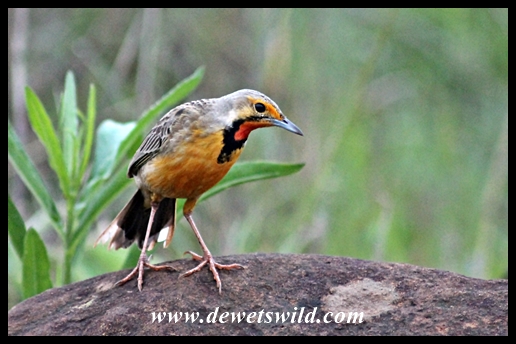
Cape Longclaw

Macronyx capensis

The Cape, or Orange-throated, Longclaw, is an inhabitant of moist grassland and wetlands with dense grass cover, often at considerable elevations. They’re often seen standing atop large rocks, anthills or shrubs. It feeds mostly on insects, with seeds featuring occasionally in its diet. Adults weigh around 45g.

Cape Longclaws breed mostly in spring and summer. Pairs are monogamous and territorial. The female builds a well-hidden nest of grass and roots among dense stands of grass, in which she incubates a clutch of 1-4 eggs for around 2 weeks. Both parents feed the chicks, whic leave the nest at about 2 weeks old.

The Cape Longclaw occurs only in Zimbabwe, Lesotho, Swaziland and South Africa (Western and Eastern Cape, Kwazulu-Natal, Free State, Gauteng, North West and the Highveld regions of Limpopo and Mpumalanga) and marginally into Botswana and Mozambique. The IUCN considers the species as being of least concern.

Woodland Kingfisher

Halcyon senegalensis

The Woodland Kingfisher is a bird of tall, open woodlands and savannas (as well as suburban gardens and parks), and despite a preference for wooded river courses does not follow an aquatic diet at all. Instead, they feed primarily on insects, especially grasshoppers, though they have been recorded taking small reptiles and chicks from Red-billed Quelea nests. Adults weigh between 55 and 80g and measure up to 24cm from the tip of the beak to the tip of the tail.

Woodland Kingfishers migrate to South Africa (North West Province, Limpopo, Mpumalanga, Gauteng and northern Kwazulu-Natal) to breed here in summer, arriving from September and departing again by end of April. They are mostly seen singly or in pairs. Pairs defend their territories aggressively against others of their kind as well as other species of birds and even humans. They nest in holes in trees, often taken over from woodpeckers and barbets. Clutches normally contain 2-4 eggs and are incubated by both parents for around two weeks. Although the chicks leave the nest at about 3 weeks old, the parents continue to care for the young for as long as 5 weeks after they’ve fledged.

The Woodland Kingfisher occurs over much of sub-Saharan Africa, from Senegal in the west to Ethiopia in the east and south to South Africa, at least for parts of the year, while they are resident in Africa’s equatorial regions throughout the year. The IUCN lists it as least concern.

The call of the Woodland Kingfisher is an unmissable part of the summer soundtrack in many of our favourite wild places, which must be why I’ve set it as the ringtone on my phone…

Double-banded Sandgrouse

Pterocles bicinctus

Double-banded Sandgrouse inhabit open, dry woodlands, savannas and arid grasslands, often in association with low, rocky hills, and is especially fond of mopane savanna. These rather plump birds (26cm long, weigh up to 270g) are often seen on or beside gravel roads, freezing in their tracks in the hope that they’ll escape detection. They feed exclusively on seeds, and drink daily, usually just before sunset. They are usually encountered in family groups numbering 2 to 5 and only rarely in bigger groups of up to 10.

Breeding in this species peaks during the dry season, though breeding attempts have been recorded throughout the year. Pairs are monogamous and use a shallow scrape in soil, gravel or sand, lined with dry grass and leaves, as a nest. The nest is usually hidden among tufts of grass or under bushes, but is often quite exposed. Clutches contain 2-3 eggs and are incubated by both parents for little over 3 weeks.

Despite being common and widespread over southern Africa, and considered of least concern by the IUCN, the Double-banded Sandgrouse population is at risk of decreasing due to habitat loss. In South Africa, this species can be found in the Lowveld, western Limpopo, and parts of the North West and Northern Cape Provinces.

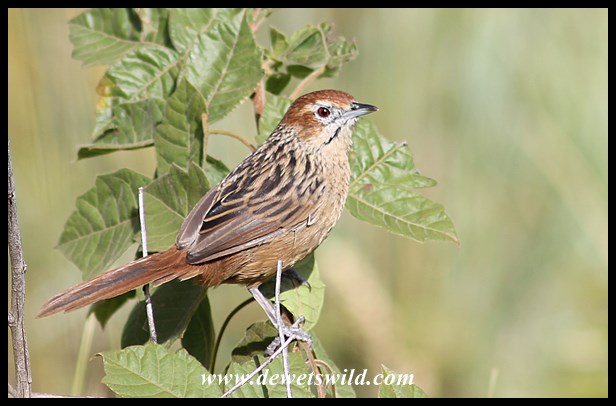
Cape Grassbird

Sphenoeacus afer

As its name suggests, the Cape Grassbird lives in areas of rank, tall grass as well as thick low-growing fynbos and stands of ferns, often on hillsides and in river valleys and usually near water. They are normally seen singly or in pairs. Cape Grassbirds follow an insectivorous diet, catching most of their food on the ground. Adults grow to 19cm in length and weigh between 26 and 34g.

Cape Grassbirds breed almost throughout the year, with a peak in spring and early summer. Pairs mate for life. The female builds the bowl-shaped nest of twigs, grass and leaves near the ground in a tussock of grass or a bush. The female incubates the clutch of 2 or 3 eggs for just over 2 weeks. After hatching, both parents feed the chicks, which fledge at around 2 weeks old.

The Cape Grassbird occurs only in South Africa, Lesotho, Swaziland and in a limited area on the border between Mozambique and Zimbabwe. In South Africa they are found in the Western and Eastern Cape, Kwazulu-Natal, Free State, Gauteng and the Highveld of Mpumalanga and Limpopo. The IUCN currently lists it as “Least Concern” but also cautions that the population of the Cape Grassbird is decreasing due to habitat destruction (threatened by agriculture, urbanisation and invasion by alien trees).