Tag Archives: wildlife

Honey Badger

Mellivora capensis

Infamous for its tenacity and downright cantankerous disposition, the Honey Badger may only stand 30cm high at the shoulder with a weight up to 16kg (males are much bigger than females), but that doesn’t deter them from tangling with buffaloes, elephants and lions (or anything else for that matter) daft enough to cross swords with them.

Honey Badgers inhabit a wide range of habitats, from deserts to mountains to forests, though they prefer more open habitats. They even occur in some of our cities and towns. They are equally catholic about their diet, feeding mostly on insects, eggs and rodents as well as fruits, berries, bulbs and carrion, but also including anything else they can overpower – snakes, young crocodiles, fish, amphibians, birds and mammals up to the size of small antelope have all been recorded. Although it isn’t a major part of their diet, their penchant for honey and the lengths they will go to in order to gorge themselves on it has earned them their English common name.

These tough creatures are usually seen alone or in pairs, and may be active by day or night. They are excellent climbers and rest up in crevices or holes in the ground (dug by themselves or taken over from other animals). This is also where the females give birth to litters of 1-4 pups (usually 2) at any time of year. The female raises the pups alone, moving them to a new den every few days until they can start moving around with her at around 3 months old. The pups are fully grown by the time they’re 8 months old but may remain with their mom until they’re as old as 18 months.

The IUCN considers the Honey Badger to be of least concern. It is distributed widely over Africa, the Middle East and the Indian subcontinent, but usually occurs at low densities. Honey Badgers are found all over South Africa.

This Honey Badger, caught on our little camera trap, raided our trashcan during a visit to Tamboti in the Kruger National park during June 2023

Drongo

Fork-tailed Drongo

Dicrurus adsimilis

One of our most cosmopolitan and abundant bird species, the Fork-tailed Drongo inhabits a wide range of habitats ranging from grasslands with a sprinkling of trees to forest edges, favoring open woodlands and savannas. It has also adapted very well to exotic plantations, suburban parks and gardens. They feed mainly on insects and other invertebrates, but have also been noted feeding on small lizards, fish, eggs and birds. Adults measure ± 25cm long and weigh around 44g.

Fork-tailed Drongos are feisty birds, often mobbing large raptors and mammalian predators much bigger than themselves. They’re often seen at veld fires catching insects trying to escape the flames, or following large mammals around to catch the insects disturbed into flight while the big herbivores are moving around – even using the backs of these animals as perches from which to launch an attack. Fork-tailed Drongos are excellent mimics – they will even imitate the alarm calls of other birds or small carnivores, like meerkats, to startle them into dropping whatever food they might have found in order to steal it.

Fork-tailed Drongos form monogamous pairs. The breeding season in this species spans spring and summer. Their nests are small cups built of fine plant material and spiderweb, usually suspended like a hammock between two twigs in a tree or shrub. Clutches of 2-5 eggs are incubated by both parents for between 2 and 3 weeks, with the chicks leaving the nest around 3 weeks after hatching.

The Fork-tailed Drongo is very widely distributed over sub-Saharan Africa and is listed as being of least concern by the IUCN. In South Africa they can be seen in all provinces, avoiding only the mostly treeless central grasslands and the western arid scrublands.


Verreaux’s Eagle-Owl

Bubo lacteus

Verreaux’s Eagle-Owl, or the Giant Eagle-Owl, is the biggest owl occurring in Africa and one of the biggest on the planet. Females are considerably larger than males, and tip the scales at up to 3kg, with a wingspan of over 1.5m. It inhabits dry savanna, woodlands and riverine forests, even penetrating deserts along drainage lines where large trees grow (such as in the Kalahari). As can be expected from such a large bird of prey their menu includes mostly small to medium vertebrates (up to the size of hares, springhares, piglets, monkeys, herons, flamingoes and even other large owls!)

Pairs of Verreaux’s Eagle-Owl are monogamous and defend fairly large territories. Here they roost and nest in large trees, taking over the large stick nests of other big birds of prey or utilising the tops of the nests of the hamerkop or sociable weavers. They breed through winter and spring, when the female incubates a clutch of (usually) 2 eggs for over 5 weeks, while the male feeds her at night. Usually the second chick to hatch dies of starvation within 2 weeks, as the first-hatched hogs most of the food brought back by the parents. The surviving chick stays in the nest for around 2 months, but will remain dependent on its parents for up to a year and some may even stay with their parents to help raise the next chick. Though they are mainly nocturnal, Verreaux’s Eagle-Owls are regularly encountered on the hunt around dawn and dusk

Verreaux’s Eagle-Owl is widely distributed over sub-Saharan Africa and considered of least concern by the IUCN. In South Africa they occur only in northern Kwazulu Natal, the Lowveld of Mpumalanga and Limpopo, and patchily along the borders with Botswana into the Kalahari regions of the Northern Cape, with a scattering of records from elsewhere in the country. In South Africa they are increasingly becoming scarce outside of the major conservation areas.

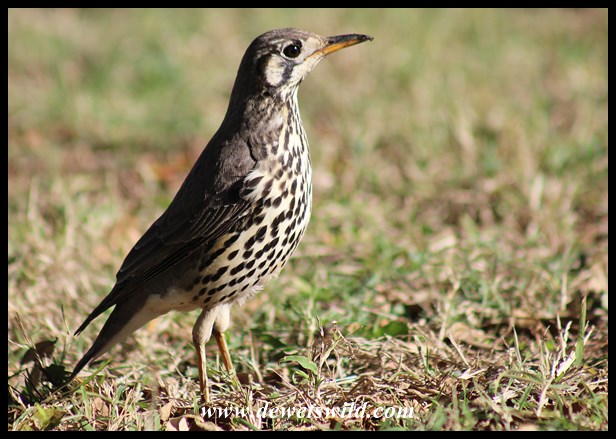
Groundscraper Thrush

Psophocichla litsitsirupa

The Groundscraper Thrush is a species of open savannas and woodlands, but have also adapted to plantations, orchards, suburbia and sports fields where they easily become quite tame and bold around humans. They feed mainly on insects, worms and other invertebrates, found by scraping away leaf litter or scratching in the grass (hence its English common name). Adults weigh around 76g and grow to a length of about 21cm.

Groundscraper Thrushes are usually encountered in monogamous pairs. They build their bowl-shaped nests in the forks of trees, using a wide variety of plant parts and other soft materials. They breed in spring and summer, with most nesting activity noticed from September to November. Both parents incubate the clutch of 2-4 eggs for around 2 weeks, with the hatchlings leaving the nest about the same length of time after hatching but remaining with their parents for up to 6 weeks more. Parents are extremely protective of their nest and young and will even attack humans venturing too close.

In South Africa the Groundscraper Thrush can be found in Kwazulu-Natal, Mpumalanga, Limpopo, Gauteng, the North West and parts of the Northern Cape and Free State, while outside of our borders they are distributed northwards to the central DRC and Tanzania. The IUCN considers the Groundscraper Thrush to be of least concern.

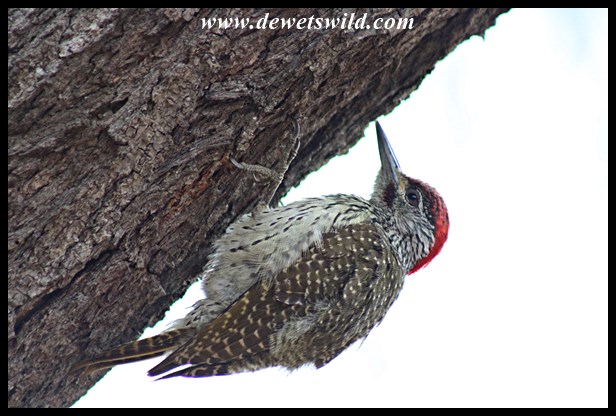
Golden-tailed Woodpecker

Campethera abingoni

Golden-tailed Woodpeckers are denizens of a wide variety of woodland habitats, especially those dominated by burkea, miombo and mopane trees, and coastal and riverine forests, but it also occurs in thickets in more open or arid areas. Like other woodpeckers it probes under bark and inside wood for insects. Adults weigh around 70g and grow to a length of 21cm.

Golden-tailed Woodpeckers form permanent, monogamous pairs. Both partners excavate the nest on the underside of a branch (nests may be used for consecutive years) and take turns to incubate the clutch of 2 or 3 eggs over a period of 2 weeks during the spring-summer breeding season. The chicks leave the nest when they’re a month old but remain dependent on their parents for a few weeks more thereafter.

The IUCN lists the Golden-tailed Woodpecker as being of least concern. It occurs widely in east, central and southern Africa – in South Africa they are to be found in Kwazulu-Natal, Mpumalanga, Limpopo, Gauteng, North West and parts of the Northern Cape.

Marsh Terrapin

Pelomedusa subrufa

The Marsh Terrapin, or Helmeted Terrapin, is a medium-sized terrapin, growing to around 30cm in length and 2.5kg in weight. Males are generally larger than females.

Marsh Terrapins are very common in still or slow-moving water, especially in temporary pans and even in arid environments like the Karoo and Kalahari. They are true omnivores, feeding on anything from water weeds to insects, crustaceans, amphibians, fish and even birds and small mammals caught at the water’s edge in very crocodile-like fashion. They will also pick ticks and other ectoparasites from the hides of wallowing animals. When their watery abodes dry up and there’s no others around to move to (these chelonians will move considerable distances from one pool to another), Marsh Terrapins will bury themselves in wet soil or mud and aestivate, sometimes for months or even years.

Mating occurs in the water, mostly during the summer months, after which the female digs a pit 10-18cm deep in moist soil above the high-water mark, using her hind feet, in which she lays a clutch of up to 40 or more (usually between 10 and 30, but sometimes as few as 2) soft-shelled eggs. The young hatch in 3-4 months and emerge after the rain has softened the soil enough for them to dig themselves free.

In South Africa, Marsh Terrapins occur in every province, being absent only from the most arid parts of the Northern Cape Province. They also occur throughout sub-Saharan Africa and Madagascar.

Namaqua Dove

Oena capensis

The small (40g) Namaqua Dove with its characteristically long tail feathers (total length including the tail is around 22cm) inhabits dry savannas, grasslands and scrub, where it forages on the open ground almost exclusively for the tiny seeds of a wide variety of grasses and other plants. Unlike many other species of pigeon and dove, the Namaqua Dove does not have a close relationship with human habitation. They are highly nomadic, moving after the flush of seeds that follow periods of good rainfall in different areas.

Normally seen alone, in pairs or small flocks (rarely larger aggregations of several hundred form at waterholes), Namaqua Doves form monogamous pairs. They breed throughout the year, constructing flimsy platforms of twigs and roots low in a tree or shrub. Pairs share the responsibility of incubating the clutch of 1or 2 eggs for a period of about two weeks. The chicks leave the nest when they’re about 2 weeks old.

The Namaqua Dove is widely distributed over continental Africa, Madagascar and the Arabian Peninsula. The IUCN considers it to be of least concern, adding that it seems to be growing its population and expanding its range. In South Africa they’ve been recorded from almost every corner of the country, though their nomadic habits means that they are not necessarily always resident in any particular area.

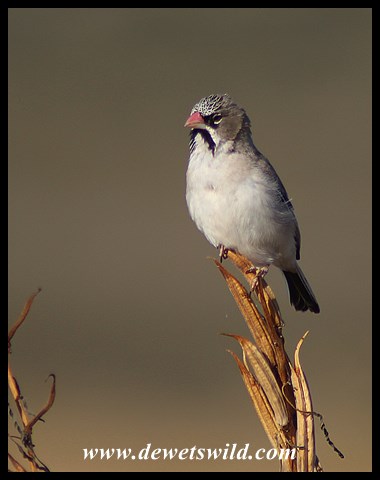
Scaly-feathered Finch

Sporopipes squamifrons

The tiny (10g) Scaly-feathered Finch inhabits dry, open savanna and thickets along drainage lines in arid scrubland, feeding predominantly on grass seeds and, to a lesser extent, insects. They are independent of drinking water.

Scaly-feathered Finches move around in small flocks, often in association with other small seed-eaters. They may breed throughout the year, but there is a distinct peak in the summer months. Nests are small balls, weaved of grass in a thorny bush, with a tiny tunnel opening to the nesting chamber inside. Clutches of up to 7 eggs are incubated for just short of 2 weeks, with the chicks leaving the nest before they are 3 weeks old.

The IUCN considers the Scaly-feathered Finch to be of least concern. In South Africa they can be found on the highveld of Limpopo and Mpumalanga, in Gauteng, the North West, Free State and Eastern, Western and Northern Cape. Outside of our borders they also occur in Zimbabwe, Botswana and Namibia, extending marginally into Angola and Zambia.

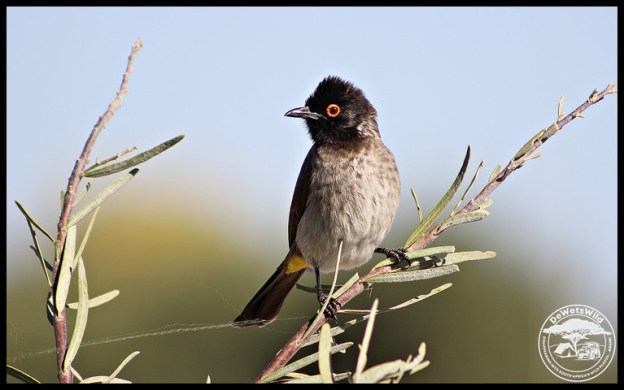
African Red-eyed Bulbul

Pycnonotus nigricans

The African Red-eyed Bulbul naturally inhabits a variety of arid and semi-arid habitats, such as scrublands and thorny savannas, but has also become a familiar garden bird across its range and is usually found within easy reach of reliable water sources – in fact, the provision of man-made waterholes in farming areas have probably aided an increase in their population and an expansion of their range. They feed mainly on fruit, but will also include flowers, nectar, seeds and invertebrates in their diet. Adults grow to a length of about 19cm and weigh approximately 30g.

Red-eyed Bulbuls are mostly encountered in monogamous, territorial pairs, though small flocks are not entirely uncommon. Building the untidy nest, hidden in the fork of a tree or shrub, is mostly the female’s responsibility. Their breeding season spans spring and summer, when clutches of 2 or 3 eggs are incubated by the female for around 2 weeks. Both parents care for the hatchlings, which fledge at about 3 weeks old. The chicks sometimes leave the nest before they are fully able to fly.

The IUCN notes a growing population for the African Red-eyed Bulbul and classifies it as being of least concern. They are to be found in south-west Angola, Namibia, Botswana, extreme western Zimbabawe, Lesotho and South Africa (Eastern, Western and Northern Cape, Free State, North West, Gauteng and western Limpopo).

Where their ranges overlap, the Red-eyed Bulbul will readily crossbreed with both the Cape and Dark-capped Bulbuls.

Eastern Nicator

Nicator gularis

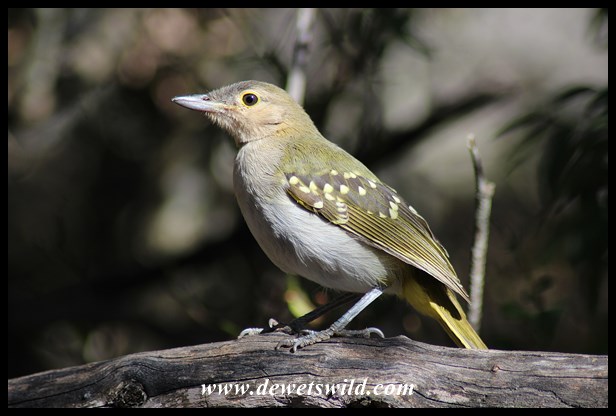
The Eastern Nicator has a patchy distribution along the Indian Ocean coast and adjacent interior from Kenya southwards to South Africa (where they can be found in parts of Limpopo, Mpumalanga and Kwazulu-Natal), inhabiting forests and woodlands with dense undergrowth. It is listed as being of least concern by the IUCN. Adults measure about 23cm in length and weigh around 47g.

Eastern Nicators feed primarily on insects, though they have been recorded preying on small reptiles and plucking ticks and other ectoparasites from the hides of large mammalian herbivores, often following them around to catch invertebrates disturbed under hoof. Their nests are untidy platforms built of sticks and stalks, placed surprisingly near to the ground in dense vegetation. Pairs are monogamous and nest in summer.

Eastern Nicators are usually very shy and seldomly seen, often only giving away their presence by their characteristic call.