
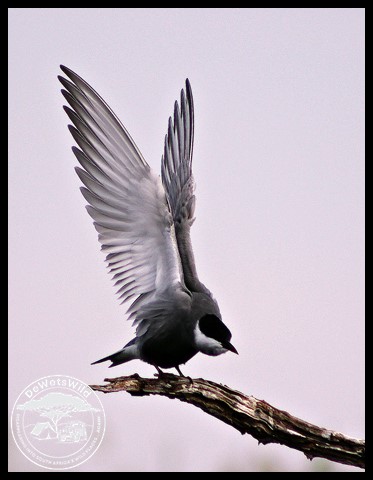
Chlidonias hybrida
The Whiskered Tern is a bird of natural wetlands, being equally at home at freshwater wetlands and marshes (even farm dams!) than at estuaries and river mouths along the coast. They feed in loose flocks, flying low above the water, and catching anything from aquatic invertebrates to frogs and small fish.
Whiskered Terns breed opportunistically following good rains, establishing loose colonies of up to 80 monogamous pairs. Their nests are floating structures consisting of plant material and built by both partners. Clutches of up to 3 eggs are incubated over a 3 week period. The chicks can’t fly until they’re almost a month old, but can swim soon after hatching and uses this to good effect to temporarily abandon the nest if danger threatens, while the parents dive-bomb the intruders – even cattle and humans! Adults weigh about 100g and measure around 25cm in length.
Whiskered Terns have a very wide distribution, occurring in parts of every continent except Antarctica and the Americas., and the IUCN list it as being of least concern, estimating a total population of up to 1.5 million. In the South African summer they occur mostly on the Highveld (Free State, Gauteng and Mpumalanga), the midlands of Kwazulu-Natal, and along the southern coastline of the Eastern and Western Cape. The population in northern Kwazulu-Natal, centred on the iSimangaliso wetlands, is resident year-round.


 DeWetsWild