
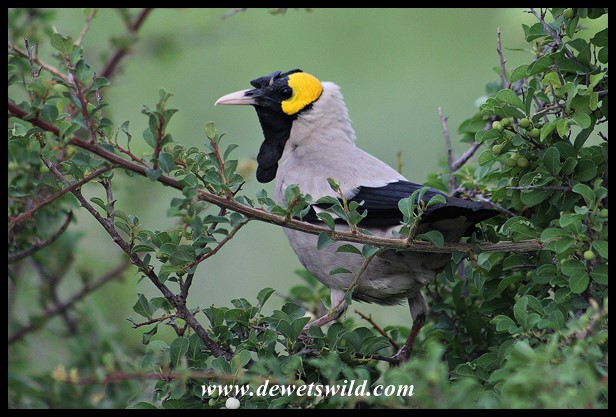
Creatophora cinerea
Certainly one of our most social and numerous starlings, the Wattled Starling is also a nomadic bird that moves around in large flocks, following surges in insect numbers and seeding grasses, their principal foodstuffs, that often follow on good rains. They’re well known for following large grazing herbivores, eagerly pecking up insects disturbed by the movement of the large animals through the vegetation. Wattled Starlings are mostly found in open habitats with short grasscover, ranging from semi-deserts to savannas and open woodland.
Wattled Starlings nest colonially, with monogamous pairs building their untidy ball-shaped stick-nests in close vicinity to one another in thorny trees, with their breeding season spanning most of spring and summer. The parents take turns to incubate the clutch of 2-5 eggs over a period of only 11 days and co-operate to feed the chicks, which leave the nest about two weeks after hatching without being able to fly yet. As a result the nesting colonies are often heavily predated on by birds of prey and other meat-eaters for these easy pickings. Fully grown adults weigh in at about 70g and measure around 21cm in length. The pronounced wattles and brightly coloured facial features of the males are seen only during the breeding season, with older males having the most impressive appearance.
Wattled Starlings are commonly recorded in all South Africa’s provinces, with its wider distribution stretching throughout southern, central and eastern Africa to Ethiopia and Somalia. The IUCN considers the Wattled Starling to be of least concern.


 DeWetsWild