
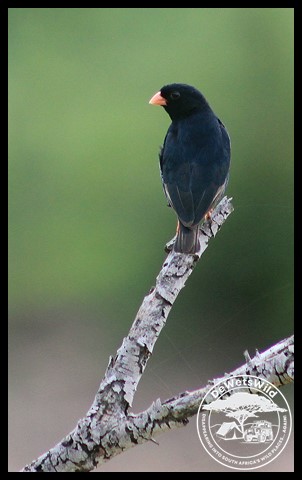
The Village Indigobird, also known as the Steelblue Widowfinch, occurs in a band from Senegal in West Africa to Sudan, Eritrea and Ethiopia, and then southwards to our country, where it is found in parts of all provinces except the Western Cape. They’re most commonly found in acacia savanna, mopane woodland and riverine thickets, feed mainly on seeds and termites, and occur singly, in pairs or flocks numbering as many as 60 birds. According to the IUCN it is not in any danger of extinction.
The Village Indigobird is a brood parasite, in which males mate with as many females as they can and the females in turn lay their eggs in the nests of other small finches – especially firefinches – even if the nest owner is in the nest! In this way each female Indigobird may produce up to 26 eggs in a breeding season, which spans December to June. The chicks are reared by their adoptive parents until they rejoin the Indigobird flock at about 4-5 weeks of age. These small birds weigh around 13g when they’re fully grown.


 DeWetsWild