

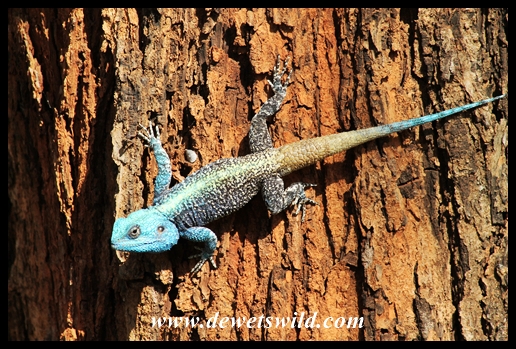
In the middle of Satara’s E-circle of bungalows lies a heap of tree stumps; the remains of a long dead Marula tree that has finally collapsed and been cut into sizable chunks by the camp gardeners. But a fierce dragon (actually a male Southern Tree Agama) has taken possession of the ruins, claiming it as his castle.

Male Tree Agama in breeding colours in Satara Rest Camp

Male Tree Agama in breeding colours in Satara Rest Camp

Male Tree Agama in breeding colours in Satara Rest Camp

Male Tree Agama in breeding colours in Satara Rest Camp

Male Tree Agama in breeding colours in Satara Rest Camp (photo by Joubert)

Male Tree Agama in breeding colours in Satara Rest Camp (photo by Joubert)

Male Tree Agama in breeding colours in Satara Rest Camp (photo by Joubert)

Male Tree Agama in breeding colours in Satara Rest Camp (photo by Joubert)
Here’s a photo of the pretty lady he was hoping to attract to his castle…

Female Southern Tree Agama (photo by Joubert)
(Incidentally, this is the 1,500th post published on de Wets Wild!)


 DeWetsWild