Charadrius tricollaris
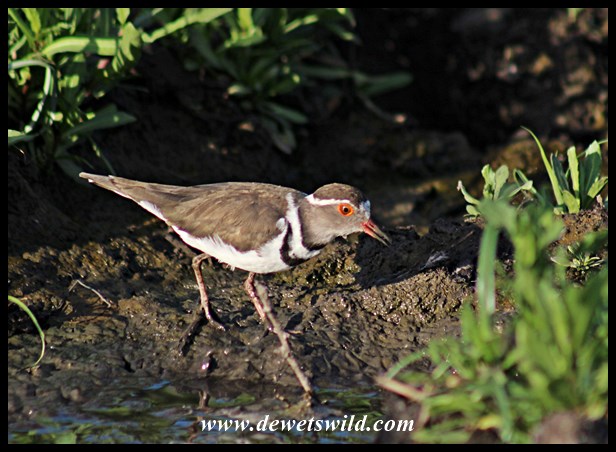
Three-banded Plovers inhabit the open, often muddy, shores of freshwater and brackish habitats, natural or man-made, and feed on a wide variety of worms, insects, molluscs, crustaceans and other invertebrates foraged from the water’s edge. They are usually seen singly or in pairs, with small flocks of up to 20 a rare occurrence. Adult Three-banded Plovers weigh between 28 and 45g, with a wingspan of around 46cm.
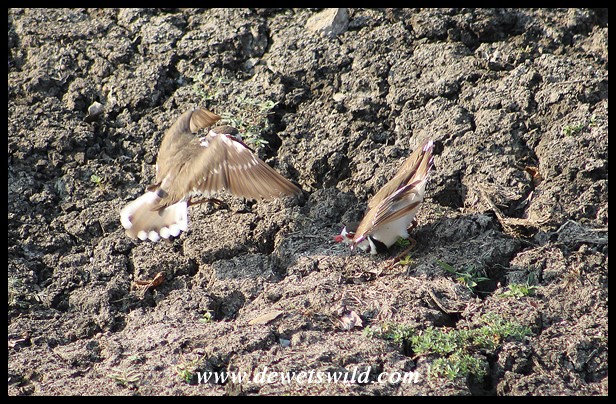
Nests are little more than well camouflaged scrapes in the ground, placed near the water among gravel, pebbles, rocks or other debris, in which one or two eggs are incubated by both parents for around four weeks. Pairs vigorously defend their territories from other Three-banded Plovers and even other kinds of birds. The chicks fledge about three weeks after hatching, but remain with their parents until they’re about 6 weeks old. This species breeds throughout the year.
The Three-banded Plover occurs all over South Africa, and has expanded its range in recent times thanks to the construction of artificial water bodies in otherwise arid areas. In the rest of Africa it occurs widely over the eastern and central parts of the continent and is considered of least concern by the IUCN, who sites a total population of between 70,000 and 140,000 (of which between 25,000 and 50,000 is estimated to occur south of the Zambezi River).

Three-banded Plover

Three-banded Plover

Three-banded Plover

Three-banded Plover

Three Banded Plover

Three-Banded Plover at uBhejane Hide

Three-banded Plover

Three-banded Plover on its nest

Three-banded Plover

Three-banded Plover

Three-banded Plover

Three-banded Plover

Three-banded Plover

Three-banded Plover

Three-banded Plover

Three-banded Plover

Three-banded Plover

Three-banded Plover

Three-banded Plover

Three-banded Plover

Three-banded Plover

Three-banded Plover

Three-banded Plover

Three-banded Plover

Three-banded Plover

Three-banded Plover

Three-banded Plover (photo by Joubert)

Three-banded Plover

Three-banded Plover

Three-banded Plover at Senyati’s waterhole

Three-banded Plover

Three-banded Plover with her eggs

Three-banded Plover eggs on a heap of building rubble



 DeWetsWild