Strongylopus grayii
The Clicking Stream Frog’s call is a good impersonation of a human tongue click, hence the common name. They’re small frogs, measuring at most 5cm in length, found only in South Africa, Lesotho and Eswatini (Swaziland) and ranging from our west coast, through the Little Karoo and Garden Route, through most of the Eastern Cape and Kwazulu-Natal and then to the higher lying regions of Mpumalanga and Limpopo. They are particularly common in the south-western corner of the country that receives most of its rainfall in winter. They’re regularly found in or near ponds and small dams as well as shallow streams, and so tolerant of poor water quality that they’ll even breed in flooded refuse pits.
Clicking Stream Frogs lay their eggs in moist spots next to the water’s edge. Females can produce up to 350 eggs. In wet weather the tadpoles may emerge within 5 days of the eggs being laid and then scramble to the water, but in dry weather the eggs could remain viable for up to 2 months. It takes 3 to 6 months for the tadpoles to go through the full metamorphosis to adult frog form.

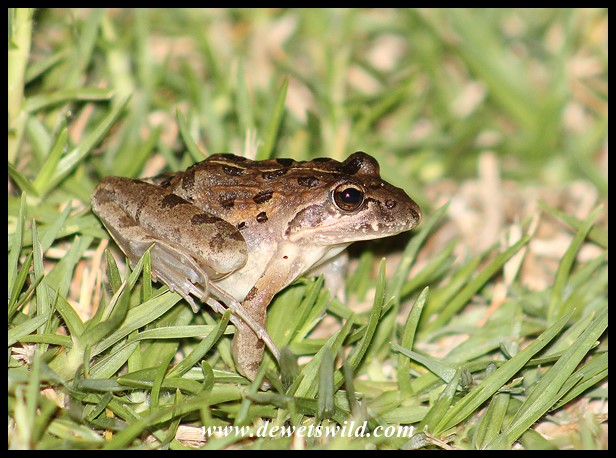
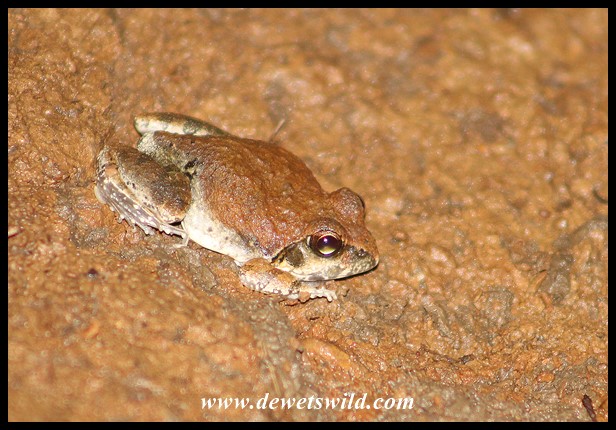
Clicking Stream Frog

Clicking Stream Frog

Clicking Stream Frog

Clicking Stream Frog

Clicking Stream Frog




 DeWetsWild