Early August is still considered winter in South Africa. In preparing for our latest trip to Royal Natal National Park, in the uKhahlamba Drakensberg Park and World Heritage Site, we had therefore anticipated snow, at least on the high peaks, and severely cold temperatures. Watching the weather forecasts in the days before our visit was a confusing affair. One private weather site was predicting extreme cold and gloomy weather, while the national weather service predicted glorious sunshine with temperatures in the mid 20’s. Not knowing what to expect, we packed for any eventuality.
The Women’s Day long weekend was only three days long, and so we decided to get an early start out of Pretoria. Through the Free State, the outside temperature remained around freezing. Imagine therefore our excitement seeing the temperature reading on the dashboard rise as we descended the Drakensberg Range into Kwazulu-Natal Province, with not a flake of snow to be seen anywhere! By the time we arrived at Rugged Glen, just to the east of the Royal Natal National Park‘s entrance, it was warm enough to start taking off some layers of clothing and soak in the sunshine. The South African Weather Service got it right this time!
Despite it being a long weekend, the campsite at Rugged Glen was devoid of people; perhaps the predictions of poor weather dissuaded many campers from venturing to “The ‘Berg” for a break. Whatever the case may have been, we didn’t complain about having only Rugged Glen’s diverse birdlife and a few nervous reedbuck to share our first mountain picnic with.

Turnoff to Rugged Glen

Rugged Glen scenery

Bald Ibis and Cattle Egret

Red-knobbed cot

Little Grebe

Cape Batis (female)

Olive thrush
From Rugged Glen, which is also the base for the popular guided bridle trails that traverse these scenic hills, we headed to the Park’s gate, supported the crafters selling their wares and then drove the short distance to the Mahai Visitor Centre. Time for another picnic at one of the tables along the Mahai stream before making our way along, and a little beyond, the pretty and easy Cascades boardwalk, passing several dainty bushbuck ewes along the way while a herd of eland grazed high above us on the slope of Dooley Mountain (named after an Irish logger given a concession to cut wood here in the late 1800’s).

Grey Duiker

Welcome to Royal Natal

Royal Natal entrance

Bushbuck ewe

Red-throated Wryneck

Groundscraper Thrush

Eland on the slope of Dooley Mountain

The murmering waters of the Mahai

The Cascades

The Cascades

The de Wet family looming over the Mahai stream

Bushbuck

Tiny beauty

Bushbuck irritation
With our hiking boots now introduced to Royal Natal’s network of walking trails it was time to head to Thendele Camp and our accommodation for the two nights we’d be spending at the foot of the magnificent Amphitheatre formation, a basalt cliff-face almost 1000m high and 5000m wide. To the left of the Ampitheatre is the Eastern Buttress, 3011m above sea level, and to the right Sentinel peak soars to 3165m ASL. These majestic natural features absolutely dominates the scenery at Royal Natal, which together with Rugged Glen covers over 8000 hectares, and was the main reason for the Park’s proclamation in 1916. The “Royal” moniker was added to the reserve’s name after a visit by the British Royal family in 1947. The vegetation in the Park, more than 900 species strong, is mostly open grassland dotted with a few hardier trees and shrubs, with heathland on the summit and mountain forests in the sheltered valleys.
We found Thendele alive with bird song, and just below the huts a small group of mountain reedbuck were right at home. Despite the camp’s 29 units (offering between 2 and 6 beds each) being fully booked, it was a haven of peace and tranquility – just the way we like it. At 1580m above sea level, Thendele lies a lot lower than the peaks that tower above it.

Baboon scratching for grass roots

Welcome to Thendele

The Amphitheatre from Thendele

Thendele

Thendele

Policeman’s Helmet formation dwarfed by the Amphitheatre

Thendele Lower Camp

Hiking from Thendele

Hiking from Thendele

Helmeted Guineafowl

Hiking from Thendele

Chorister Robin-Chat

Cape Robin-Chat

Mountain Reedbcuk

Southern Boubou
Evening temperatures were admittedly a lot cooler, and our chalet’s lounge with its cosy fireplace was just the place to enjoy dark chocolate and a cup of coffee at the end of a wonderful day spent outdoors.
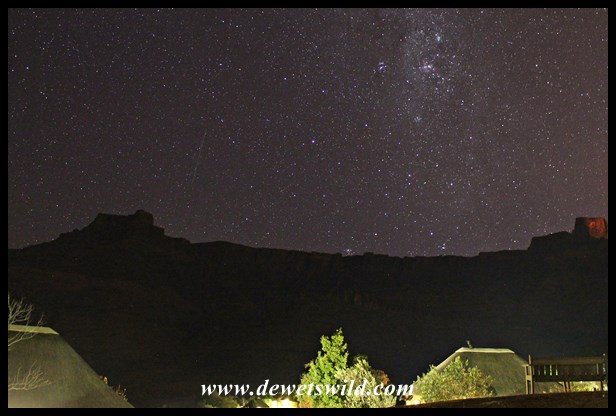
The early morning sun on Sunday bathed Thendele and the Amphitheatre in a glorious gold, inviting Joubert and I to walk around camp while Marilize prepared a hearty breakfast.

Early morning in Thendele

Early morning from Thendele

Thendele Chalet 23

Highveld Cabbage Tree

Huge tree clinging to a rock face

Curious Helmeted Guineafowl
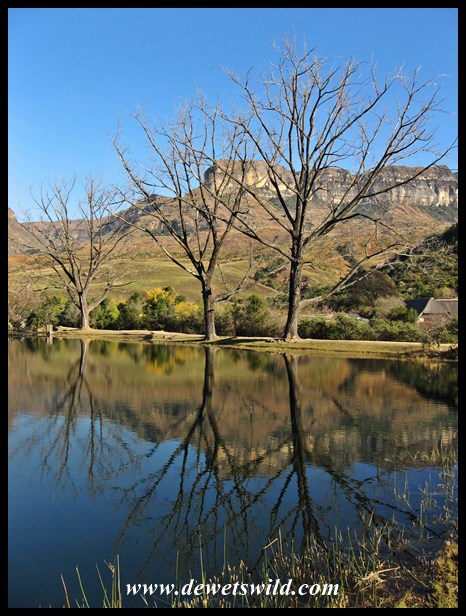
Our first destination this morning was the trout dam at Mahai, where the windstill conditions made for splendid reflections on the water’s surface and we found out just how easy it is to loose complete track of time while marveling at the spectacular scenery around us.

Reflections at Mahai

Reflections at Mahai

Reflections at Mahai, Royal Natal National Park

Little Grebe

Olive Woodpecker

Reflections at Mahai
Royal Natal’s biggest attraction is the selection of well demarcated hiking trails traversing the area and excellent pocket guides and maps are available at the shops at Thendele and the Visitor Centre. One of the easier trails is Otto’s Walk, which starts at the Visitor Centre’s parking area and named after one of the reserve’s early Superintendents, Otto Zunckel. It follows the course of the Mahai stream through dense mountain forest for most of the way before returning along the main access road, a total distance of 3km. The pair of rare Mountain Wagtail we encountered at a pleasant spot next to the stream was a real highlight. Another particularly interesting walk is to the San Rock Art site in the Sigubudu Valley, accessible at a small fee and accompanied by a local guide.

Getting closer with the locals

Bushbuck

Jennifer Sutton Memorial Wall

Jennifer Sutton Memorial Wall

Otto’s Walk route marker

Alert bushbuck ewes

Otto’s Walk passes through mature mountain forest

Mountain Wagtail

Mountain reedbuck on the run

Wildlife have right of way!

Smiling dassie

Cape Grey Mongoose
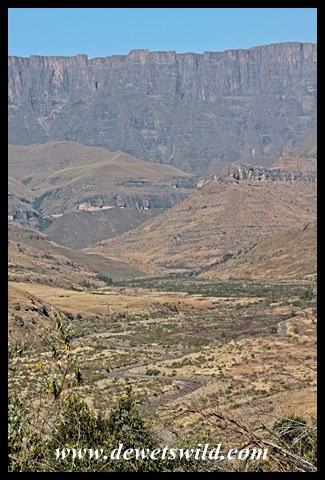
Along the main access road from the gate to the Visitor Centre there’s a viewpoint offering an absolutely unobscured view of the Amphitheatre and the wider Drakensberg range. With winter being the dry season, the Thukela River was barely flowing, with only a trickle evident among the rocks and pebbles in the river bed. There was also no sign of the Thukela Falls, which with a combined drop of almost 950m is the 2nd highest waterfall on the planet. One of the Park’s most popular trails follows the impressive gorge cut by the Thukela through the Drakensberg’s sandstone.
We spent the afternoon relaxing around Thendele, enjoying an ice cream on the lawns outside the reception office and exploring the short forest walk behind the camp.

Common Tree Ferns

Male Greater Double-Collared Sunbird
On our final morning, before heading back to Pretoria, we awoke to a Thendele cloaked in thick mist. And cold. Neither the Amphitheatre above nor the Thukela Valley below was to be seen. The wintry weather we had been dreading seemed to have set in just as we were about to depart. After spending two lovely days walking and picnicking in these beautiful mountains, we were immensely grateful for the blessing of good weather! And as we drove out the park that morning, we were already going through our diaries to see where we’d be fitting in our next visit to this magnificent mountain landscape.

Misty Thendele

Sun trying to break through

Goodbye, till next time, Royal Natal!
The previous time we visited Royal Natal (April 2012), we traveled to the Park via the Oliviershoek Pass and found it such a pothole-ridden affair that we took a 100km detour to return via Van Rheenens Pass instead. This time we decided to give Oliviershoek (the R74) another try for the last 70km from Harrismith to the Park. The road is being rebuilt and by the time it is finished this should again be one of the country’s most enjoyable drives. For the moment, there’s a 6km stretch of one way traffic on which Stop / Go controls are operating, and a further 15km portion on a wide, smooth gravel detour, perfectly safe to travel in a sedan as long as you don’t try to drive too fast.
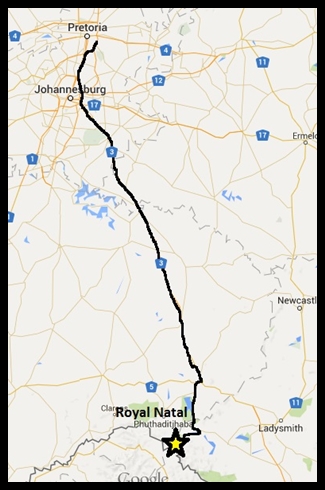
Pretoria to Royal Natal (drawn with Google Maps)
The Royal Natal National Park, Thendele Resort and Mahai and Rugged Glen Campsites are managed by Ezemvelo KZN Wildlife.


 DeWetsWild