
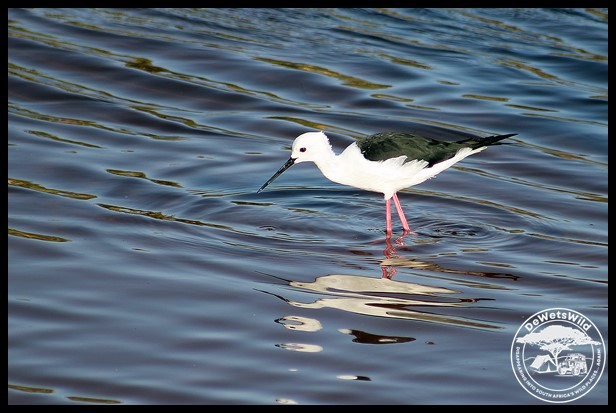
Himantopus himantopus
The very elegant Black-winged Stilt is one of the most widespread birds on the planet, occurring on every continent except Antarctica (though some authorities consider it to actually be as many as five different species). As a result it is listed as being of least concern by the IUCN. It is also widely distributed over all of South Africa, even occurring in the arid west of the country where its habitat requirements are met – basically any open wetland habitat, whether fresh or brackish, natural or man-made (even sewerage plants and salt works), is to their liking. They are nomadic birds, regularly moving from one body of water to the next. As is probably to be expected, Black-winged Stilts feed on aquatic invertebrates, tadpoles, frogs, small fish and fish- and frog-eggs.
Pairs of Black-winged Stilts are monogamous and usually nest alone, though occasionally up to 10 pairs may nest in close proximity. Their nests are mounds of mud and plantmaterial built by both partners at the edge of the water. They breed at anytime of year, but there’s a distinct peak in nesting behaviour in the spring months in our part of the world. The female is responsible for incubating the clutch of up to 5 eggs for almost 4 weeks. The chicks leave the nest within 24 hours of hatching to follow the parents around and feed themselves. By the age of a month they start flying and become fully independent by the time they are two months old. Black-winged Stilts are active both by day and during the night.
With probably the longest legs in relation to its body of any bird, adult Black-winged Stilts weigh in at about 165g and measure 38cm from tip-to-tip.


 DeWetsWild