
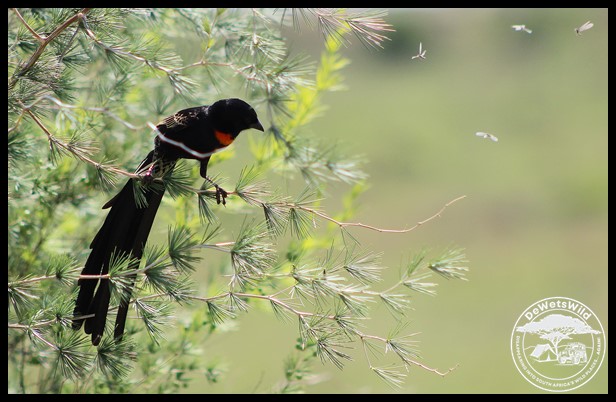
Euplectes ardens
In their striking black breeding plumage with streaming tails it’s almost impossible to miss the male Red-collared Widowbird in its savanna habitat during summer, quite a contrast with the drab plumage they don during other parts of the year (and worn by females throughout). These birds are mainly seed-eaters but will also peck up ants and termites on occasion.
Outside of the breeding season, which spans from spring to autumn, Red-collared Widowbirds move around in large flocks, often associating with other seed-eating birds. When breeding however mature males are territorial, weaving several oval-shaped nests in trees, shrubs and tall grass to attract as many females as possible into his harem. Females incubate clutches of 2-6 eggs for a two week period and the male plays no parental role whatsoever. The chicks leave the nest when they’re 2-3 weeks old. Breeding males are up to 35cm long with their expansive tails included in the measurement, while females and non-breeding males are only about 12cm in length and weigh around 19g.
Red-collared Widowbirds occur patchily over much of sub-Saharan Africa, and in South Africa can be found over most of the wetter eastern half of the country, from the Eastern Cape to Limpopo. According to the IUCN this species is of least concern.


 DeWetsWild